Penn men’s basketball’s Ivy League championship victory was a stunner. Soon, it may be the standard.
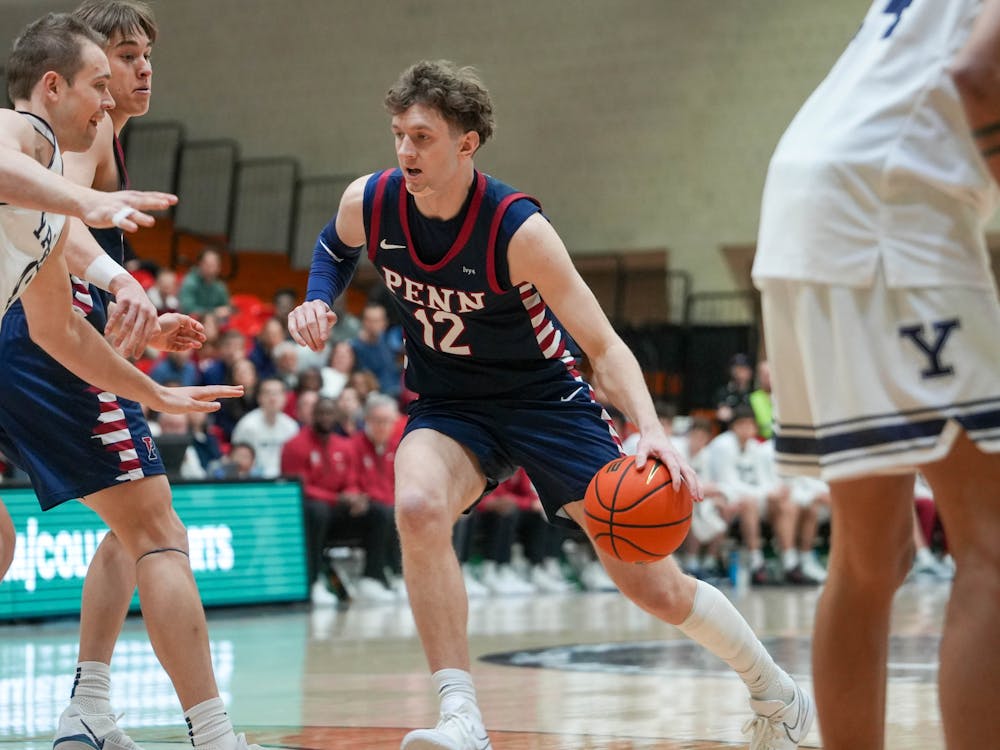
As the dust starts to settle on the Quakers’ thrilling title win over Yale and subsequent NCAA tournament appearance, the short-term takeaways are many — the dominance of junior forward TJ Power’s 44-point performance, the impressiveness of Penn’s victory in the absence of senior guard/forward Ethan Roberts, the poise of the team’s competitive first half against Big Ten juggernaut Illinois.
But for a program in its first year under coach Fran McCaffery, the run also signaled a big picture shift, one that would have seemed like wishful thinking just a year ago. In an evolving college basketball landscape, McCaffery gives Penn a chance to become not just a perennial Ivy League power, but mid-major program with relevance at the national level.
First, there’s the immediate future. The Quakers enter the offseason set to return four of their five typical starters, and though the transfer portal always looms, Power’s comments in the press conference following Penn’s win over Yale didn’t sound like a player looking for the exit.
“I made the mistake twice of saying no to [McCaffery],” Power said, referencing McCaffery’s attempts to recruit him while he coached at Iowa. “I didn’t want to make that the third time.”
Assuming Power rebuffs the high-major suitors that will undoubtedly come calling, he’ll return to University City as the favorite for Ivy League Player of the Year and the focal point of a Penn lineup with another year of age and development under its belt. Senior guard/forward Michael Zanoni, sophomore guard AJ Levine, and junior forward/center Augustus Gerhart should all take steps forward after a second summer in McCaffery’s system, as should the team’s underclassmen standouts: freshman guard Jay Jones, freshman forward/center Dalton Scantlebury, and sophomore forward Lucas Lueth.
Throw in three-star recruits Ethan Lin and Isaiah Carroll, who are both among the Red and Blue’s highest-rated additions in the modern era, and there’s reason to believe Penn could maintain or improve despite the creation gap left by Roberts’ departure. On the other side of the league, Yale will graduate Nick Townsend, the Player of the Year, and Casey Simmons, the Defensive Player of the Year, while Bulldogs starting center Samson Aletan recently entered the portal.
The Quakers should enter next season as top contenders to defend their crown. But in the grand scheme of McCaffery’s tenure, that may be only the beginning.
RELATED:
Illinois dominates boards, downs Penn men’s basketball 105-70 in first round of NCAA tournament
In November, McCaffery publicly discussed the program’s implementation of an alumni “collective,” one in which donors could financially support student-athletes with true NIL opportunities and internship opportunities.
“We can raise money in the collective, but then it has to be dispersed … for true NIL opportunities where somebody is legitimately profiting from their name, image, and likeness and basically funneled through legitimate business opportunities,” McCaffery said.
Athletic director Alanna Wren later clarified McCaffery’s use of the term, saying the Quakers’ collective differed from the mammoth funds utilized at high-major schools and instead “should be more seen as a group of alums who care desperately about Penn basketball and who want to help students, whether that’s via jobs, networking, or commercial NIL opportunities.”
Regardless of the specific application, it’s clear Penn has begun to utilize its powerful alumni base as a bargaining chip in recruitment. Other Ivy League schools may have similar initiatives in place, but none have a high-major veteran with Big Ten collective experience steering the ship. Other national mid-major programs may have greater dollar amounts at their disposal (see High Point’s reported $4 million NIL budget), but cannot match Penn’s long-heralded draws, including an elite education and college basketball’s most historic home venue.
When McCaffery himself wore the Red and Blue, Penn was a familiar fixture in the latter weekends of March Madness, winning six combined tournament games from 1978-1980. While that expectation may be too far afield for a non-scholarship school in the modern era, the Ivy League dominance of the ’90s and early 2000s — when coach Fran Dunphy led the Quakers to 10 titles in 14 seasons — is not. Penn arrived ahead of schedule by winning the conference in McCaffery’s first campaign. Now, it has the Ancient Eight’s most decorated coach as well its most innovative known recruitment model. McCaffery has already shown his ability to bring plus-talent to Philadelphia in Power, Lin, and Carroll. Over the course of several recruiting cycles, that advantage will compound.
Penn is also uniquely situated in its level of coaching security. At 66 years old, McCaffery still has plenty of basketball ahead of him, but it’s reasonable to assume that he won’t be jumping ship for another high-major opportunity — McCaffery said he’s never “had more fun coaching a team” than he did in year one at his alma mater. For most high-achieving mid-majors, each offseason presents a new opportunity for larger institutions to poach their coach. For Penn, each summer will provide a new chance for McCaffery and his staff to build on their prior momentum.
Last weekend’s championship win will always stand out as an iconic moment in Penn’s program history. But in a few years’ time, we may also retroactively view it as the start of something greater — something Power forecasted in the days leading up to Ivy Madness.
“We have a vision for this program and what we can do this year, but also what we can build for future years,” Power said on the Tuesday prior to the conference tournament. “And it starts with an Ivy League championship.”
WALKER CARNATHAN is a College senior and former DP Sports editor from Harrisburg studying English and cinema and media studies. All comments should be directed to dpsports@thedp.com.