With course registration for the fall 2026 semester set to open next week, several members of the Penn community spoke to The Daily Pennsylvanian about the Advance Registration process.
Managed by the Office of the University Registrar, Advance Registration is designed to optimize course selection to ensure students receive as many preferred classes as possible. The University began course planning and maintenance for the fall semester last October to prepare the roster for Advance Registration.
“This is a relatively new system that we’re using, so there are going to be some hiccups along the way, but we definitely have not lost sight of the way that we want it to be seamless,” Associate Dean and Director of Academic Advising Carolyn Ureña told the DP. “From an advising perspective, we would love for it to continue to be sort of the one-stop shop for how to search for courses, find out about majors that they want to explore, and think through their academic decision-making.”
Director of Course Management and Student Records Rick Dunn similarly spoke to the complexity of “trying to reach the most optimal kind of state in terms of rostering in an environment that is as distributed and non-centralized as Penn.”
“I think that we do the best that we can,” Dunn said. “I think that our departments do a great job in managing all of those complexities and giving our students opportunities to build a comprehensive schedule.”
According to Dunn, departments undergo a “several-month process” of maintaining and managing course offerings before the University officially publishes them for students and advisors to access. Penn released courses for the upcoming registration cycle on March 5, “for students to start to look at courses and speak with their advisors about their course selection prior to the Advance Registration period opening.”
Dunn characterized Penn’s Advance Registration process as a “throw your name in the hat” system, though he said it is “actually one of the fairest forms of registration” and “a little bit more sophisticated” compared to lottery-style systems used by many other universities.
During the advising period, students meet with advisors to build registration carts with the courses they want to take. Students can rank classes by priority and select alternatives “so that you can optimize your choices as … the process,” Dunn explained.
RELATED:
Board of Trustees discusses Penn’s financial future, global tensions at winter meeting
A look into Penn’s new club registration process
He added that submitting a cart does not immediately enroll a student in a class, but allows students to signal their preferred classes.
Ureña shared that advisors help students build their carts by putting “their primary choices” in the main cart and linking alternatives. Once advance registration closes, she said, “there’s an optimization process that happens.”
Dunn said course requests are processed through a “very complex algorithm” that randomizes student selections while working to “maximize student choice.” The system also accounts for course demand, seat availability, and the total number of offered classes.
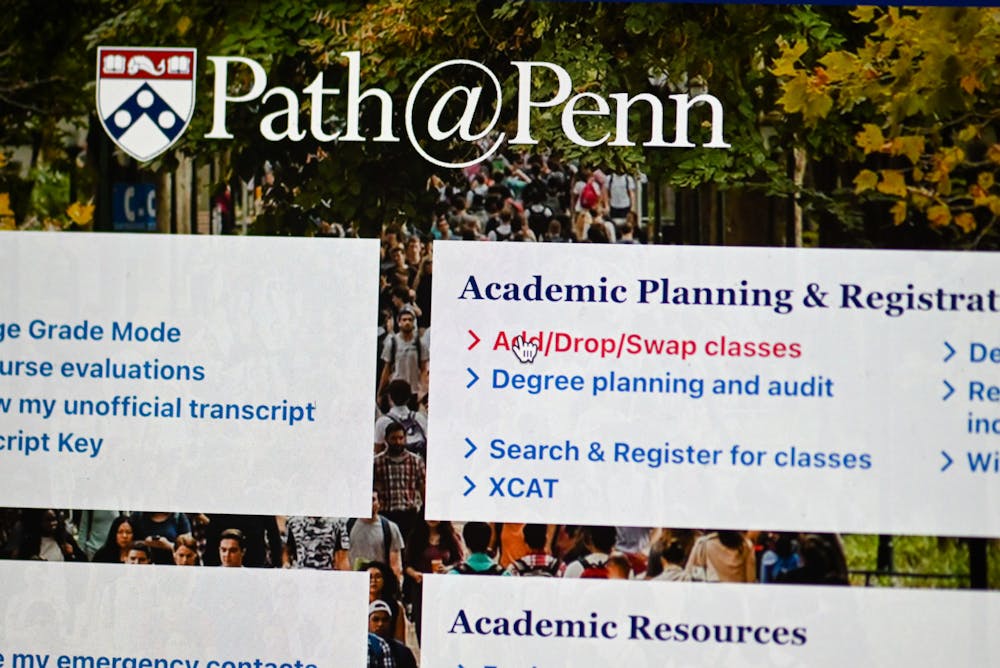
After the system finishes running, students’ schedules are published in Path@Penn — the University’s central resource for registration, financial aid, and academic records.
Students who do not receive all of their desired classes are encouraged to speak to their pre-major advisor, which Ureña described as “the first line” of support. She also said students can continue monitoring closed courses through Penn Course Alert, which notifies users if a seat opens.
Ureña explained that some courses have specific “attributes,” meaning certain students are given preference based on their academic status. Classes may be reserved for majors within a department, “because those students who are majors in that particular program need that class.” As a result of these limitations, Ureña said advisors encourage students to list backup options.
She added that the advising office focuses on how students will “encounter the registration deadlines or the options that may come up at particular moments in the semester.”
According to Ureña, more students are “getting the choices that they have selected,” whether those are their first-choice classes or alternatives.
The advising office also uses Penn’s Canvas platform to communicate with students throughout the registration cycle. Each class year has its own Compass site, where students receive reminders that Advance Registration is approaching and are encouraged to meet with their advisor.
After schedules are released, follow-up messages prompt students to review their results and seek advising support if they have questions or need to adjust their plans.
Ureña noted that she was “incredibly impressed” with Penn’s Advance Registration system, “because the chances of getting your class are more equally distributed.”
“There’s a way that those priorities are set up, but overall, I think that this is a great system because it allows for more equitable access to the courses to more students across the class years,” she stated.
While describing the course registration process, College sophomore Amy Tran told the DP that “it’s so exciting just planning my future and looking forward to all the different classes I get to take, especially with the College’s requirements offering me a sophisticated liberal arts education.”
Despite her “love” for the course registration process, Tran said that she hopes the University could consolidate platforms like Penn Course Review, Penn Course Alert, and Path@Penn.
“I feel like I’m screwing around and lollygagging when I just really want to have my primary cart assembled,” Tran said.
Although Tran described selecting alternatives as “a little bit of a hassle,” she called the process “fair,” adding that while she does not always receive all her preferences during Advance Registration, she has historically been able to stay on track academically.
“Because I didn’t get the specific econ classes I needed, I was like ‘let me just focus on my general requirements,’” Tran said. “I got more sectors and foundations done, and then when I ended up pivoting later, it was nice because I could still apply those, and then I just changed what major classes I was taking.”
College sophomore Helen Liu said previous course registration periods have been both “really fun” and “really stressful,” particularly when she registered for many courses that were “either popular or had application processes.” She emphasized that “it was hard to know whether I would be able to get into those courses before the Advance Registration deadline.”
“I ended up having a lot of chaotic switching of courses at the beginning of the semester, which was really stressful, because not only was I trying to find the right courses, I would also have to make up work when I entered those courses, and then sometimes I’d end up switching out of that too,” Liu said.
Liu also stated that academic advisors have generally been “helpful,” and peers and friends have served as a “less formalized source of help.” She said that Penn Course Review “tries to fill in that gap” by making peer feedback more accessible, clarifying that it can be “hard to get an idea of what a course will be like before actually being in the course for half a semester, and that can just be risky as a student.”
Ureña said students should “feel welcome to share with their pre-major advisor things that they’re thinking about, their goals, their disappointments.” She stated that “what we really emphasize is holistic advising, which includes understanding that as advisors, we may not have all the answers, but we want to be the connectors for you.”
RELATED:
Board of Trustees discusses Penn’s financial future, global tensions at winter meeting
A look into Penn’s new club registration process
Senior reporter Amy Liao covers student life and can be reached at liao@thedp.com. At Penn, she studies philosophy, politics, and economics and cinema and media studies. Follow her on X @amyliiao.