No matter who you ask about Penn men’s basketball’s Ethan Roberts, no matter how far back you start the search, the answer will be more or less the same: he works.
Roberts’ college teammates will tell you horror stories of hours-long shooting workouts that only end when Roberts says. His strength coaches will blush recalling the times the 6-foot-5 guard has challenged them to a grueling conditioning competition — and won. His AAU teammates will remember daily games of one-on-one at 5:30 in the morning, and his high school coaches will lament the many late nights spent prying their star player from the gym.
It is that drive, that insatiable ambition, that has gotten Roberts here — a place many thought he’d never reach. Division I basketball, his team’s leading scorer, the subject of each opposing coach’s pre-game nightmare. But if you ask the man himself, that willpower has a price.
“It comes with more pain than joy, if I’m being honest,” Roberts said. “I’m critiquing myself 24/7. And it weighs on you after a while, because it’s like, I’ve been doing this basketball stuff and critiquing myself for so long. It’s all I’ve known in life.
“Sometimes I’m like: ‘I’m done. I don’t wanna do it anymore.’ That’s happened more this year than ever.”
And yet, the Quakers’ leading scorer finds it in himself to lace his shoes up again each day. It hasn’t always been easy — since beginning his high school career, Roberts has changed schools four times. He entered his senior year of high school without a Division I offer and was ghosted by his top choice in Division II. He lost his high school sophomore season to a broken back and his collegiate sophomore season to a stomach illness that sent him into a “major life crisis.”
It has taken, as Roberts puts it, “a thousand swings of the axe” for him to reach West Philadelphia. But along the way, the line between success and failure has not been drawn by his performance on the court. It has been drawn by his ability to maintain his sense of self off it.
“I want to be great, and I understand the sacrifices. But you talk about ‘the greats.’ Michael Jordan — that’s a bad guy. Every person I’ve ever heard that’s had an interaction with Michael Jordan — that’s a bad guy. Even Tom Brady, he lost his family. He lost everything. I realized after a while: yes, I want to be great. But I don’t want to be like that guy.”
RELATED:
Penn men’s basketball earns first win over St. Joe’s since 2019, besting former coach Donahue
“I don’t want to be Michael Jordan. I don’t want to be Tom Brady. I just want to be happy. I just want to be Ethan.”
In the spring of 1988, the entire racquetball world descended upon Houston for the sport’s pinnacle on United States soil: the Amateur National Singles Championships. There, reigning champion and No. 1 seed Jim Cascio stormed his way to the championship match where he was favored to repeat against the same player he had defeated in the title tilt the year before: Andy Roberts.
Instead, Roberts avenged his defeat, sweeping Cascio two games to none and cementing himself as the top amateur player in the nation. Roberts went on to professional racquetball, where he peaked as the No. 1 player in the world in 1993 and 1994 and never held a ranking lower than No. 4. Known for his wicked power, Roberts gained induction to the U.S. Racquetball Association Hall of Fame in 2003 and was described as “the best offensive player to ever play the game.”
Decades later, the lessons that brought Roberts to the top of his sport are still alive in his son.
“Ethan has gotten that competitiveness from his father,” Charlie Leonard, who coached both father and son during their respective high school days in Memphis, said. “When you look at Ethan, you think this is this suburban kid who’s a pushover. … You don’t expect this kid to have the kind of dog in him that he actually has.”
Raised in a family of athletes, Ethan Roberts describes an upbringing that saw him training as early as first grade and constantly reminded him of the discipline necessary to succeed. His parents, Andy and Kim Roberts, were both high-level racquetball players, while his older sister Olivia played Division I lacrosse at Fresno State.
“I’ve been [at the Roberts house] when they’re playing board games and tables get flipped,” Austin Scott, Roberts’ high school coach in Illinois, said. “It’s not an easy environment to survive, but they challenge each other, and they’re still so open with their emotions, whether it’s joy or struggle. They’re there for each other, and intensely loyal.”
“I just watched and learned,” Roberts said.
Prior to his junior year of high school, Roberts’ family relocated from Memphis to Arlington Heights, Illinois. A lanky 6-foot-1 kid with a Tennessee accent, Scott said Roberts was still maturing — physically and emotionally — when he arrived at the local John Hersey High School.
In his first year at Hersey, Scott said Roberts would occasionally suffer “mini meltdowns” during games, reacting emotionally to his own or others’ shortcomings. In those situations, Scott developed a technique that forced him to harness his feelings rather than unleashing them.
“When Ethan would have these moments in practice, we would bring out the bench chairs and simulate taking him out of the game,” Scott said. “So he had to sit down for a full minute, a full five minutes … He would hold onto the seat, be almost uncontrollable. It was all that competitive energy, all that passion … It was torture.”
“[Scott] knew that got to me really bad,” Roberts recalled. “Which is obviously why he did it.”
That same passion drove him to the gym early and often, where he found a friend in Rocco Ronzio, a player two years his senior at Hersey who had committed to Division III Lake Forest College.
In the summer of 2020, Ronzio and Roberts became inseparable. As the former prepped for his first season at the collegiate level and the latter chased his chance, they found camaraderie in early-morning training sessions, late-night conditioning, and all the meals in between.
“We worked out together one time, and from there, it was everyday,” Ronzio said. “Workout, get food. Workout, get food. We just did that the whole summer.”
Ronzio got to know both sides of Roberts. On one hand, there was the competitor, the scrupulous self-corrector Ronzio saw up close.
“I’ll never forget, we were playing 1-on-1 one day, and he tries a dribble move and the ball goes off his foot,” Ronzio said. “And he went to the sideline, practiced that move 10 times, and he’s like ‘Well that’ll never happen again.’”
“He has a certain unquietable rage in him to be better,” Scott said. “More so than any other athlete I’ve ever coached.”
On the other hand, there was the friend, the affable and wise-cracking confidant Roberts becomes once the whistle blows. The one Roberts himself has always sought to protect.
“He’s probably the funniest, goofiest kid I know,” Ronzio said. “When he came to my house and met my parents, his first line to them was ‘I’m just a Christian soldier from Memphis.’ He’s always got these weird wordings.”
“It’s the relationships, to me, that really bring the joy to all of this,” Roberts said. “So that’s why I laugh super hard in the locker room and I make a lot of jokes. I try to be as lighthearted as possible away from basketball.”
That summer also coincided with the COVID-19 pandemic, curtailing Roberts’ opportunities to showcase his skills in front of college coaches. His only sustained interest came at the Division II level, and even there, he struggled to secure a spot: UC San Diego made contact with Roberts but ultimately offered his AAU teammate the same position. Grand Valley State offered Roberts a spot but told him he likely wouldn’t see the floor during his first two seasons. Nova Southeastern engaged Roberts enough that he toured the campus on an independent visit. Then, they went silent.
“I was begging them, and then they ghosted me,” Roberts said. “They ghosted me bad.”
After a senior season that saw Roberts average 20.3 points per game and earn all-state honors, he finally received his only two Division I offers: Army and Navy. Then-West Point coach Jimmy Allen said Roberts “fit the profile” of a good Patriot League player — he had length, he could shoot, and not insignificantly, he had the grades to hack it.
Still the doubts persisted, this time from Roberts himself. After his first taste of Division I action, Roberts says he called his father in tears, fearing that the level of competition was too steep.
“I’m like, ‘I can’t play here,’” Roberts said. “Everybody put it in my head how hard it was to get here. I see people that are way bigger than me. I’m like, ‘Dad, I’ll never play here.’”
“He basically just tells me to put my head down and work. The same thing he’s always told me.”
Roberts not only played as a freshman for the Black Knights — he performed. He improved rapidly from game to game, adjusting to the pace of college play and learning how to push it. By year’s end, he had started 31 of 33 games, finishing second on the team in scoring, rebounding, and three-pointers. His efforts earned him Patriot League Rookie of the Year, and proved the coach who had taken a chance on him right.
“He was able to take a lot of the things that we were teaching in terms of finishing around the basket and shooting the ball,” Allen said of Roberts. “The biggest thing about Ethan is that he loves to play and he really competes. … He’s definitely as good as anybody that’s played in [the Patriot League].”
A 40.7% three-point shooter with grit and a handle, Roberts suddenly fielded suitors from across the college basketball world. He reportedly received interest from at least one school in every power conference, including SEC juggernauts like Texas, South Carolina, and Vanderbilt. Roberts had gone from unwanted to undeniable overnight, and now, the only question was where the journey would take lead next.
He never thought the answer would be his bathroom floor.
“Why is getting out of bed so hard?”
The question had a daily stay in Roberts’ mind as he lies physically and mentally battered in his Des Moines, Iowa dorm room. It pervaded and proliferated, spreading and sprouting into other similarly crippling asks: “Why is this happening?” “When will it end?” “Who am I?”
After his freshman year, Roberts chose to transfer to Drake, a small school in the midwest with a reputation for basketball excellence. At the advent of name, image, and likeness, the mid-major Bulldogs and coach Darian DeVries utilized an innovative player payment model to claim Missouri Valley Conference titles in 2021 and 2023. When Roberts saw a lucrative opportunity alongside a “perfect basketball fit,” the choice was easy.
At first, those promises bore fruit. Roberts recalled a summer of fun and freedom, one where he was far from the constraints of military life, one where he could hone his craft at the highest level he’d ever known and earn a living doing it.
“Then, I started to get sick,” Roberts said. “And I watched everything that I’d worked so hard for just plummet.”
The illness came on quickly. Roberts first experienced a feeling of nausea while running shortly after the team returned for the fall. Within two weeks, he fainted during a workout. Before long, he was left incapable of physically exerting himself in any way, vomiting up to five times a day and losing up to 24 pounds in a single weekend.
“In the middle of the night,” Roberts said, “I would crawl to the toilet and throw up.”
Roberts did not see the court for the Bulldogs that season. Eventually, he left the school entirely and returned home to Arlington Heights, where he described a mental battle just as grueling as its physical counterpart.
“I went [to Drake] purely for basketball, and that was kind of my own fault,” Roberts said. “I didn’t feel encompassed there as a person. Being a basketball player, that’s who I thought I was, and it was ripped away from me.”
“I felt like I let coach DeVries down, I felt like I let the staff down, my teammates. I felt worthless. …That was the lowest point in my life.”
Lost in an unknown place, Roberts turned to the familiar: work.
First, he buzzed his head. “I promised myself: I’m gonna grow from here.” Then, he set out to regain his strength and conditioning, step by meager step. One down-and-back. Then another. Two feet on the exercise bike. Then two more.
Slowly, agonizingly, Roberts crawled back to where he’d fallen from. At the end of the campaign, DeVries left Drake to coach at West Virginia, sending Roberts into the portal again. This time, the high-majors did not come calling. But another school did.
“They were like, ‘Would you be interested in Penn?’” Roberts recalled. “That was a blessing from God. That’s the best way I could describe it.”
Roberts committed to the Quakers in April 2024, citing his desire to join a school that “invests in [him] as a person.” The game that Roberts had given so much to had finally begun to give back again.
For that, he has his ambition to thank.
“My life’s gone like this because of basketball,” Roberts said, holding his hand in a steep vertical incline. “From the city of Memphis — because of basketball. I never would’ve been able to get to Penn — if it wasn’t for basketball. However good basketball is going for me, my life’s been going that way too.”
“That’s why I put so much stress on it. I don’t treat it like a kid’s game. It’s a job, it’s a lifestyle, it’s a ticket. It’s been a ticket for me.”
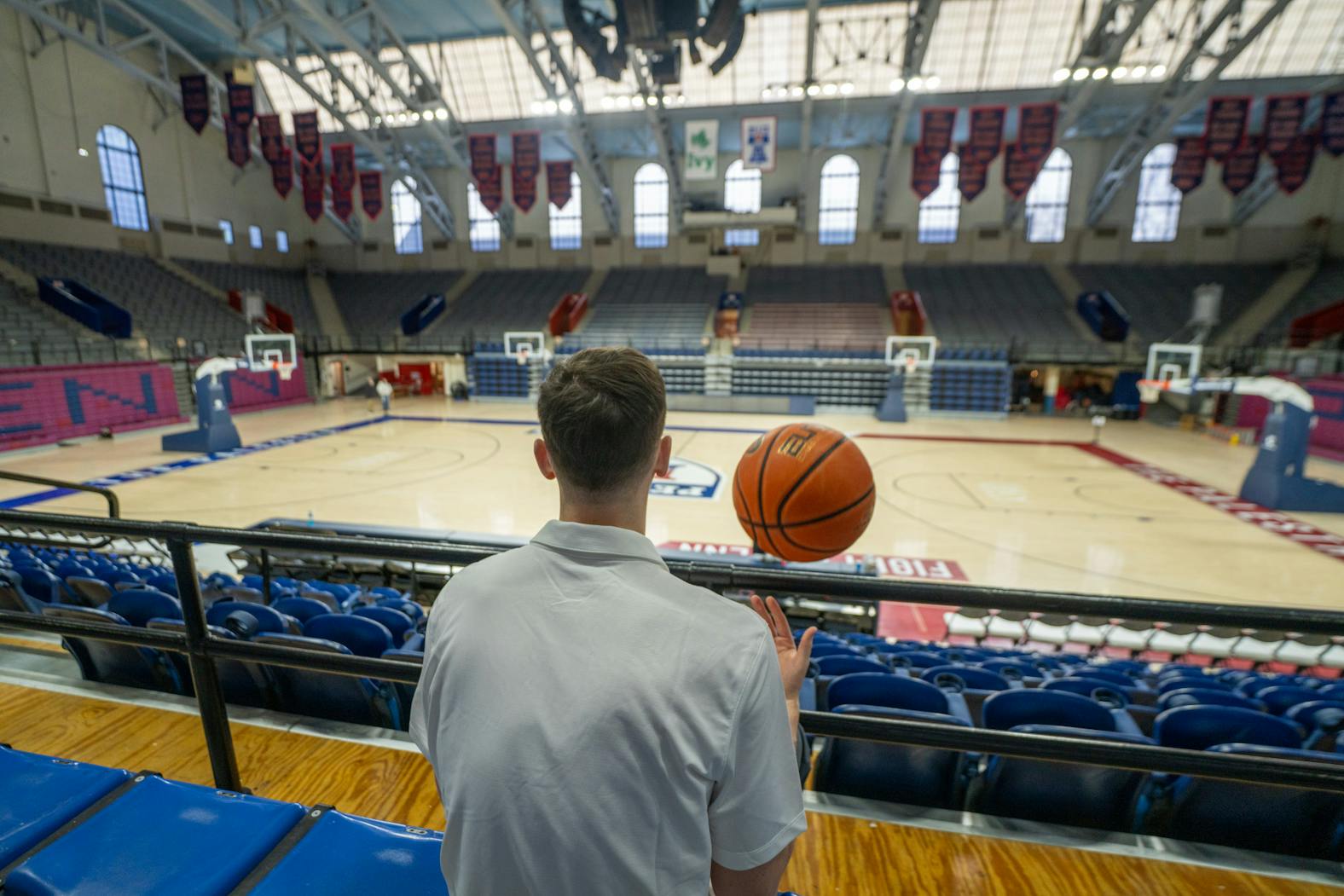
Nearly two years later, life in West Philadelphia has been everything Roberts hoped for, both on and off the court.
Roberts is averaging 17 points per game so far this season, good for second in the Ivy League. That includes several memorable performances, including a 31-point gem against Saint Joseph’s that helped earn him the national mid-major player of the week award.
“The way he played in that game was really special,” coach Fran McCaffery said. “Truthfully, it was nothing I did. It was all him.”
“I feel like that’s the story of Ebo,” Ronzio said. “You don’t expect him to do what he does, then he goes out and does it.”
Penn currently sits fourth in the Ivy League standings and has a chance to earn its first Ivy Madness berth since 2023. Roberts says playing for the Red and Blue is already “the pinnacle” of his basketball career, but that winning an Ivy League championship and going to March Madness with the Quakers would be a greater honor still.
The deeper joy for Roberts has come away from the Palestra, where he says the Penn community has embraced him — the whole of him. He finds “beauty” and “inspiration” in the brilliance of his fellow students, who in turn give him the sense of belonging he’s long been missing.
“It’s like iron sharpening iron in every facet of my life,” Roberts said. “I feel encompassed as a student here, as an athlete, and just as a friend. … I don’t know if I’m seen as a basketball player. I’m just seen as Ethan.”
Soon, Roberts will be forced to make another decision about his future. With his Penn graduation imminent and an additional year of eligibility remaining, Roberts will play his final collegiate season in a different jersey — likely one bearing another high-major logo.
Roberts says he’s tried to stay in the moment — that overly analyzing what comes next and focusing on his individual performance will make him “an ice cube” for a Penn team that needs him to be water. But with the culmination of his career journey at hand, Roberts says it’s “humanly impossible” not to look ahead.
“I’m ambitious. And I’ve worked my whole life,” Roberts said. “I’m trying not to think about [next year], but I can’t lie, it can be overwhelming. I put a lot of pressure on myself.”
“Things get more complicated as the journey goes on. I just want to keep them simple.”