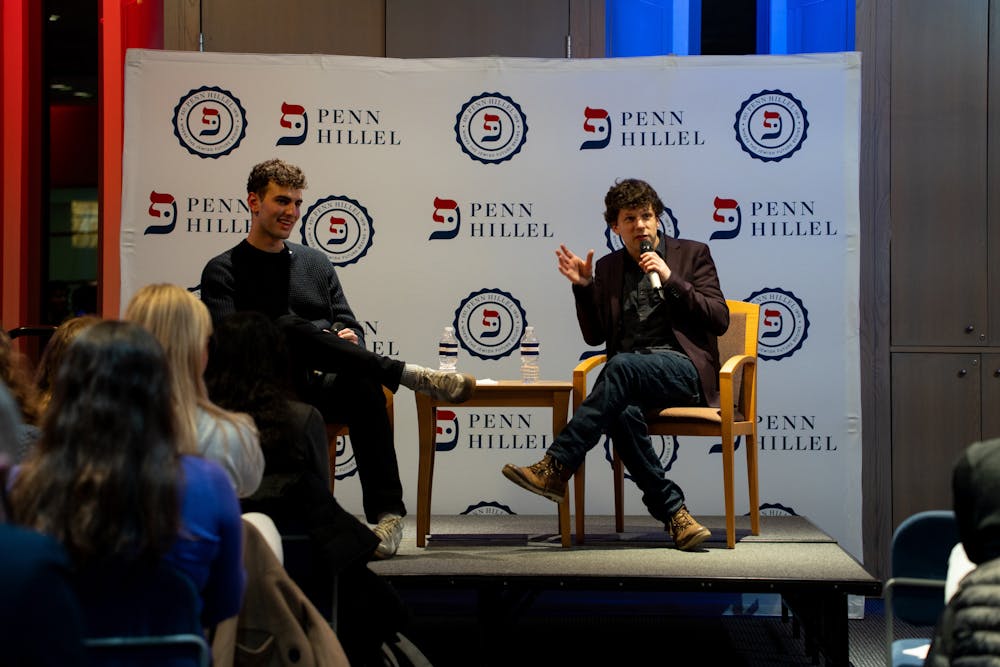
Penn Hillel and Wharton Undergraduate Media and Entertainment hosted writer, director, and actor Jesse Eisenberg to discuss Jewish representation in the entertainment industry on Tuesday.
The event was part of the Jackie Reses Speaker Series and drew roughly 100 attendees. In a conversation moderated by College sophomore Dylan Karz, Eisenberg discussed his own Jewish identity and how it relates to his film characters.
When asked about how his process for selecting roles has changed, Eisenberg said it now “intersects with the way I think about presenting Jews in media.”
He told the audience that many projects include “coded Jewish characters,” whom he described as characters who are written without explicit religious or cultural identifiers but are portrayed through familiar stereotypes.
“A perfect example is ‘Seinfeld,’” he said. “George Costanza is an Italian name. It’s an Italian character, but it’s coded as Jewish.”
He also said he avoids accepting roles that rely on narrow portrayals of Jewish identity.
“I just don’t ever want to play the one-dimensional version of that thing, because I view it as a bad presentation of Jews,” Eisenberg said, adding that such depictions appear “in many, many movies” and are “so one-dimensional that I find it personally offensive.”
Eisenberg also spoke about the shift from theatrical releases to streaming platforms. He said that films spend less time in theaters because “the movie company can make more money when it’s on streaming.”
RELATED:
Kelly Writers House hosts poetry editor to discuss book of collected letters
Black Wharton Undergraduate Association hosts annual Black Ivy League Business Conference at Penn
Citing the “Now You See Me” franchise, he said that while the first film was in theaters for about 10 weeks, the latest installment, now in its third week of its theatrical run, “is probably gonna get pulled [for streaming] soon.”
He attributed the trend to habits formed during the COVID-19 pandemic, adding that many viewers now wait to watch films at home rather than pay for theater tickets.
When asked about Aaron Sorkin’s planned follow-up film to “The Social Network,” Eisenberg said he did not want to continue being associated with Mark Zuckerberg.
During the question and answer portion of the event, Eisenberg confirmed that he plans to donate a kidney later this month. He said he first learned about altruistic kidney donation from a podcast and later underwent testing at NYU Langone Health. Eisenberg said the decision reflects values he associates with his upbringing, referencing the Jewish concept of “tikkun olam,” or repairing the world.
When asked about depicting the Holocaust in “A Real Pain,” Eisenberg’s second directorial work, he said he aimed to avoid portrayals that felt self-congratulatory or melodramatic.
“When a movie does it in a way that feels exploitative of suffering, that’s really offensive,” he said.
He added that while filming at a concentration camp, he chose not to film certain scenes because the site felt “too hallowed, important, and sacred,” opting instead for “silent images of people looking.”
Eisenberg also reflected on how coded expectations around Jewishness shaped his early career. He described working on his first film, “Roger Dodger,” where the director encouraged him to adjust his performance.
“Three days into shooting, he said, ‘Less like Woody Allen, more like Woody Harrelson,’” Eisenberg said. “And I didn’t know what he meant. And now I do.”
He told the audience the suggestion was “coded language,” as he was playing “a Midwestern, hasty kid” rather than a stereotype associated with neuroticism.
Before the event concluded, Eisenberg discussed how writing and acting shape the way he approaches conflict and perspective. He explained how he is drawn to stories built around two characters who want different things, because he rarely feels certain about his own views. Even when playing antagonists, he said that he approaches them as protagonists of their own narratives.
“When you’re playing a villain, you think, ‘I’m exactly right,’” he said. “As an actor, that’s how you have to think about it.”
RELATED:
Kelly Writers House hosts poetry editor to discuss book of collected letters
Black Wharton Undergraduate Association hosts annual Black Ivy League Business Conference at Penn
Senior reporter Ananya Karthik covers central administration and can be reached at karthik@thedp.com. At Penn, she studies communication and economics. Follow her on X @ananyaakarthik.