

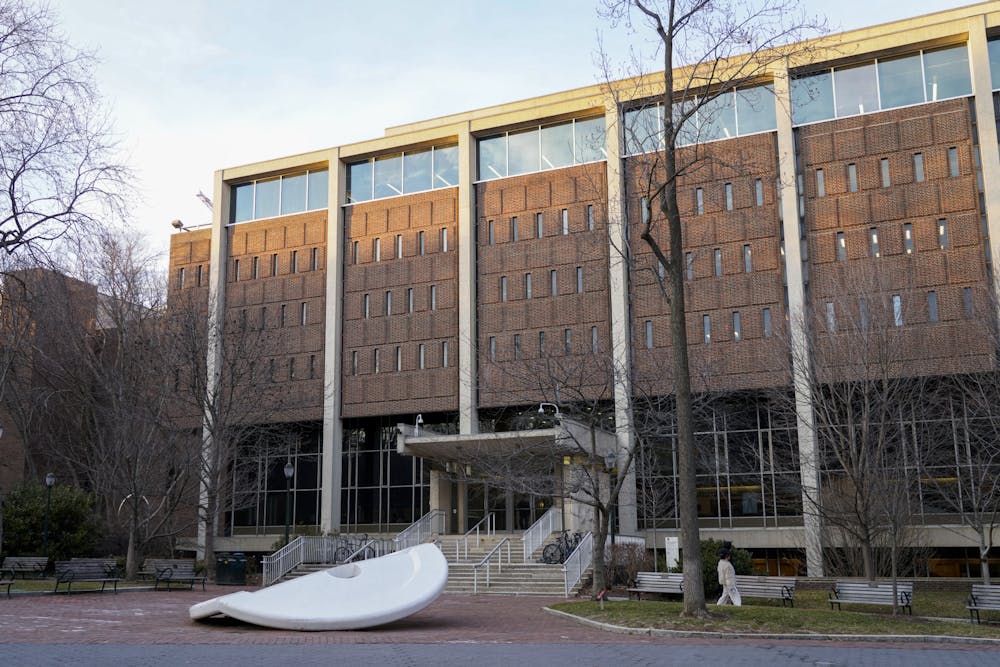
Penn Libraries hosted the 18th annual Lawrence J. Schoenberg Symposium on Manuscript Studies in the Digital Age from Nov. 20 to 22.
This year’s three-day program, titled “Interpreting the Ancients,” explored how philosophers, poets, and scientists adapted ancient authors across manuscript traditions. The event was hosted by the Schoenberg Institute for Manuscript Studies in partnership with the Free Library of Philadelphia, and all sessions were free and open to the public.
The symposium ran alongside “Reinventing Aristotle,” a fall exhibition curated by Penn Italian Studies professor Eva Del Soldato and Hannah Marcus, a Harvard history of science professor and 2009 College graduate. The exhibition traces how readers from the Middle Ages through the early modern era transformed Aristotle’s writings using marginalia, diagrams, commentary, and printed editions.
The program opened Thursday at the Free Library of Philadelphia with a keynote conversation between Del Soldato and Marcus that was moderated by Lynne Farrington, senior curator and director of programs at Penn's Kislak Center for Special Collections, Rare Books and Manuscripts. Their discussion connected the exhibition’s focus on the transmission of Aristotle’s works with the symposium’s broader interest in how ancient texts circulated and changed meaning over time.
“We really wanted to demystify these classical materials,” Del Soldato told The Daily Pennsylvanian. “Even if you’re not a specialist, there are so many ways to approach works like these without seeing them as heavy or monolithic.”
Events continued Friday and Saturday at the Kislak Center, with an option to attend virtually. Other presenters examined how readers engaged with classical texts through annotation, translation, and commentary, demonstrating how these practices shaped the interpretation of ancient works. In one talk, scholars analyzed how the layout of a medieval astronomical manuscript shaped how its diagrams were understood.
Farrington reflected on how events like the symposium demonstrate the Kislak Center’s collaborative environment.
“It’s always good to have people who are enthusiastic when we acquire materials that tie in with their research,” she told the DP. “Working with faculty and students to bring in items that truly impact their work is one of the most exciting parts of what we do.”
RELATED:
Penn Press releases three-volume book project on Philadelphia history
Penn’s Kislak Center hosts archival pop-up exhibit on histories of health
Both the symposium and the exhibition emphasized making classical knowledge accessible.
“Classics can be for everyone,” Marcus told the DP. “You don’t need to know Greek or be a professional. Even if all you know is the name Aristotle, there is still something you can do with it.”
RELATED:
Penn Press releases three-volume book project on Philadelphia history
Penn’s Kislak Center hosts archival pop-up exhibit on histories of health
Staff reporter Hailey Hilsabeck covers facilities and infrastructure and can be reached at hilsabeck@thedp.com. At Penn, she studies cinema and media studies and English. Follow her on X @hhilsabeckk.


