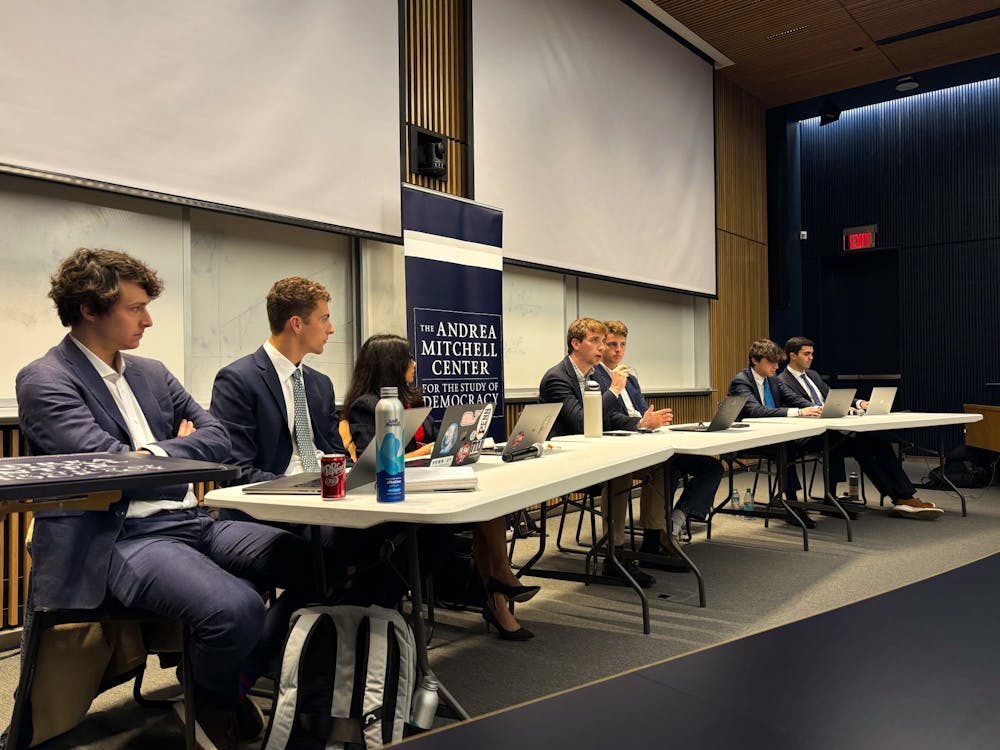
Three of Penn’s major student political organizations — Penn Democrats, Penn College Republicans, and Penn for Liberty — participated in an all-parties debate last Thursday.
The Nov. 20 event — which took place in the Perelman Center for Political Science and Economics — was co-hosted by Penn Political Union and the Andrea Mitchell Center for the Study of Democracy. The debate followed a structured format that included opening statements, timed issue rounds, audience questions, and votes to determine which organization presented the strongest argument for each topic.
College sophomore Marcus Michie, president of PPU, served as the event’s moderator.
The organizations debated three topics: whether the country’s immigration policy should promote mass deportation, whether religion should play a role in governance, and whether diversity, equity, and inclusion initiatives should exist within a meritocratic system.
College senior Tasneem Reza, representing College Republicans, argued that enforcing existing immigration law requires “supporting” mass deportation and described the policy as “secure, orderly, and legal.”
Reza added that “supporting mass deportation is not anti-immigration” but instead “anti-illegal immigration” — citing resource pressures on local governments — and argued that stricter enforcement is needed to address “human trafficking, drug smuggling, and cartel operations.”
Penn for Liberty agreed that current immigration law should be enforced, simultaneously supporting reforms for legal immigration pathways.
Representing the group, College junior Simon Webber said that the United States should consider reforms that make it “easier for people that actually are contributing to society to have recourse for that and to have a path for citizenship,” adding that “the border is where immigration should be enforced.”
College junior and Penn Dems representative Aidan Carroll opposed mass deportation, saying it “hurts the economy” and violates due process protections.
Carroll referenced estimates of undocumented immigrants’ tax contributions and labor participation. He also brought forth that U.S. Immigration and Customs Enforcement engaged in “unacceptable” conduct when “smashing windows” and “pointing firearms out of windows.”
Shifting to the topic of religion in governance, Penn Dems representative and College junior Cole Hanover argued for “the separation of church and state,” citing religious freedom as a fundamental aspect of the U.S. Constitution.
Taking a similar stance to that of Penn Dems, Webber, on behalf of Penn for Liberty, stated that “the government should not enforce religion,” referencing the Establishment Clause of the Constitution in support of his argument.
College Republicans disagreed with both parties, arguing that religion, specifically Christianity, should indeed play a role in governance.
“When we ask whether religion shall have a role in governance, we’re really asking what moral framework makes universal rights possible in the first place,” College senior Nicolas Casey said. “My position is simple: religion should have a role, and that religion is Christianity — the source of universal human dignity.”
For the final question relating to DEI and meritocracy, Hanover stated that DEI aims to “level the playing field,” citing workplace studies on diversity and belonging and arguing that DEI initiatives differ from affirmative action.
College Republicans argued that DEI opposes meritocracy, saying merit should be based on “ability, performance, qualifications, or achievements,” and race-based considerations “engineer” outcomes.
Penn for Liberty opposed government involvement in DEI initiatives, arguing that “the government should not forcibly discriminate or act favorably upon a certain group of people” and that private organizations should decide their own practices.
Penn Dems won the audience vote in all three rounds.
College first year Shannon Katzenberger, who attended the event as a member of Penn Dems, told The Daily Pennsylvanian that she came “to see what other parties thought of issues that [she] really care[s] about” and described the debate as evidence that “civil conversation is possible.”
PPU Executive Vice President and College sophomore Ferenc Brezo explained that PPU has a long history of hosting partisan debates and club activities. PPU’s all-parties debate is part of the club’s greater initiative to promote political discourse across party and ideological lines.
“Given the very heightened political polarization that we see all around this nation, we need to have a discussion where we bring different opinions together and debate on them,” Brezo said to the DP. “[The debate] showcased that there is a way where you can disagree with someone but also preserve [decorum].”
“I hope they’re riled up to be more involved in politics and feel more informed,” Michie told the DP after the debate. “I hope they feel more confident to express their political views [both] in the classroom and around campus.”
Senior reporter Ananya Karthik covers central administration and can be reached at karthik@thedp.com. At Penn, she studies communication and economics. Follow her on X @ananyaakarthik.