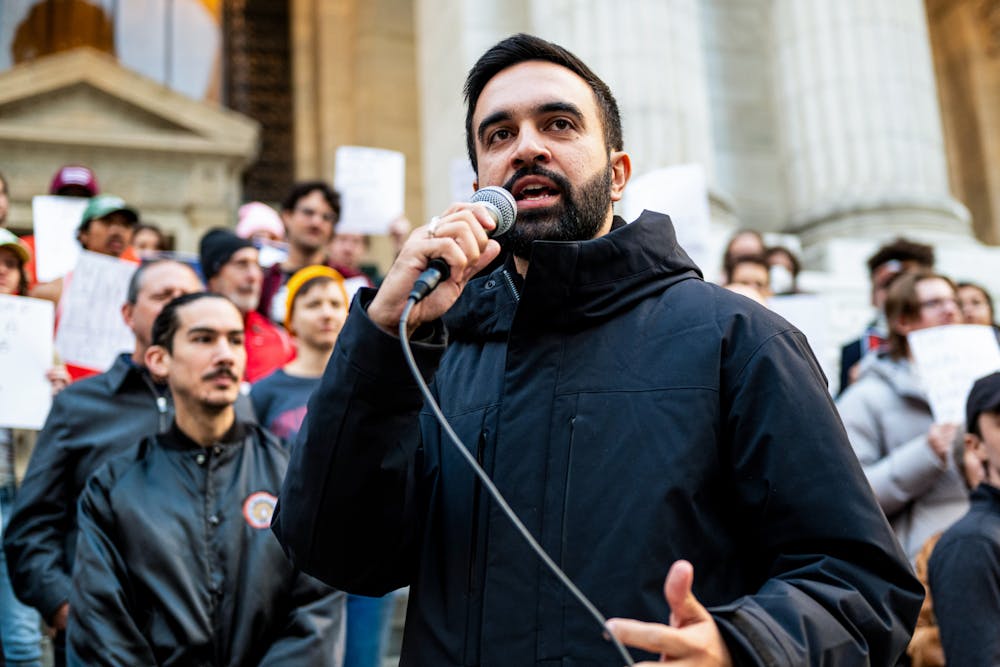
The school that drives New York’s capitalism and populates its elite cannot ignore last night’s election.
Few believed that Zohran Mamdani, a democratic socialist polling at just 1% at the start of the year, would ever become mayor of New York. His upset victory demonstrated that the city’s faith in Wharton-backed capitalism wasn’t as absolute as we thought.
Mamdani’s victory wasn’t founded on Bernie Sanders-esque tirades against “the 1%.” Instead, he ran a campaign built on substantive policy: a rent freeze on rent-stabilized housing units, fare-free buses, city-owned grocery stores, universal child care, and a higher minimum wage. His rhetoric avoided the usual caricatures of populism. There was no simplistic villainizing of an obscure “elite” or scapegoating at the expense of political opponents. That restraint made his movement harder to dismiss. His platform didn’t rely on politics of resentment, but instead competence and conviction. Using his charisma and a remarkably effective social media campaign, he organized a coalition of everyday New Yorkers — tenants, transit riders, and service workers — determined to remake their city.
The young state assemblyman didn’t defeat the city’s business-backed establishment by himself. His victory speaks more to the magnitude of grievances working-class New Yorkers have experienced under the “trickle-down” economy of Wall Street. Most major developers, financiers, and real-estate groups backed his opponents. And yet, their candidate lost. The message is stark: The business world’s grip on politics may be loosening, a warning that should reach from New York’s City Hall to our own Huntsman Hall.
Wharton School alumni populate the very ecosystem Mamdani challenged. From private-equity firms aggressively reshaping housing markets to consulting shops being paid millions in taxpayer sums to advise on banal city services, Wharton-trained minds sit at the fulcrum of United States capitalism. Yet for all its business competence, the culture at Wharton reads like a trade school for corporate bubbles — focused on margins, valuations, and deal flow — at the cost of civic conscientiousness.
In an age in which voters are demanding a new mandate for how capitalism must serve society, Wharton’s allergy to politics and civic purpose risks making it irrelevant — or worse, antagonistic — to the political will of the people of the United States. Wharton must not be detached from civic questions: What are the evolving social purposes of business? What obligations do business leaders owe to the communities in which they operate? If Wharton doesn’t adapt to this political moment, its graduates may find themselves leading businesses that people no longer trust. The business world needs more than Excel models and never-ending exit opportunities. It needs critical thinkers who ask why this matters. Wharton graduates can and should be those leaders.
Mamdani’s win underscores a broader shift: Voters are not just asking how they grow the pie, but who gets a slice — and under what terms? And when a city like New York elects a mayor on that basis, it exposes a reckoning for the institutions that train tomorrow’s business elite to separate profits from the civic and social conditions that make our markets legitimate in the first place.
Wharton must prioritize civic engagement, policy literacy, and public leadership foundations — not as electives or categorically relegated to their liberal arts requirement, but as core, business-integrated coursework. Students should not just learn how housing policy affects profitability, but how it shapes labor outcomes or neighborhood belonging. Students must think past balance sheets and understand how tax strategy intersects with theories of democratic legitimacy. These business decisions don’t stop at the bottom dollar — they ripple into the very communities and livelihoods that, in turn, shape the character of the markets themselves.
SEE MORE FROM SOHUM SHETH:
The art of no deal: Why Trump cannot be negotiated with
In caving to the Trump administration, Penn betrays its motto
I urge my fellow students — the next generation of Penn-grown business leaders — to stop viewing the city as a marketplace and start seeing themselves as stewards of a larger project: carrying the American experiment in capitalism to a future rooted in civic purpose. Should Wharton lose sight of the world beyond its spreadsheets, it risks training leaders out of step with its very own backyard.
SOHUM SHETH is a College first year from Jacksonville, Fla. studying philosophy, politics, and economics. His email is sheth0@sas.upenn.edu.