On July 1, Penn announced its intent to comply with the Trump administration’s Title IX overhaul, which mandates binary, biology-based definitions of sex in athletics. In a resolution agreement with the Department of Education’s Office for Civil Rights, the University committed to banning transgender women from participating in women’s sports. While Penn framed this as a matter of legal obligation, the truth is that this was a choice. In caving to the politics of the moment, Penn abandoned the moral commitments it once claimed to uphold and, in doing so, compromised both its values and its future.
The Biden administration’s 2024 Title IX reforms had left the issue of trans athletes unresolved, allowing institutions the autonomy to determine their own policies. In that legal vacuum, Penn made its own choice and allowed Lia Thomas, a transgender woman, to compete on the women’s swimming and diving team in 2021 and 2022.
That decision was grounded in principles of dignity and inclusion. It was a moral stand taken at a time when the right-wing culture-war machine was already mounting its assault on trans rights. Our University held firm, not because it was forced to, but because our community believed it was right.
Penn’s motto, “Leges sine moribus vanae,” asserts that laws without morals are meaningless. The University had already made its moral position clear; to now walk it back under political and financial pressure is a troubling hypocrisy.
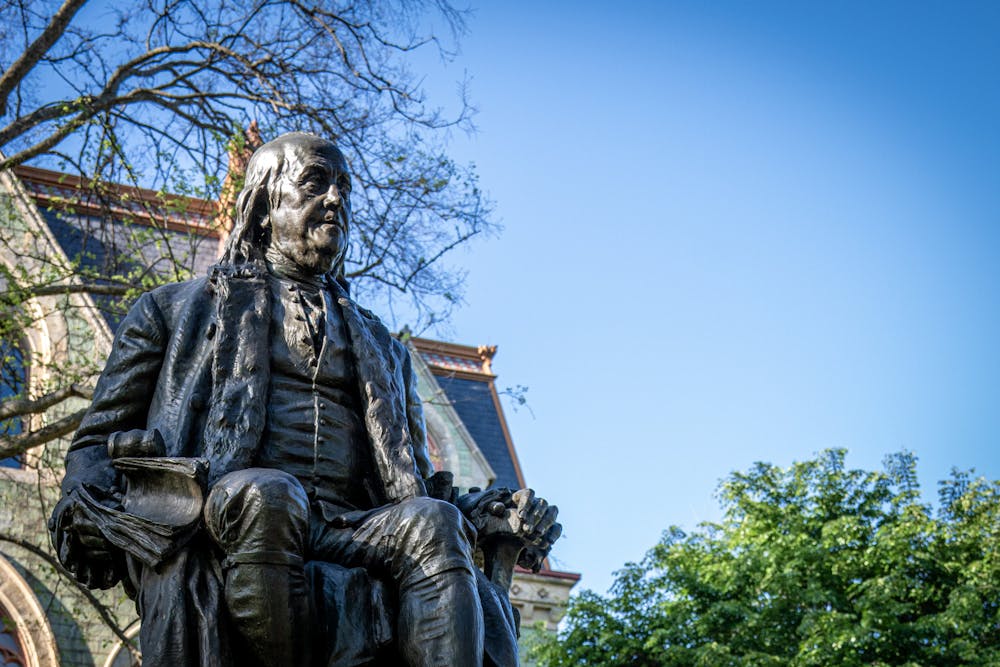
Penn was founded not as a theological seminary like Harvard, Yale, or Princeton before it, but as a secular university invested in the future American republic. It aimed to fuse Enlightenment ideals with practical civic training: useful, morally grounded knowledge for a free people. Benjamin Franklin’s project was to build a university beholden not to traditions and the political maneuvering of institutions, but to truth.
Penn has honed that identity across generations. The University was one of the first to admit women for graduate study. Its students voiced opposition to the Vietnam War with sit-ins. In recent years, it offered refuge to transgender students by backing Lia Thomas, even as they were targeted by statewide culture wars.
It is shameful that, instead of challenging the federal interpretation of Title IX in court — a legally open and winnable argument — Penn chose to quietly negotiate with the federal government. The University could have asserted, as it did in 2022, that its inclusion of Lia Thomas complied with NCAA guidelines and respected the spirit of Title IX’s commitment to fair access. That case could have been litigated openly, inviting judicial review of how the law should apply to transgender athletes. Just last week, the Supreme Court agreed to hear a case on transgender student-athletes, confirming that this is precisely the kind of contested legal question Penn could have fought.
Despite its immense legal resources, a part of the sixth-largest endowment in the country, Penn acquiesced to the Trump administration’s demands in order to avoid the loss of $175 million in federal funds. That money matters, no doubt. Penn receives NIH grants that pave research into cancer immunotherapy, biomedical technology, community health, and more. Withholding these funds would harm both Penn and the country. But the University still had a choice — and it chose the path of least resistance. In doing so, it risks losing far more than just federal support or some abstract moral high ground.
Public trust in elite universities is already eroding. Right-wing opposition to academia’s perspective on gender identity aside, the combination of exorbitant tuition costs and exceedingly low acceptance rates continues to reinforce centuries-old elitist stereotypes about top national universities. In this climate, Penn both had and lost the chance to regain its favor with the American psyche by standing by its scruples. If our University continues folding to political pressure, principled Americans will disavow their support for a Penn that no longer upholds its foundational values, thus harming the University’s standing for years to come.
To my peers in the incoming Class of 2029, I urge you to remember the words shared with us by Dean of Admissions Whitney Soule at Quaker Days: We were admitted not as idyllic “Penn students,” but as “the students that will make Penn.”
We are a part of one University, but our morals are our own. In the spirit of “Leges sine moribus vanae,” we must recognize our obligation to protect discourse relevant to the pursuit of the enlightened, informed governance envisioned by Benjamin Franklin. The question before us is not merely whether trans athletes should be included, though that matters deeply. The question is how we decide.
Penn reneged on its values, ignoring our community’s decision. When challenged by the government, the decision should’ve unfolded openly — argued in court, debated beneath the trees of Locust Walk — it should certainly not have been through closed-door dealings on Capitol Hill.
Law is not inherently sacred; it must be made worthy. Law without a moral compass is misguided, unworthy. If the University refuses to follow its moral compass, it is up to us as students to help reset its course: We must dissent to the University’s transactional forfeiture of our autonomy and lead principled, open discourse as students when our University will not.
SOHUM SHETH is a College first year from Jacksonville, Fla. studying public policy and governance. His email is sheth0@sas.upenn.edu.