

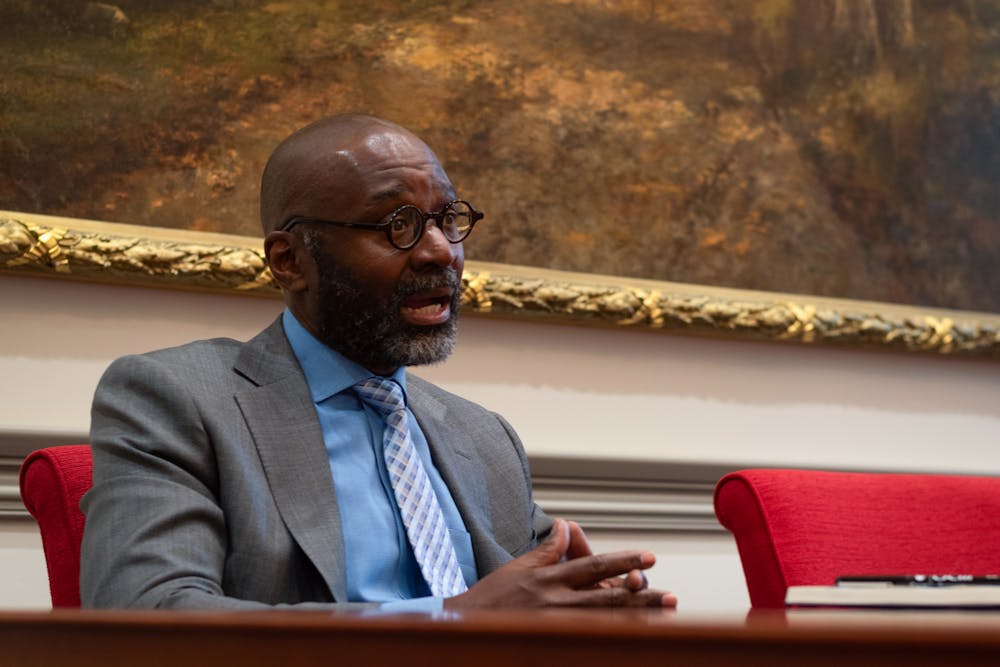
Two years after being named Penn’s 31st provost, John Jackson Jr. sat down with The Daily Pennsylvanian for an exclusive interview to discuss his tenure, recent administrative initiatives, and his role in guiding the University through uncertainty surrounding federal funding.
Jackson — who assumed the position as Penn’s chief academic officer in 2023 — described his office as “the perfect perch from which to really make sense” of Penn as an institution. He discussed his priorities for the new academic year and the University’s plan for navigating current and future threats to higher education.
Reshaping the Provost’s Office
Jackson’s office has expanded significantly in the last two years, including the addition of four new vice provost positions for the arts, climate change, undergraduate education, and graduate education, respectively.
He said that connecting these new areas of focus with the rest of the Penn community has proved to be the most “compelling part of [his] job.”
“This is the role, ultimately, that’s responsible for partnering faculty [and] deans with department chairs to make sure we bring in the top talent we can from all over the country and the world,” Jackson said. “That’s the top researchers, that’s the top teachers, that’s fantastic students — and to do that well gets you really excited.”
Jackson added that the structure of the Provost’s Office should intentionally reflect an understanding of the distinct experiences of students, faculty, and staff at Penn.
“There’s no reason not to make sure we’re thinking about these different kinds of communities in really purposeful ways,” he said. “We’ve been thinking for a while that it’s going to be important to make sure we’re being sensitive to the different needs of the undergraduate versus the graduate population.”
RELATED:
Michael Mann resigns from role as vice provost for climate science, policy, and action
Penn announces two new vice provost positions for graduate and undergraduate education
In June, Jackson named professors Russell Composto and Kelly Jordan-Sciutto as the inaugural vice provosts for undergraduate and graduate education, respectively.
Jackson also explained his office’s “concerted approach to the arts” with the help of Timothy Rommen, Penn’s vice provost for the arts.
“An institution like this has to be thinking in all these registers at the same time,” Jackson said.
On Sept. 29, Michael Mann — who was named the inaugural vice provost for climate science, policy, and action in 2024 — announced his resignation from the role after an almost 11-month term.
Mann wrote that his scientific advocacy work conflicts with Penn’s “established institutional neutrality policy.” The announcement came two weeks after Sen. Dave McCormick (R-Pa.) called for Penn to take action against Mann in light of his social media activity — including reposts and a since-deleted post of his own — regarding the death of conservative activist Charlie Kirk.
Jackson told the DP that Mann was neither fired nor “driven out” of the position.
“I think his position has been that it’s more and more difficult for him to do the kind of public intellectual work he wants to do while also being a University administrator at an institution that says we pride ourselves on institutional neutrality,” Jackson continued.
Penn’s evolving vision
Jackson highlighted the University’s new strategic framework — titled “Penn Forward” — as the defining tool for Penn’s “priorities … as an institution.”
He pointed to the work of Penn’s Red and Blue Advisory Committee, which has clarified the University’s goals since former Penn President Liz Magill announced the “In Principle and Practice” initiative in 2023.
While Jackson applauded the work of “In Principle and Practice,” he described the plan as “very abstract” in comparison to “Penn Forward.”
“Penn Forward is taking what I think are the really important abstract ideas and making them more tangible,” Jackson said. “[We’re] making it clear to folks how we’re going to turn that stuff into things students and faculty experience more every day.”
Jackson also discussed the new College Foundations program, a pilot curriculum for first-year students in the College of Arts and Sciences launched this summer. He added that the initiative will help students explore the College’s “amazing variety of research and scholarship.”
He mentioned the importance of “rethinking” what “AI is going to allow us to think about” when designing future curriculums.
Jackson emphasized that Penn’s administration should not simply respond “to the current moment,” but think “long term” about the ways “AI portends for the future of what we do.”
“I think there’s probably no aspect of what we do that is going to be the same 10 years from now,” Jackson added. “If institutions like Penn can't figure out the right way to make sense of what's emerging, no other institution has a chance.”
Challenges across higher education
Jackson characterized the current state of higher education as an especially “important moment” for Penn.
“We feel like this is a time where there’s so much movement, so much dynamism,” Jackson said. “Let’s make sure we’re thinking collectively about how to ensure that — not just for the next five years, but for the next 100 — Penn is really trying to be a genuine leader on these issues that matter.”
Penn’s administration, despite that commitment, has faced significant challenges and threats from the federal government.
In February, Penn graduate department chairs significantly reduced admissions rates across graduate programs in the face of federal research funding cuts, with faculty at the Perelman School of Medicine reducing admissions for its fall 2025 Ph.D. cohort by around 35%.
Jackson emphasized that the University — and each department within it — is “committed to” remaining “sensitive to how many Ph.D. students” it brings in.
“We’ve been trying to make sure we are looking at the market for our Ph.D. students with a very good sense of the fact that we want students to emerge from this place and have life-sustaining professional careers — either in the academy or outside of the academy,” Jackson said.
He added that decisions to make changes to graduate admissions rates were not made by the Provost’s Office, but instead individual schools across the University.
While acknowledging other challenges faced by Penn, including a federal mandate to eliminate diversity, equity, and inclusion policies, Jackson said that the University’s “educational mission hasn't changed.”
“One of the things we’re trying to make sure we do as effectively as possible is to continue to give students and faculty the kind of experiences that I think have made Penn a special place to do the kind of intellectual work we bring people here to do,” he added.
Jackson also referenced concerns surrounding free speech on Penn’s campus, along with the future of the University’s temporary guidelines for campus demonstrations.
“They gave us what I think is a fantastic document,” Jackson said. “Now we’re still in conversation with them as we think about ways to actually operationalize it.”
He explained that the goal is to use this semester to decide how to implement the committee’s recommendations and announce formalized guidelines “early next year.”
RELATED:
Michael Mann resigns from role as vice provost for climate science, policy, and action
Penn announces two new vice provost positions for graduate and undergraduate education
Ayana Chari is the assignments editor at The Daily Pennsylvanian and can be reached at chari@thedp.com. At Penn, she studies political science. Follow her on X @AyanaChari_.


