

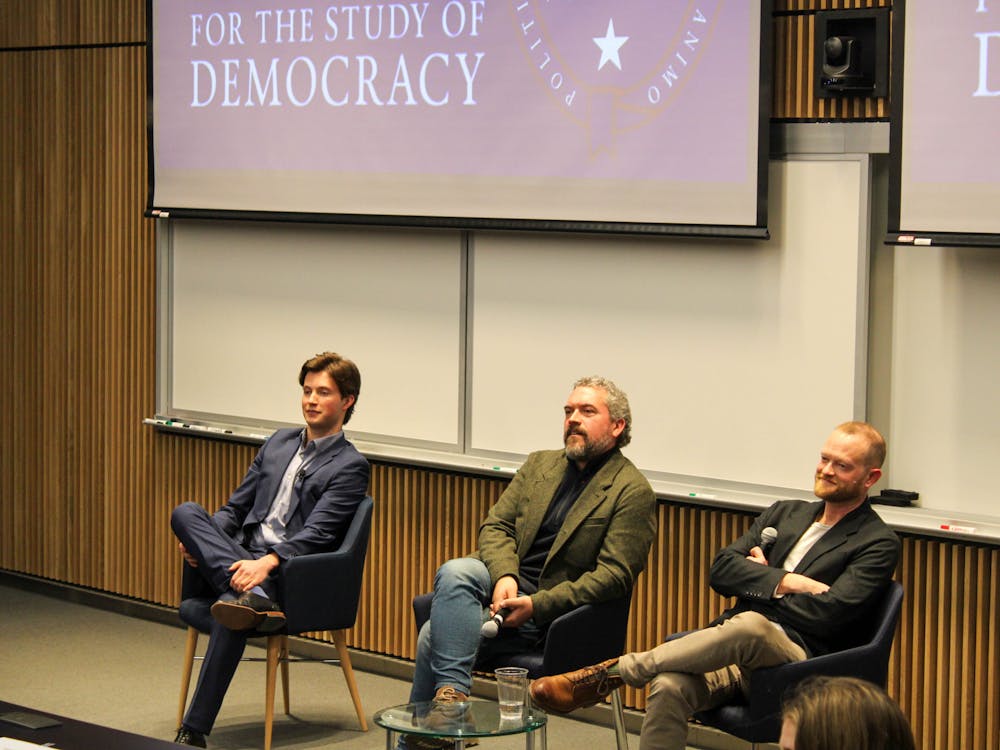
Two speechwriters for former President Barack Obama joined the Penn Political Union on Tuesday for a discussion about presidential communication.
Cody Keenan and Tyler Lechtenberg — who both worked for eight years in the Barack Obama administration — spoke about the former president’s most recognized speeches and the evolving landscape of political messaging. Around 50 people attended the Feb. 3 event, which was sponsored by the Andrea Mitchell Center for the Study of Democracy and moderated by College sophomore and PPU President Marcus Michie.
Keenan, Barack Obama’s chief White House speechwriter, described the writing process behind several speeches — including Obama’s address after the 2012 shooting at Sandy Hook Elementary School and his eulogy following the Charleston church shooting in 2015.
Keenan said his favorite speech he worked on was Barack Obama’s remarks on the 50th anniversary of “Bloody Sunday,” when Alabama state troopers attacked civil rights demonstrators outside Selma, Alabama in 1965.
“The very fact that a Black man could return there as President of the United States 50 years to the day makes it memorable,” Keenan said at the discussion.
Both panelists emphasized the importance of writing a speech that is “effective” in conveying a message to the American people.
“It’s harder to mobilize an entire country with a speech than it used to be,” Keenan said. “Fewer people see presidential speeches. We consume them in different ways. We create our own news and social media cocoons.”
The two shared anecdotes from their time working at the White House. Lechtenberg detailed the process of collaborating with former First Lady Michelle Obama on her memoir “Becoming.”
RELATED:
Penn School of Arts and Sciences hosts panel on United States intervention in Venezuela
Penn’s Leonard Davis Institute hosts panel on Trump administration’s new drug pricing policies
“I’ve learned so much from Mrs. Obama and her story,” he said. “I had a very unique and lucky opportunity to sit with her for a long time as she just talked about everything she’s gone through.”
According to Lechtenberg — who primarily worked with the former First Lady — Michelle Obama prioritized “connecting with” her audience during speeches.
“I’ve spent a lot of time with Mrs. Obama on her approach to everything from a Youth Science Bowl to the Democratic National Convention,” Lechtenberg said. “But she approaches each speech the same way — which is thinking about who’s in the audience, what they’re going through, what they’re thinking about, and how she can move them.”
Keenan spoke to the relationship the president had with his speechwriters.
“If you’re writing a speech that’s not in Washington, DC, you travel with the president,” he said. “And that’s not just to give you the perks of being on Air Force One.”
Keenan added, “It was a way to make sure everybody got to work with him, or really got to understand him.”
Both Keenan and Lechtenberg described how 1968 Wharton graduate and President Donald Trump’s presidency altered the nature of presidential messaging and emphasized how social media platforms have replaced more traditional forms of communication.
After the event, Michie told The Daily Pennsylvanian that “there’s been a real shift in what presidential communication looks like” — pointing to the difference between Trump’s social media posts and “formal, deliberate speeches back in Obama’s day.”
Keenan, who now teaches at Northwestern University, encouraged Penn students to become involved in politics.
“Whether or not you run for something yourself, you should still try a campaign,” he said. “You’re going to go join actual people in real life who believe in the same things that you believe in, who care about the same things you care about, and you’re working together on one mission.”
RELATED:
Penn School of Arts and Sciences hosts panel on United States intervention in Venezuela
Penn’s Leonard Davis Institute hosts panel on Trump administration’s new drug pricing policies
Staff reporter Luke Petersen covers politics and can be reached at petersen@thedp.com. At Penn, he studies philosophy, politics, and economics. Follow him on X @LukePetersen06.


