

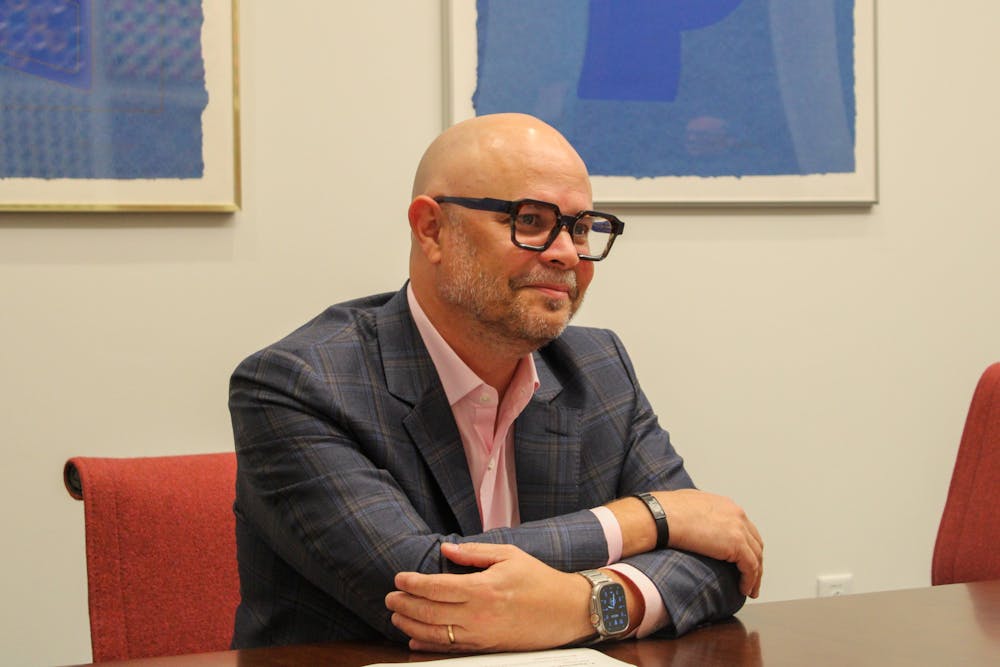
Vice Provost for the Arts Timothy Rommen discussed the future of Penn’s arts scene and how to integrate creative disciplines across the University in an interview with The Daily Pennsylvanian.
In the 10 months since he took office in January, Rommen — a professor of music and Africana studies — has begun the process of reshaping Penn’s priorities for the arts. Rommen described his tenure as an opportunity to create a space where the arts are central to the University’s mission.
“I’m really interested and invested in bringing a cultural change to align the arts at literally the core of what we’re doing,” Rommen said. “That isn’t the way it’s been in the past — there’s so much great stuff happening, but it’s sort of peripheral.”
Rommen described the process of “going back to school” to learn about the arts at Penn, including programs at the Stuart Weitzman School of Design.
“I’m learning about all of our amazing arts and culture units — things that I knew existed but didn’t understand just how vital they are to our arts ecosystem,” he said.
Rommen added that his ultimate goal is for students to come to Penn “because of the arts.”
That vision requires strategic planning, according to Rommen. More specifically, he noted that the University’s new framework — titled “Penn Forward” — can be used to shape and “articulate” priorities for the arts.
“It is a fundamental shift in the conversation [and] the way that we understand what the arts offer us that I’m really going for,” Rommen said. “The creation of this office is a down payment on that kind of a culture change.”
Rommen characterized his priorities as developing the “four spheres of activity” across Penn’s arts and culture programs. He described the first area of focus as building an interdisciplinary connection across the University, rather than keeping each department separate.
The remaining spheres — which include new resources, communication, and “how to be a good neighbor” — aim to help Penn capitalize on the “vibrant arts city” of Philadelphia.
Rommen also hopes to make faculty arts projects more sustainable and expand student resources through the new Student Performing Arts Center, which has been under construction since 2024. The new center, located in the triangular site between Hill and Lauder College Houses, will be 37,300 square feet and cost $75 million to construct.
Penn first announced its plans for the building in 2021. The proposal originated with a 2019 study by the vice provost for University Life that identified a need for additional student spaces to “meet current and future demand.”
Rommen characterized the center as a “home for extracurricular student arts,” including dance, theater, and other rehearsal and academic spaces.
“It’s going to transform what’s possible for our student groups, and I just can’t wait,” Rommen added. “During the day, there’s a chance for curricular integration where we could have courses taught in SPAC that otherwise wouldn’t have space.”
He noted that while SPAC’s use for academic purposes will ultimately be decided by individual schools, the opportunity is “exciting” to think about.
“I’m in this role for five years, and what I’m hoping to have accomplished by then is that many of the priorities that come out of this strategic planning process are really well underway and we’re seeing real progress,” Rommen said. “If I step out of that role at that five-year mark, I can hand a train that’s moving on the tracks to whoever comes next.”
Rommen assumed the inaugural role as vice provost for the arts after participating in various communities on campus.
“I have an interdisciplinary home in music, I have an intellectual home in Africana, and I have a methodological home in anthropology,” he said.
Rommen emphasized that the arts at Penn can facilitate such collaboration across the disciplines by “integrat[ing] knowledge” and drawing on “multiple perspectives.”
“It’s really important to emphasize how much amazing work is already happening on Penn’s campus,” Rommen said. “One of the things that I think needs to happen going forward is we need to stitch that together into a cohesive whole, so that we can actually see the whole ecosystem.”
Ayana Chari is the assignments editor at The Daily Pennsylvanian and can be reached at chari@thedp.com. At Penn, she studies political science. Follow her on X @AyanaChari_.


