

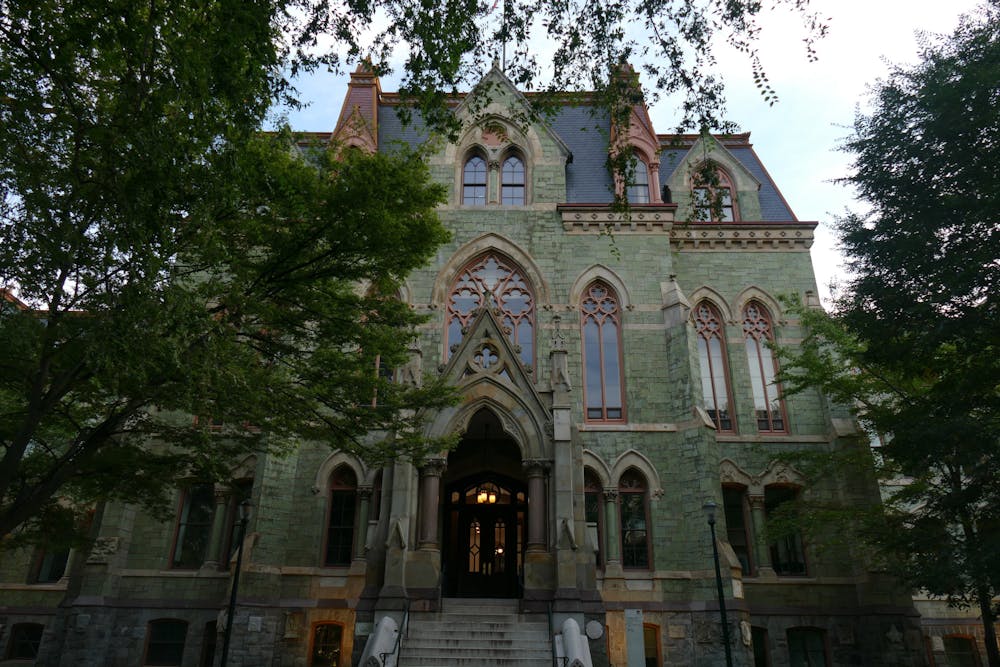
At a time of federal scrutiny and institutional change, understanding who leads Penn offers insight into where the University is headed next.
Many of Penn's most consequential decisions — from academic initiatives to addressing new federal policies — are made within the upper ranks of University administration. Though these deliberations often unfold behind closed doors, their outcomes ripple across Penn's community, shaping campus priorities, University finances, and student life.
The Daily Pennsylvanian compiled 10 key administrators whose leadership define Penn today.
Larry Jameson, Penn president
Jameson is seven months into his term as Penn’s 10th president, following a 15-month tenure as interim leader of the University. In September 2025, Jameson made his first major institutional effort as president by announcing “Penn Forward,” a new University-wide strategic framework to shape the school’s future.
Jameson’s leadership has been marked by a period of intense federal scrutiny — beginning with his appointment as interim president days after former Penn President Liz Magill resigned.
Since January, Jameson has navigated the Trump administration’s higher education agenda. Under his leadership, the University entered a Title IX resolution agreement with the White House in July, and rejected the Department of Education's proposed preferential funding compact earlier this month.
In April, Jameson expressed hopes for his “legacy” at Penn in an interview with the DP.
RELATED
Jameson releases Penn’s letter declining White House compact in ‘spirit of transparency’
Penn’s compact rejection reflects changed approach to administrative transparency, DP analysis finds
“I want my legacy to be that I help Penn adapt successfully to a rapidly changing world so that each [student] and those who follow … are prepared to play a part in that, to help shape it and be successful,” Jameson said at the time.
John Jackson Jr., provost
Jackson has served as Penn’s 31st provost for two years, significantly expanding the office in that time. Most recently, Jackson announced the addition of four new vice provost roles — for the arts, climate change, undergraduate education, and graduate education.
In an Oct. 2 interview with the DP, Jackson emphasized that these expansions allow the Provost’s office to think about “different kinds of communities in really purposeful ways.” Jackson stated that his role is “responsible for partnering faculty [and] deans with department chairs” to bring the “top talent” to Penn “from all over the country and the world.”
In March, Jackson announced several “proactive financial measures” — including a hiring freeze and a review of capital spending amid federal funding uncertainty. He also reaffirmed Penn’s support for its international community as they were impacted by federal travel bans, on-campus Immigration and Customs Enforcement activity, and visa revocations.
Ramanan Raghavendran, Board of Trustees chair
Raghavendran — a 1989 Wharton and Engineering graduate and 2015 College of Liberal and Professional Studies graduate — was elected to chair Penn’s Board of Trustees following Scott Bok’s resignation from the position in January 2024.
At the Trustees’ 2025 annual Spring Full Board Meeting in June, a unanimous motion by the board members present reappointed Raghavendran as chair through June 30, 2029.
“I appreciate the confidence and the enthusiasm,” Raghavendran said after the resolution’s approval. “I'm grateful for the honor and look forward to continuing my service.”
Raghavendran has also described Penn as a “scholarly community” that fosters excellence and discovery, rather than a place of “elitism.”
At their Spring meeting this year, the Trustees passed forty-three resolutions and heard briefings from senior Penn administrators on topics ranging from campus renovations to budgetary plans. The Trustees will meet again this year on Nov. 6 and 7.
Mark Trodden, School of Arts and Sciences dean
Trodden — who assumed his role on June — is in charge of 28 departments across various areas of the humanities and sciences. In a September interview with the DP, Trodden said that SAS will prioritize equity throughout a year of “unknowns” and “difficult decisions.”
In a September special edition of the Ampersand podcast, Trodden and Stephen A. Levin Family Dean of the College of Arts and Sciences Peter Struck spoke about the importance of liberal arts concepts in integrating interdisciplinary fields.
Trodden has been a member of Penn’s faculty since 2009, including as a professor, co-director of the Center for Particle Cosmology, chair of the Department of Physics and Astronomy, and associate dean for the natural sciences. He is also a fellow of the American Physical Society, the American Association for the Advancement of Science, and the United Kingdom’s Institute of Physics.
Mark Dingfield, executive vice president
Dingfield previously served as vice president for finance and treasurer before beginning his term as Penn’s chief financial and administrative officer in August. In an interview with the DP on Oct. 12, Dingfield discussed the stability of the University’s finances, research infrastructure, and governance in the face of federal uncertainty.
In his previous role, Dingfield led the charge for expanded financial aid through the Quaker Commitment — an initiative that raised the income threshold for families eligible to receive full-tuition scholarships from $140,000 to $200,000 with typical assets.
Dingfield has also highlighted the impacts of the federal endowment tax that Penn is expected to face in July 2026.
Erika James, Wharton School dean
James has served as dean of the Wharton School since 2020. She is one of the foremost leaders regarding organizational psychology, and is the first woman and first Black dean of the school.
In April, James helped to announce Wharton’s launch of the “Artificial Intelligence for Business” concentration and major.
She has written several books about leadership in the workplace. Alongside her academic duties, James is a board member of Morgan Stanley, The Economic Club of New York, Pomona College, The Philadelphia Orchestra, and Kimmel Center, Inc. She serves as an advisory board member to Tsinghua University School of Economics and Management and as an executive board member to the Indian School of Business.
Matthew Grossman, Office of University Communications vice president
Grossman has served as vice president of university communications since April. In the role, he advises Jameson and other senior administrators on Penn’s external communications.
“Penn’s integration of rigorous academics and groundbreaking research with real-world application is unrivaled,” Grossman wrote in the announcement of his appointment. “I cannot wait to join the University Communications team and look forward to working with Penn’s twelve schools to share the stories of this great institution and its global impact.”
Grossman was appointed by Jameson, who said he brought a “wealth of communications experience and a strategic, innovative mindset to this vital leadership role.”
Grossman assumed his role during a period of global attention and fiscal instability at Penn — particularly directed toward Penn’s 12 schools following significant reductions to graduate admissions rates in light of federal research funding cuts.
He previously worked at the venture capital firm Techstars and The Walt Disney Company.
Jonathan Epstein, Perelman School of Medicine dean
Epstein was appointed dean of the Perelman School of Medicine in February 2025 after serving as the executive vice dean and chief scientific officer of Penn’s medical school. Epstein was appointed by Jameson the same day he was named Penn's interim president.
He oversees the entire Penn Medicine system, which includes six hospitals, an outpatient network, and the nation's oldest medical school. The health system — valued at $12 billion — employs over 50,000 faculty, clinicians, and staff.
Amid National Institutes of Health funding cuts in February, Epstein wrote that “Penn Medicine leadership is actively involved in responding to this latest challenge to our mission,” adding that he was “engaged in many discussions with colleagues and officials across the nation.”
Epstein's research investigates the molecular mechanisms of cardiovascular development and its implications on the understanding and treatment of human disease, with a recent focus on epigenetic regulation of stem cell biology, developmental biology, and cardiovascular medicine.
Wendy White, senior vice president and general counsel
Since June 2003, White has served as senior vice president and general counsel for Penn Medicine and the University.
Earlier this month, White — along with Penn’s Vice Provost for Global Initiatives Ezekiel Emanuel — wrote a letter to the Department of Homeland Security opposing a federal immigration rule that could disrupt international student enrollment.
Emanuel and White wrote that the new rule would undermine the “competitiveness” of the American education sector, disrupt “virtually all” Ph.D. programs and many medical programs, and impose “significant administrative costs” on both students and universities.
Previously, White gave depositions related to the legal battle with 2021 School of Social Policy & Practice graduate and 2020 College graduate Mackenzie Fierceton.
Leigh Whitaker, vice president for government and community affairs
In August 2025, Whitaker was appointed as the University’s top liaison to federal and local governments. Her office has overseen Penn’s recent lobbying efforts to the federal government.
In a recently filed disclosure, Penn listed Associate Vice President for Federal Affairs William Andresen and Penn Medicine Corporate Director for Government and Community Relations Kristen Molloy as the two individuals who lobbied on behalf of the University. Through their efforts, Penn spent $360,000 on in-house federal lobbying this quarter, marking its highest single-period expenditure on record.
Andresen has been listed as a lobbyist on Penn’s behalf since 2006, and Molloy has been listed since 2019. Penn spent an additional $260,000 retaining three external lobbying firms: BGR Group, Mehlman Consulting, and Cassidy & Associates.
The disclosure included information on the issues Penn’s lobbying has focused on — including topics related to the NIH, research, international student visas, and student financial aid.
RELATED
Jameson releases Penn’s letter declining White House compact in ‘spirit of transparency’
Penn’s compact rejection reflects changed approach to administrative transparency, DP analysis finds
Senior reporter Arti Jain leads politics reporting and can be reached at jain@thedp.com. At Penn, she studies economics and political science. Follow her on X @arti_jain_.
Ayana Chari is the assignments editor at The Daily Pennsylvanian and can be reached at chari@thedp.com. At Penn, she studies political science. Follow her on X @AyanaChari_.


