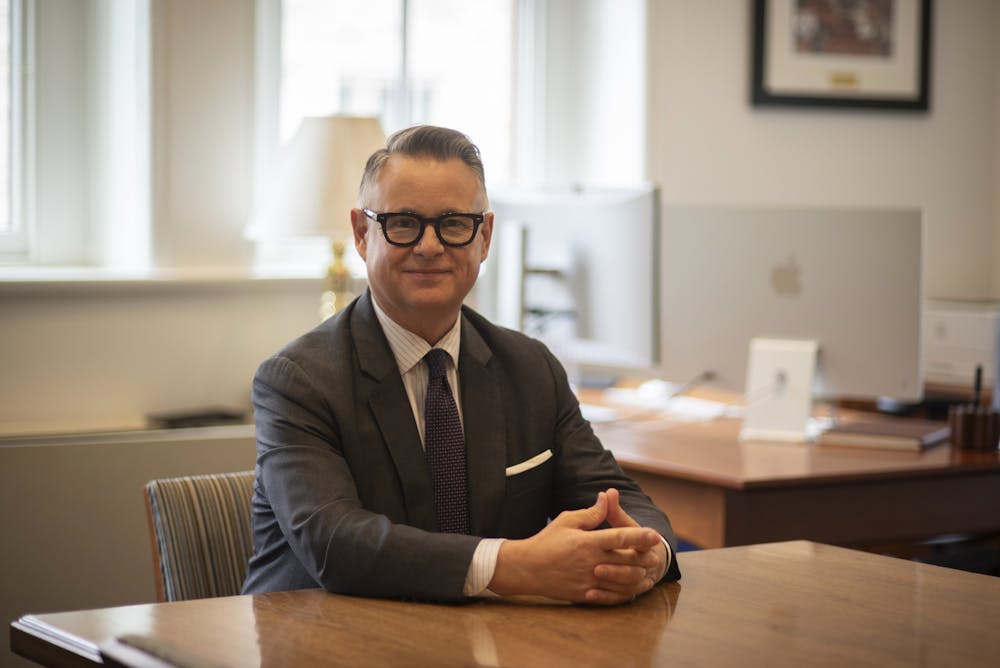
Dean of the School of Arts and Sciences Mark Trodden discussed his vision for the liberal arts and advocating for students across disciplines in an interview with The Daily Pennsylvanian.
In the role, Trodden will lead 28 departments across various areas of the humanities and sciences to form an interdisciplinary school based in the liberal arts. He previously served as the school’s associate dean for the natural sciences and holds the Thomas S. Gates Jr. Professorship in the Department of Physics and Astronomy.
Trodden’s June appointment came after former SAS Deputy Dean Jeffrey Kallberg completed his term as interim dean.
In an interview with the DP, Trodden discussed how the school will prioritize equity among students as it faces a year of “unknowns” and “difficult decisions.” He emphasized the importance of the “strategic update for the school” that will help “address these big questions and issues in ways that are unique to our School of Arts and Sciences.”
“Often when a dean comes into a job like this, they do a very lengthy strategic planning process for the school,” he said. “We’re not going to do that. We want to get going quickly.”
For his first six months, Trodden’s primary goal is to construct the new framework and travel across the United States and internationally to “tell the story of the School of Arts and Sciences.”
To engage the SAS community across disciplines, Trodden is visiting faculty meetings from each department and hosting events open to students across the school — an experience he described as “really exciting.”
Trodden has been a member of Penn’s faculty since 2009, including as a professor, co-director of the Center for Particle Cosmology, chair of the Department of Physics and Astronomy, and associate dean. He is also a fellow of the American Physical Society, the American Association for the Advancement of Science, and the United Kingdom’s Institute of Physics.
“I bring a perspective to this that comes from the sciences — that is a great strength,” Trodden said, referencing his background as a physicist. “The flip side of that is that there are parts of the school that I’m less familiar with and have their own ways of thinking about things, and those are just as valid and important, and my job is to make sure I don't miss things.”
Trodden explained that he is “still learning” and is working on the “balancing act” of acknowledging various perspectives.
“I want to use the strengths that come with my experience as a scientist, as a professor, [and] as an administrator, but I want to make sure I’m open to all these other perspectives as I try to figure out how I’m going to do this job,” he added.
Trodden emphasized that he will avoid prioritizing one over area of study over another. His goal, Trodden said, is to “champion excellence.”
“I’m trying to make sure that all our students, no matter what their interests are, have access to an ability to explore all the amazing things that are going on in the school,” he continued. “We want to have the best scientists, the best social scientists, the best humanists, and ideally, the best of those people who know how to talk to one another and explore avenues that no one else has thought of.”
In the context of the current higher education climate, Trodden noted that the school faces “challenges to the core of how we think of ourselves as a School of Arts and Sciences, and what’s important to us.”
In February, Penn reduced graduate admissions rates and rescinded acceptances across graduate programs in the face of federal research funding cuts. Trodden, who was a part of the group making the decision, explained that they did not take it lightly.
“I work with graduate students every day — they are the lifeblood of my research and everything that goes on in my department and pretty much every other department,” he said. “Having a robust, energetic, [and] well staffed graduate program is one of the highest priorities I have.”
Then-Interim Dean Kallberg attributed the school’s decision to cut graduate admissions to National Institutes of Health funding changes in an email at the time — a circumstance Trodden called an “unusual situation.”
“We had no choice but to do what we did,” Trodden said. “We’re going to decide soon what we do for the coming year.”
For future and prospective students, he encouraged people “not to get hung up on last year and decisions that had to be made very quickly in a very rapidly moving environment.”
“The School of Arts and Sciences is a place where everyone should feel welcome and supported and nourished to do what they came here to do — to explore the frontiers of knowledge, to learn as much as they can, about as many things as they can, and to leave here better prepared to be a citizen of the world than they were when they came,” he said. “That should be open to everyone — no matter who you are.”
Trodden said that he wanted to be a “good listener” by listening to student organizations, letting students “make their opinions known,” and encouraging open expression and dialogue for the whole school.
He added that Penn should be “a place where people are unafraid to take on big questions and difficult questions” and encouraged students to ask questions and listen to as many perspectives as possible when they have the opportunity to do so.
“There are things that are taught in lessons I didn't know existed before I became a professor,” he said. “Do it all. Do what you can, take advantage of as much as you can. You won't have this opportunity again.”
Staff reporter Anvi Sehgal can be reached at sehgal@thedp.com. At Penn, she studies philosophy, politics, and economics. Follow her on X @anvi_sehgal.