

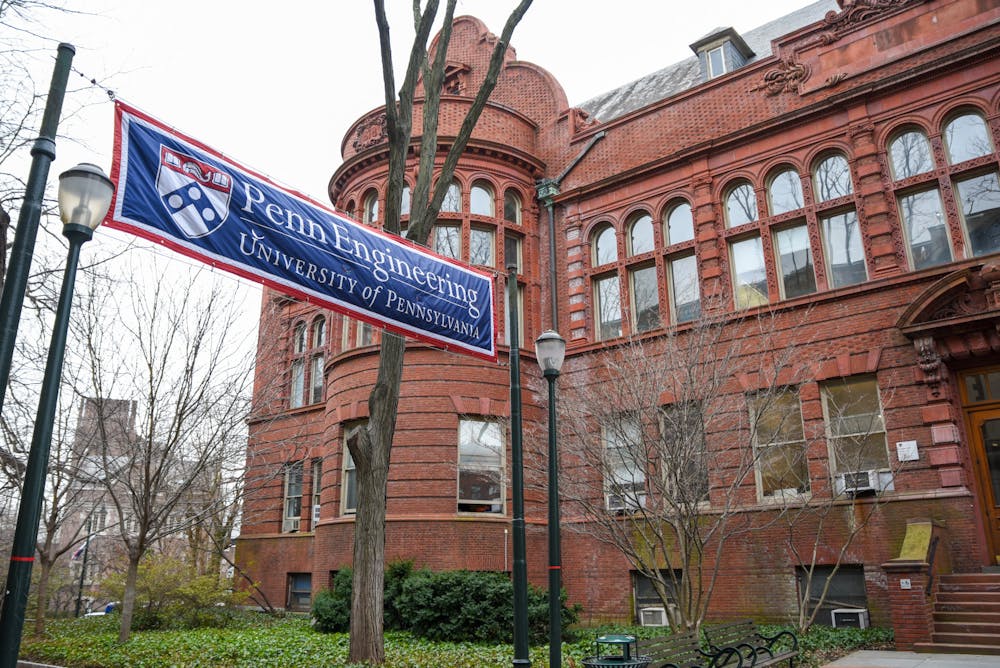
The Penn Climate seminar series hosted its inaugural event yesterday, featuring Ali Zaidi, School of Engineering and Applied Science professor and former White House national climate advisor.
Hosted by the Office of the Vice Provost for Climate Science, Policy, and Action, the new seminar series is part of a larger effort to unite climate endeavors from all 12 schools under a single roof, now called Penn Climate. The four interdisciplinary seminars throughout the fall semester will feature speakers from the Engineering School, the School of Social Policy & Practice, the Stuart Weitzman School of Design, and the Wharton School, according to Executive Director of Climate Science, Policy, and Action Stephen Decina.
“The idea behind the seminar series is that we want voices from every school, from every perspective,” Decina told The Daily Pennsylvanian, adding that they will help showcase Penn’s “breadth of experience” on climate to the community.
Wednesday’s seminar focused on the implications of AI on the energy and sustainability investment landscape.
Vice Provost for Climate Science, Policy, and Action Michael Mann delivered the opening remarks, introducing the goals of the Penn Climate initiative.
“Penn Climate’s mission is simple: to leverage, drive, and augment all the great work that Penn does on climate and sustainability, working with important Penn partners,” Mann said. “To lead the way in building a healthier and more secure future for all humankind.”
In his talk, Zaidi discussed the impact of artificial intelligence on global materials consumption, water consumption, and energy consumption, emphasizing the importance of “urgency and agency” towards developing solutions. He also discussed some cases where AI is being used as a positive force for change, such as monitoring deforestation in the Amazon rainforest to inform prevention methods.
“AI can help us, and there are so many uses of it,” Zaidi said. “But the values and the prioritization have to come from outside the machine.”
Zaidi analyzed the current state of the renewable and fossil fuel industries, identifying areas of economic growth, including nuclear and geothermal energy, and areas of stagnation, such as gas power plants and the industrial sector. Amid these recent trends — accompanied by private sector shifts — Zaidi stated that he sees an opportunity to “potentially accelerate the pace” of clean energy deployment and break through “the perceived barriers of the past.”
He then discussed several hurdles to societal progress on climate issues, including retail friction and a disconnect between public interest and policy action.
“There’s been an erosion of trust in our ability to actually attack the problem,” Zaidi said. “Maybe people see it, they feel it, they understand it, but then they feel like maybe all of this stuff isn’t actually happening or improving their lives.”
He emphasized the need for integrating “adaptation, affordability, and access” into the climate conversation.
“Costs of climate change are going up. People now feel it everywhere,” Zaidi said. “We’re realizing that there are no [climate] havens.”
Senior reporter Norah Findley leads coverage of science and health and can be reached at findley@thedp.com. At Penn, she studies environmental studies. Follow her on X @NorahFindley_.


