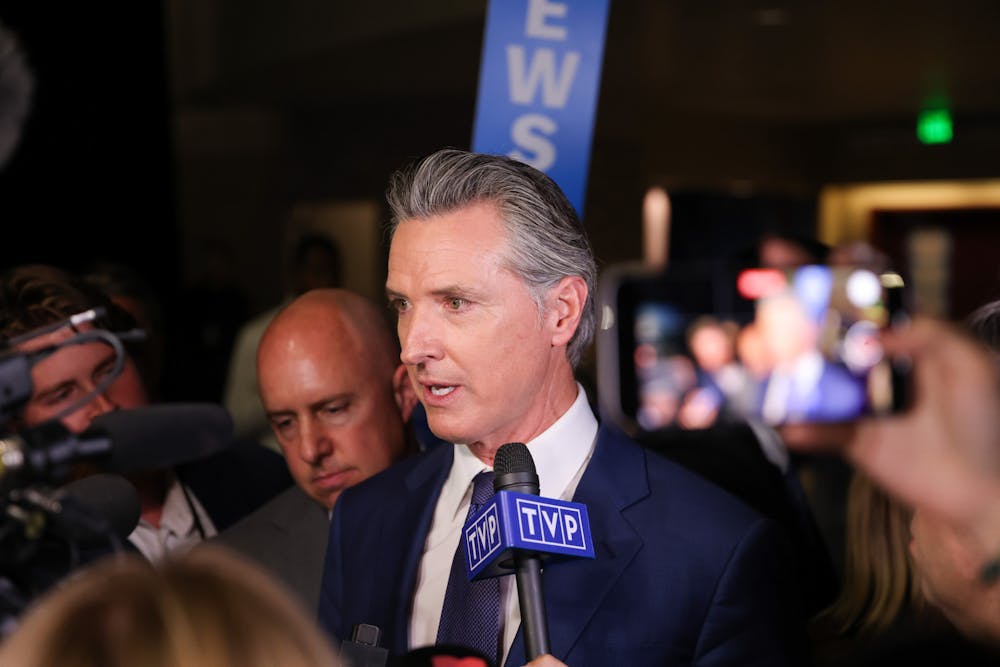
University of Pennsylvania Carey Law professor Claire Finkelstein and the Center for Ethics and the Rule of Law filed an amicus brief last week, arguing that 1968 Wharton graduate and President Donald Trump posed serious constitutional risks by attempting to federalize the California National Guard against the wishes of Gov. Gavin Newsom.
On Aug. 22, CERL — alongside the National Institute of Military Justice, Lawyers Defending American Democracy, and other legal scholars — submitted the brief in Newsom v. Trump. The case before the U.S. District Court for the Northern District of California challenges Trump’s June 7 order to place the California National Guard under federal control.
The filing, primarily authored by Finkelstein, warns that this executive action undermines federalism, violates the Posse Comitatus Act’s prohibition on military involvement in law enforcement, and threatens the First and Fourth Amendment rights of American citizens.
“There are very significant concerns when the U.S. military is deployed in a domestic as opposed to a foreign context,” Finkelstein told The Daily Pennsylvanian. “The U.S. military really trains to neutralize threats in a foreign environment. They're not very well trained or well situated to engage in what should probably be called law enforcement work.”
The Posse Comitatus Act restricts the use of federal troops in policing roles, with very limited exceptions. Finkelstein added that she has long worried about the diversion of federal troops from other important tasks, especially those concerning “military readiness to fight foreign threats.”
While the brief focuses heavily on constitutional violations, it also touches on the importance of functioning checks and balances within government institutions.
“It is a fundamental responsibility, if not the fundamental responsibility, of Article III courts to protect the rights of American citizens and lawful residents against governmental overreach, including the potential for executive overreach in the exercise of presidential Article II authority,” the brief reads.
The three-day bench trial in Newsom v. Trump concluded on Aug.13 before Judge Charles Breyer, who is expected to issue a ruling in the coming weeks.
RELATED:
Wharton Budget Model projects Trump 'mass deportation' plan to increase federal deficit, reduce GDP
Education Department requires Penn to submit incoming students' demographic data amid DEI crackdown
Penn named in lawsuit accusing top universities of using early decision admissions to inflate prices
Although amicus briefs are typically accepted without objection, the Department of Justice opposed CERL’s filing, arguing that the post-trial submission was untimely. The court nevertheless granted leave to file on Aug. 25.
Beyond California, Finkelstein warned that the lawsuit could set a dangerous precedent for future attempts to federalize state National Guards.
“Newsom v. Trump is the canary in the coal mine, because, as we saw, it was followed by Trump using the D.C. National Guard to deploy in the District of Columbia for the stated purpose of addressing homelessness, beautifying the city, [and] controlling crime — despite the fact that crime in DC is at an all time low,” Finkelstein noted, citing a roughly 27% drop in crime since 2024.
Trump has also threatened to deploy troops to Chicago and Philadelphia. Unlike in Washington, D.C., which is governed under a Home Rule statute that gives the president direct authority over its Guard, such deployments would test unsettled legal boundaries.
“It would be very good to have a decision in this case before the administration tries to deploy troops to the next jurisdiction, because the circumstances in Chicago would be much more similar to Los Angeles than to D.C.,” Finkelstein said.
“This could really set a precedent for what could happen in Chicago.”
She further explained that issuing a ruling in California before any additional action in other metropolitan cities could serve as a critical marker, emphasizing the judiciary’s role in checking executive power.
"In general, we've seen federal courts very unwilling to step in and tie the hands of the President when decisions are made with regard to troop deployments, because, after all, the President is the commander in chief of the armed forces,” she said.
RELATED:
Wharton Budget Model projects Trump 'mass deportation' plan to increase federal deficit, reduce GDP
Education Department requires Penn to submit incoming students' demographic data amid DEI crackdown
Penn named in lawsuit accusing top universities of using early decision admissions to inflate prices
Senior reporter Riana Mahtani covers national politics and can be reached at mahtani@thedp.com. At Penn, she studies political science. Follow her on X @Riana_Mahtani.