

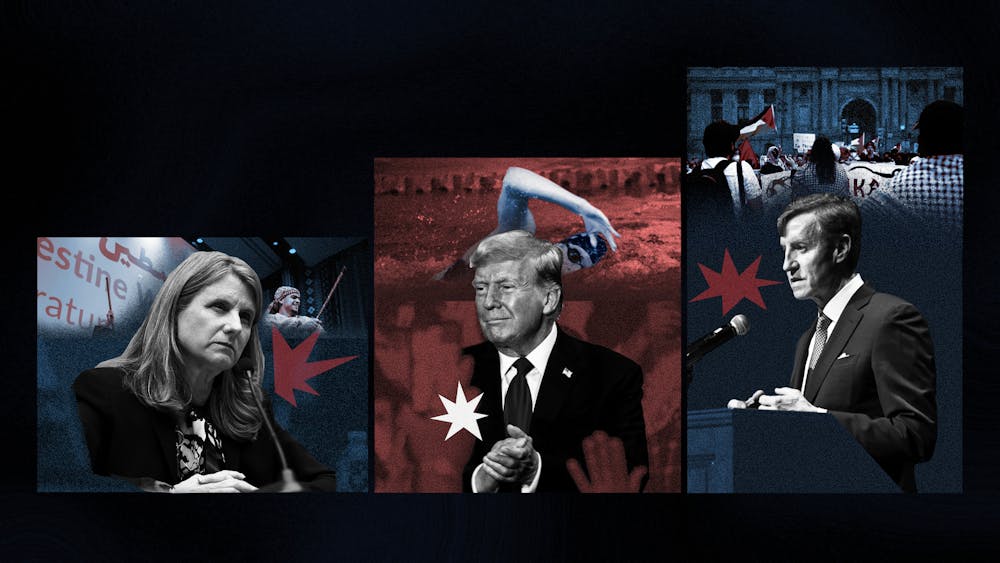
For the past two years, Penn has been at the center of national debates over free expression, federal oversight, and the role of higher education.
The 2024-25 academic year at Penn was defined by heightened political attention as the federal government increased its scrutiny of higher education institutions nationwide. Throughout the year, the University navigated student protests, leadership shifts, and new federal mandates — much of it stemming from controversies that first erupted two years prior.
Early in the fall 2023 semester, writers and performers gathered in Irvine Auditorium to celebrate Palestinian art and culture while discussing their right to national independence. The event, titled the Palestine Writes Literature Festival, immediately drew criticism from students, alumni, and national Jewish groups who objected to the inclusion of speakers that they alleged had made antisemitic remarks.
Despite a statement from then-Penn President Liz Magill condemning antisemitism, many faculty members and prominent alumni donors urged the University to take a stronger position against the festival. As tensions escalated following Hamas’ Oct. 7, 2023 attack on Israel, members of the University Board of Trustees called for the resignations of Magill and the Board of Trustees’ then-Chair Scott Bok.
The controversy erupted on the national stage on Nov. 1, 2023, when more than 20 members of Congress sent a letter to Magill criticizing the University. Fifteen days later, the Department of Education launched an investigation into Penn over allegations of campus antisemitism.
Magill faced widespread backlash for her congressional testimony, in which she said that whether calls for the genocide of the Jewish people violated Penn’s code of conduct was “context dependent.” On Dec. 9, 2023, Magill stepped down from her role as Penn president. Minutes later, Bok announced his own resignation as chair of the Board of Trustees.
Current Penn President Larry Jameson — who was dean of the Perelman School of Medicine at the time — was appointed to the presidency in an interim capacity following Magill’s resignation. He officially became Penn’s 10th president in March 2025.
The administrative overhaul did little to halt the rise of campus activism and public scrutiny. Penn became the site of multiple demonstrations, including a 16-day Gaza Solidarity Encampment on College Green that began on April 25, 2024.
RELATED:
NIH restores Penn research grants following federal court order, termination appeal
Penn named in lawsuit accusing top universities of using early decision admissions to inflate prices
After weeks of protests, rallies, and negotiations with administrators, Penn Police officers — assisted by the Philadelphia Police Department — dismantled the encampment and arrested 33 people, including nine Penn students, on May 10, 2024.
The move, which followed the University’s decision to place six student organizers on mandatory leaves of absence, drew strong criticism from members of the Penn community and local elected officials.
On June 6, 2024, Penn announced a temporary set of guidelines for campus demonstrations and began the process of reviewing its open expression policies. The University also unveiled several new security measures, including a ban on encampments and the installation of barricades around College Green and along Woodland Walk.
As students returned to campus for the fall 2024 semester, conversations on campus shifted to the presidential election between the United States’ then-Vice President Kamala Harris and 1968 Wharton graduate and President Donald Trump.
Philadelphia — located in the key battleground state of Pennsylvania — quickly became a hotspot for rallies and campaign events. Penn voted overwhelmingly in favor of Harris, who received 81.6% of the votes cast on Election Day across four campus polling locations.
Trump’s victory reinvigorated the federal government’s effort to reform higher education. Early on, his administration rolled out multiple executive orders targeting universities, including a mandated termination of any diversity, equity, and inclusion programs in potential violation of federal civil rights laws.
In response, Penn scrubbed the University’s main diversity and inclusion website, renaming it to “Belonging at Penn.” The University also removed references to DEI initiatives and programs from the websites of all four Penn undergraduate and 12 graduate schools.
On Jan. 29, Trump issued an executive order directing federal agencies to identify and deport non-citizen students — including college students — participating in pro-Palestinian protests.
In February, $240 million of Penn’s funding from the National Institutes of Health was jeopardized after the agency issued a directive capping “indirect costs” — which fund overhead expenses including laboratories and support staff — at 15%. Earlier this month, the NIH reinstated funding for three grants following faculty appeals and federal court rulings in lawsuits challenging the executive action.
One month later, an additional $175 million of Penn’s federal funding was frozen by the Trump administration. The decision, according to the White House, was due to Penn’s “policies forcing women to compete with men in sports.”
In April, the Education Department found Penn in violation of Title IX for allowing 2022 College graduate and transgender woman Lia Thomas to compete on the women’s swimming and diving team during the 2021-22 season. The Education Department gave the University 10 days to “voluntarily” respond to a set of three demands or risk losing federal funding.
To recoup its frozen funding, Penn entered into a resolution agreement with the White House in July. The University removed Thomas’ individual records and issued a public statement specifying that Penn Athletics “will adopt biology-based definitions for the words ‘male’ and ‘female’ pursuant to Title IX and consistent with President Trump’s Executive Orders.”
Penn’s agreement — which several Trump administration officials suggested could serve as a “model” for other institutions — was quickly followed by the announcement of settlements by both Brown University and Columbia University, along with the start of similar negotiations with other peer institutions.
In his July 1 message to the Penn community regarding the settlement, Jameson wrote that the University’s “commitment to ensuring a respectful and welcoming environment for all of our students is unwavering.”
He cautioned, however, that Penn “must comply with federal requirements, including executive orders” and mandates from other institutions.
While political scrutiny of Penn has dampened in the weeks since the settlement, the University still faces external efforts to reshape its policies, from an ongoing investigation into potential price-fixing within the Ivy League to a lawsuit challenging early decision admissions at elite institutions.
RELATED:
NIH restores Penn research grants following federal court order, termination appeal
Penn named in lawsuit accusing top universities of using early decision admissions to inflate prices
Isha Chitirala is a News Editor at The Daily Pennsylvanian and can be reached at chitirala@thedp.com. At Penn, she studies economics and political science. Follow her on X @IshaChitirala.
Finn Ryan is a News Editor at The Daily Pennsylvanian and can be reached at ryan@thedp.com. At Penn, he studies political science and Russian. Follow him on X @FinnRyan_.


