The National Institutes of Health — which terminated several Penn research grants in March 2025 — reinstated funding for three University research project grants in recent weeks.
After receiving termination notices from the agency, grant holders at Penn were given the opportunity to appeal their loss of funding. Some reinstatements were awarded following the appeal process, while others were mandated by federal court rulings.
On April 2, the American Public Health Association and other organizations filed a lawsuit against the NIH, “challenging [its] abrupt cancellation of research grants.” The complaint noted the agency’s failure to provide a clear rationale for the terminations.
“Defendants attempt to justify this ongoing ideological purge of hundreds of critical research projects because they assuredly have some connection to ‘gender identity’ or ‘Diversity, Equity, and Inclusion’ (‘DEI’) or other vague, now-forbidden language,” the plaintiffs wrote. “The new arbitrary regime is not codified in any law or policy.”
On June 23, United States District Judge William Young ordered the NIH to restore roughly 800 grants. Young later held that although the NIH has the right to make sweeping policy changes, the agency must provide a “reasonable explanation for doing so.”
As of July 11, the Department of Health and Human Services listed 21 Penn project grants as terminated. The projects focused on researching the impact of HIV vaccines, nicotine addiction and vaping among sexual and gender minorities, and other topics. As of publication, 18 terminated Penn project grants remain on the list.
A request for comment was left with a HHS spokesperson.
Communication professor Andy Tan previously told the DP that the NIH terminated two of his grants, including funding for “Project SMART: Social Media Anti-vaping Messages to Reduce ENDS Use Among Sexual and Gender Minority Teens” on March 12, and “Project RESIST: Increasing Resistance to Tobacco Marketing Among Young Adult Sexual Minority Women Using Inoculation Message Approaches” one week later.
RELATED:
Penn postdocs, research associates vote to unionize with overwhelming majority
Pa. lawmakers discuss research cuts, higher education policy during Philadelphia town hall
On June 27, Tan received a notice that his grant for Project SMART was reinstated. He received a similar notice on July 3 for Project REISIST. Both messages were delivered after the NIH notified Penn’s Office of Research Services.
Although the NIH originally cited Tan’s research into “gender identity” as the reason for the grant termination, he noted that “they did not state the reason” as part of the reinstatement notification.
According to Tan, the reinstatement letters were sent directly from Matthew Memoli, the principal deputy director of the NIH. The letters “referenced the appeal” made by Tan’s team following the terminations, and noted that the funding “will be reinstated in line with the previous terms and conditions of the award.”
The letters — obtained by The Daily Pennsylvanian — were addressed to Penn’s Associate Vice Provost and Associate Vice President for Research Elizabeth Peloso.
“NIH terminated the project on the grounds that the research activities do not align with the agency’s priorities,” the letters read. “As a result of recent court rulings, your award will be reinstated in line with the previous terms and conditions of the award.”
A request for comment was left with a University spokesperson and with Peloso.
At the time of the grant’s termination, Project SMART was in its fourth year of research, which was set to end before April. Tan emphasized that while the funding was terminated in early March, the reinstatement only restored the project’s “budget back to the fourth year.”
Despite the project’s reinstatement notice coming on June 27, Tan did not receive funding until July 23.
While some Penn researchers were granted reinstatements after joining APHA’s lawsuit, others found success through the appeal process.
Class of 1942 Endowed Term Chair and Nursing professor Dalmacio Dennis Flores, for example, received a termination notice in March for a five-year grant titled “Parents ASSIST: Intervention to Improve Parent Communication about Sexuality with Sexual Minority Male Adolescents.” The grant was originally approved in September 2024.
“Prior to the termination, we received year one of funding, but because we were only halfway through the year, we weren't able to spend everything,” Flores said. “We had to stop all the expenses [and] all the activities.”
With assistance from the University General Counsel, Flores “decided to appeal the termination with the NIH.” Even while the grant was terminated, Flores said that he received support from his “advisory boards” — composed of “youth and … parents” who aided his research.
Although many members of the advisory boards agreed to “continue on for free,” Flores noted his hope that “they won’t now, because the money … will come back.”
“[My] most positive projection is that we will get reinstated with the full five-year funding intact, but it has caused delay,” he added. “We'd rather just continue doing the work, get it done, see if it works or if it doesn't, and then publish and disseminate to everybody.”
Despite receiving “an email saying that [the grant] will be reinstated” on July 15, Flores was not made aware that his first year of funding would be reinstated until about two weeks later.
Flores clarified that his reinstatement came as a result of the “regular appeal process,” while others — including Tan — received renewed funding “because the judge ordered for it.”
As of July 27, Flores received reinstated funding for his first year of research.
Multiple graduate students were also recently informed that their research grants had been reinstated.
A molecular biology Ph.D. student — who requested anonymity due to fear of retribution — told the DP that their NIH F31-Diversity grant, which seeks to provide funding for predoctoral students from “diverse backgrounds,” was reinstated on July 9.
The student initially applied for funding in 2023 and was awarded a three-year grant lasting from July 2024 to July 2027. She received an email from the NIH on April 2 that explained that “the entire grant had been terminated due to a change in priorities.”
After informing her principal investigator and graduate group of the termination, the student “figured there was nothing that … could be done.” She received guidance, however, from members of Graduate Employees Together — University of Pennsylvania, a unionized group of graduate employees at Penn.
According to the student, GET-UP began “encouraging people whose grants were canceled to join the lawsuit” brought by APHA against the NIH. Shortly after doing so, she received an “automated email about the reinstatement” of her grant.
The email, which was obtained by the DP, simply lists the date of the reinstatement. As of publication, the student has not received any additional information.
Peter Bailer — a fifth-year Ph.D. candidate and member of GET-UP’s bargaining committee — noted the union’s larger efforts to fight “the Trump administration’s NIH cuts” in an interview with the DP.
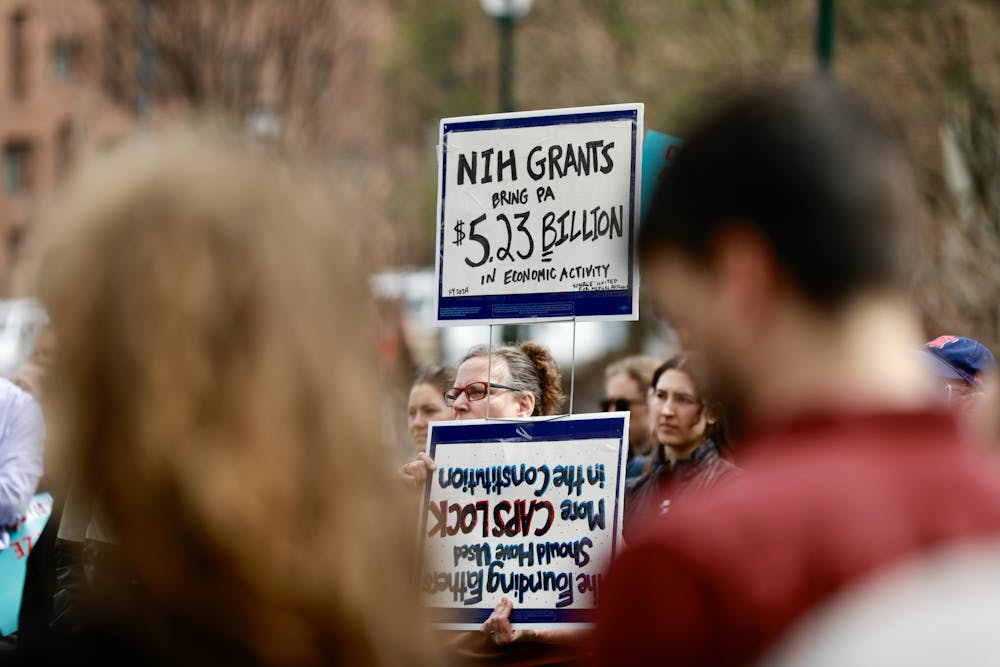
GET-UP “organized and participated in a rally in front of Senator McCormick's office to “[urge] the release of NIH grant funding.” On March 7, the union also had members speak at Philadelphia’s Stand Up for Science rally, which protested cuts to federal research funding.
Despite having her grant funding restored, the student said the termination felt targeted because her program supports researchers from underrepresented backgrounds.
A Penn professor and project investigator for another terminated NIH grant similarly described the “heartbreaking” termination of “diversity supplement” grants.
The professor — who requested anonymity due to fear of retribution — wrote to the DP that they had been working on a grant for a graduate student whose funding has yet to be reinstated. The program was intended to support research by students from backgrounds “considered to be underrepresented in science.”
“It felt like the government's sending a clear message to her that students like her are not wanted in science,” the professor wrote. “She's a student who's incredibly accomplished. She could have easily gotten a fellowship on her own without having to invoke diversity as a background for funding, but she took advantage of this opportunity that was available through the federal government.”
According to the professor, the student’s grant was terminated because “the policy of NIH” is to “not prioritize research programs related to DEI.”
“I think they are using vague, boilerplate anti-DEI language to terminate a large group of research programs,” the professor added. “It seems like there isn’t any reason in the terminations that are specific and tailored to each Award.”
The student’s termination notice from the NIH, obtained by the DP, included a statement that “research programs based primarily on artificial and non-scientific categories, including amorphous equity objectives, are antithetical to the scientific inquiry.”
“Worse, so-called diversity, equity, and inclusion (“DEI”) studies are often used to support unlawful discrimination on the basis of race and other protected characteristics, which harms the health of Americans,” the notice continued.
Flores similarly highlighted the “historical narrative” that NIH cuts “[feed] on.”
“Issues affecting LGBTQ people have always been politicized, and this is just another chapter in the politicization of the health and the well-being of members of the group,” Flores said. “Playing around with politics is playing with the lives of LGBTQ people.”
RELATED:
Penn postdocs, research associates vote to unionize with overwhelming majority
Pa. lawmakers discuss research cuts, higher education policy during Philadelphia town hall
Ayana Chari is the assignments editor at The Daily Pennsylvanian and can be reached at chari@thedp.com. At Penn, she studies political science. Follow her on X @AyanaChari_.