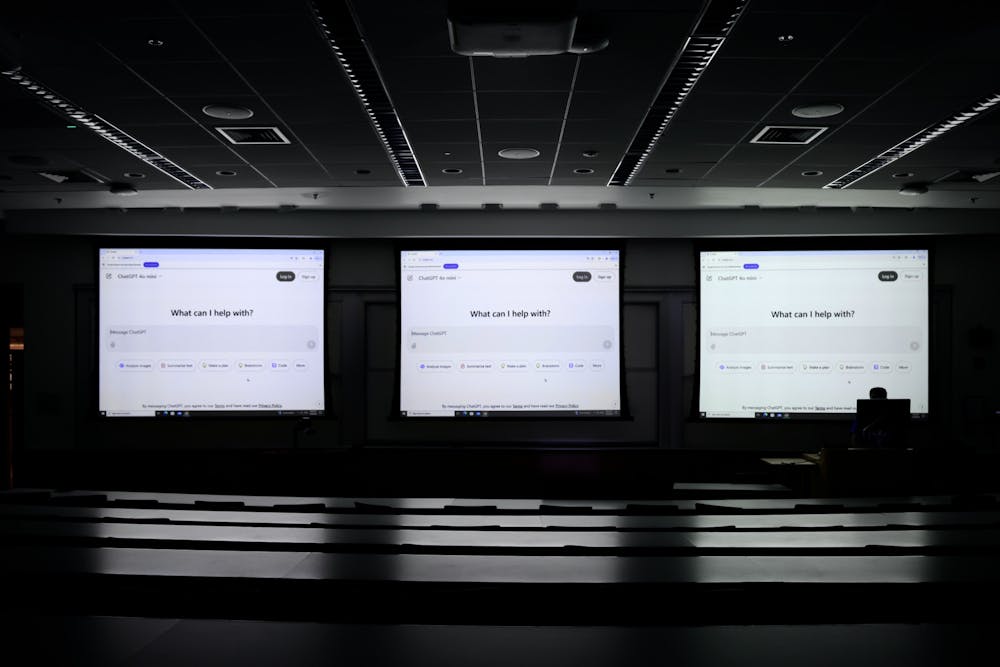
For most of modern history, we have defined intelligence in numbers: test scores, IQs, GPAs. A high SAT score once meant you were smart and full of potential. But in 2025, “intelligence” only costs $20 a month. For the price of three Starbucks lattes, a chatbot can out-write you, out-code you and out-analyze you. It doesn’t sleep. It doesn’t charge by the hour. It never needs breaks. It just runs.
Of course, the SAT has never been perfect. Still, it has provided a ubiquitous data point for college readiness among applicants. Similarly, the IQ test quantifies one’s ability to use information and logic to make predictions. For decades, these were indicators of success. While they didn’t measure everything, they aligned with what our economy rewarded: precision, pattern recognition, and speed.
In a world where artificial intelligence can outperform humans in all three, these numbers don’t mean what they used to. While knowing facts may help you win trivia night, AI doesn’t just memorize. It ingests, integrates, and applies information in milliseconds. No matter how quickly you think, you will not beat a machine trained to process billions of data points in real time. It executes reasoning tasks with precision and consistency. To compete with AI on its terms is not only difficult, but it is also fundamentally impossible to win.
This doesn’t mean humans are obsolete. It means that the definition of intelligence is shifting from retention to application, from knowing answers to asking the right questions.
As a result, the workforce is changing. AI has the ability to make recent graduates far more efficient and productive than those with decadeslong careers — not because they know more, but because they know how to leverage machines that do. AI doesn’t just speed up tasks — it enhances decision making, streamlines workflows, and provides access to insights that previously took years to develop. It makes expert-level output more accessible and less dependent on time served.
In 2020 (back to the pre-ChatGPT days), the World Economic Forum reported that 97 million jobs will be created for the development of AI and human-AI collaboration. Indeed found that manufacturing, retail and commerce, transportation, data analysis, and financial analysis roles are very likely to be taken over entirely by AI. However, those who can develop AI, like machine learning engineers, data scientists, and software developers, will be safe.
The critical divide will no longer be about high scores and low scores — it will be between those who can work with AI and those who cannot. To succeed, you no longer need to be the best at doing what a machine can do. You need to be good at doing what a machine cannot: Frame the problem, direct the tools, synthesize the results, and ask what’s next. To be smart today is to be AI-literate — to prompt, evaluate, iterate, and apply.
In other words, asking the right question is now more valuable than knowing the right answer.
SEE MORE FROM CASEY GOTTLIEB:
If you’re still operating in a world where standardized tests define talent, you’re behind. Not because these tests are useless, but because they no longer reflect the skills that the future demands.
In the past, leaders didn’t need the highest scores — they just needed to be sharp, driven, and good with people. That used to be enough. But not anymore. Today, the ones who will lead are those who will adapt the fastest. Who rethink what it means to be smart. Who treat AI not as a threat but as a collaborator, a force multiplier. Those who don’t fear being replaced because they’ve already figured out how to make themselves indispensable.
The question isn’t whether AI will replace you. It’s whether you know how to use it well enough that it won’t have to.
CASEY GOTTLIEB is a Wharton first year from New York. Her email is caseygot@wharton.upenn.edu.