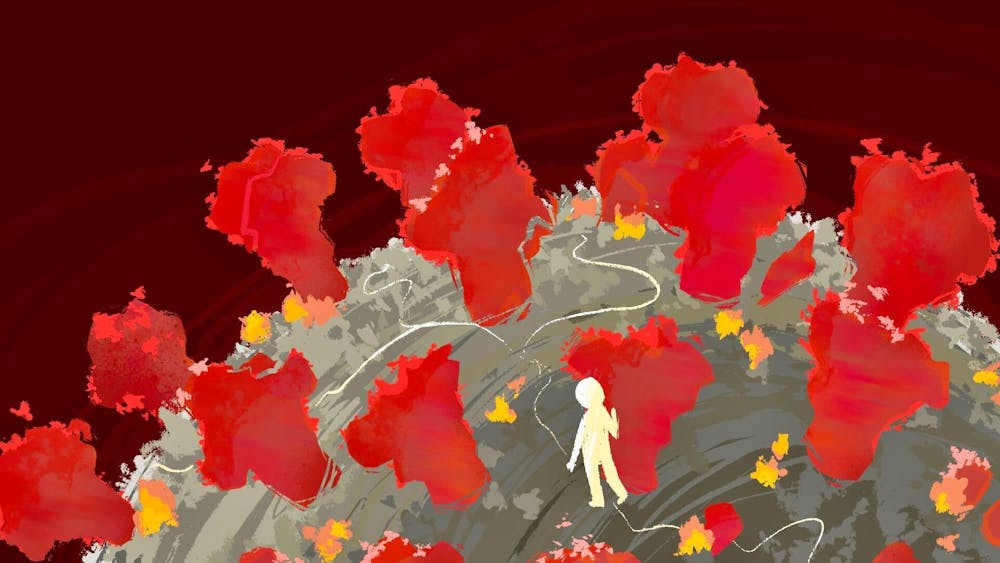
While it may seem like a fever dream now — binge-watching “Tiger King,” late-night Among Us games on Discord, birthday parties on Zoom — COVID-19’s effects still linger in how we live, how we learn, and most importantly, who we are.
For Penn’s Class of 2029, the pandemic wasn’t just a global pause — it was the backdrop to our coming of age. When the world spun into chaos, we were in bedrooms, basements, and backyards, quietly growing up. We may have been too young to fix the world, but we were just old enough to be changed by it. And somehow, weirdly enough, it is the reason many of us got here.
For us, lockdowns meant playing video games all night with friends and slowly updating our families on the news, hoping for a way back to normalcy. Wharton first-year Esteban Machorro remembers how, eerily, the world felt more united than ever. For him, COVID-19 sparked a fascination with digital commerce. He began analyzing how companies advertised on social media and eventually launched his own online social media marketing business, which pushed him to apply to and commit to Penn. In a world that seemed to be shrinking, our ambitions somehow expanded. COVID-19 gave the Class of 2029 the time and urgency to dream bigger, earlier.
Machorro isn’t alone. College first-year Charlie Yang found his voice, ironically, over Zoom. Trapped inside like the rest of us, he could have just disappeared into the passive rhythms of online school. Instead, he suddenly had access to national debate tournaments and could find online resources like coaching without ever needing to leave his room. It’s not hard to imagine a world without the pandemic, where Charlie never discovered debate at all. But he did. And it changed his trajectory.
Stories like these aren’t rare — they make up our entire class. Wharton first-year Jaya Parsa says COVID-19 helped her discover her love of baking. College first-year Ryan Cho fell mesmerized by microcontrollers. College first-year Gio Choi found a love for basketball. Others turned to learning guitar, keeping up with politics, or coding their own video games. These weren’t just quarantine hobbies. These were lifelines to discovering who we are in a time when routines vanished.
While from afar it seemed we were lost in canceled field trips and closed cafeterias, we were forced to explore who we were without anyone watching. We weren’t just killing time — we were finding ourselves.
In the absence of structured school days, we were forced to grow as more independent thinkers. We turned to online resources, Reddit forums, and self-made study schedules. COVID-19 forced us to sit through overdue dinner conversations and adapt to uncertainty, leading to growth.
Even social media evolved. What was once “just a distraction” became our way of connection. College first-year Julia Zhang says, “I began relying on Discord and Webtoon, which helped me connect with a group of close-knit friends who I’m still besties with today … Without their support and stability, I wouldn’t have the same personality and mindset as I do now.”
SEE MORE FROM CASEY GOTTLIEB:
The extension of test-optional admissions for the incoming class also reshaped how a large portion of our class appraised their own value. College first-year Eeman Syeda wrote that “standardized tests are not the only measure of intelligence and academic ability … [The test optional policy] encouraged people to showcase their other talents and lean into exploring their genuine passions.” With this flexibility, students were able to focus more on their extracurriculars, school courses, and to better understand themselves. People could explore without feeling confined to exemplifying their abilities in a single number.
The pandemic didn’t hand us resilience — it demanded it. It didn’t give us passion, but it made room for it.
College and Wharton first-year Alexsys Soriano, puts it best: “Dear COVID-19, I’m still standing, asshole.”
We didn’t ask for this. We didn’t want this. But we lived it. Out of all of the loss, the uncertainty and the silence, we built something.
And that’s why, shockingly, awkwardly, and maybe reluctantly, Penn’s class of 2029 thanks you, COVID-19 — not for what you took, but for what we found in your aftermath.
CASEY GOTTLIEB is a Wharton first-year studying business from New York City. Her email is caseygot@wharton.upenn.edu.
SEE MORE FROM CASEY GOTTLIEB: