

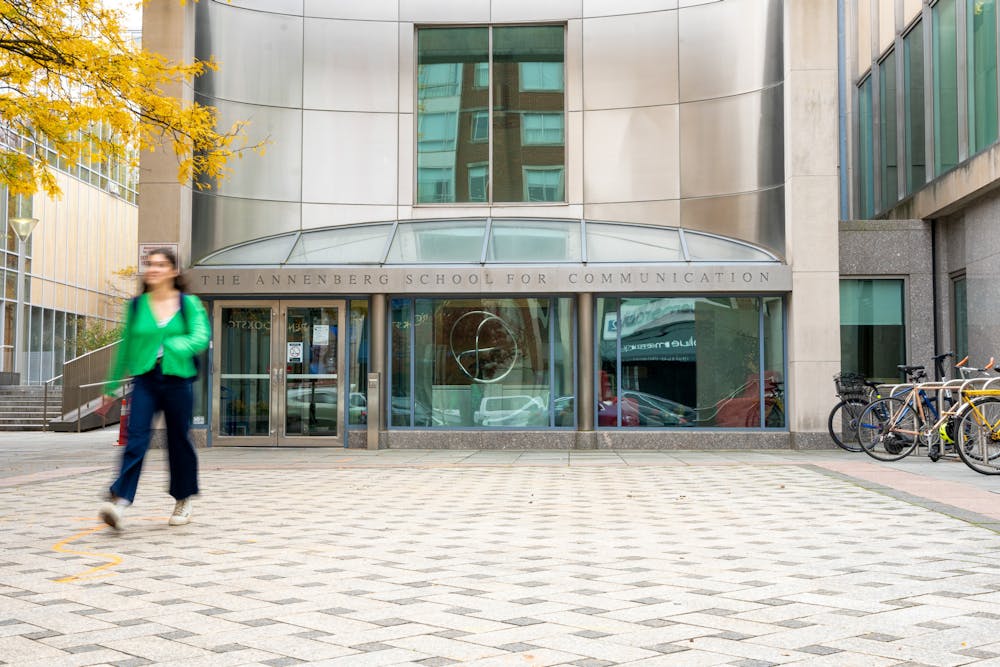
Longtime Penn donor Wallis Annenberg — who oversaw major contributions to the University as chair and president of the Annenberg Foundation — died on Monday at the age of 86.
Annenberg, daughter of 1931 Wharton graduate Walter Annenberg — who established Penn’s Annenberg School for Communication in 1958 — supported the development of many campus initiatives, including the Annenberg Public Policy Center and the Annenberg Center for Collaborative Communication. She died on July 28 of complications related to lung cancer.
“Here at Penn, Wallis fostered ASC’s growth in interdisciplinary approaches and collaborations within and beyond the school through centers and joint ventures,” Annenberg School Dean Sarah Banet-Weiser wrote in a statement to The Daily Pennsylvanian. “She touched my life personally in so many ways; her faith in me and her commitment to the things I value in life—compassion, care, and social good, among other things—has guided me throughout my career.”
Banet-Weiser noted Annenberg’s “truly indefatigable spirit of optimism” and “lifelong commitment to altruism” through the Annenberg Foundation — which she had run since 2009, following the death of her stepmother, Leonore Annenberg, who served as the foundation’s former chair, chief executive, and president.
Annenberg was particularly influential in Southern California, giving “about $1.5 billion to thousands of organizations and nonprofits in Los Angeles County,” according to the Los Angeles Times. Banet-Weiser met Annenberg while teaching at the University of Southern California — which was endowed with its own Annenberg School for Communication and Journalism in 1971.
With support from Annenberg in 2021, Penn and USC jointly launched the Annenberg Center for Collaborative Communication to facilitate a long-term relationship between faculty and students across two premier institutions for communication in the United States.
The center — also called Annenberg C3 — was designed to create opportunities for research projects and classes at both schools, focusing on how communication can address issues such as healthcare, politics, data privacy, and journalistic trust.
Banet-Weiser wrote that Annenberg “helped create [her] position as the first joint professor at the two Annenberg Schools and co-created, along with [herself] and the Dean of USC Annenberg, Willow Bay, the Annenberg Center for Collaborative Communication.”
RELATED:
Wharton graduate, longtime Penn donor Leonard Lauder dies at 92
Former Penn President Amy Gutmann to receive award honoring her contributions to Jewish Americans
The Annenberg C3 website currently notes that the center’s work “is made possible by the generosity of Wallis Annenberg and the Annenberg Foundation.”
In 1993, the Annenberg Foundation gave the University $120 million — then the largest gift in the history of higher education — to permanently endow the Annenberg School and establish the Annenberg Public Policy Center, which is based in Philadelphia and Washington.
Researchers at APPC — which is home to Factcheck.org, a project aimed at reducing deception within politics — work to help all people “better understand the role that media play in their lives and the life of the nation,” according to the center’s website.
Banet-Weiser emphasized Annenberg’s commitment to “ASC’s growth in interdisciplinary approaches and collaborations within and beyond the school,” highlighting the “construction and expansion of the Annenberg Public Policy Center,” among other “focused research centers.”
“Wallis understood the connection between communication and cultural responsibility, and she championed the work of the Annenberg School for Communication,” Banet-Weiser continued.
The Annenberg Foundation — first headed by Annenberg’s father, former University trustee, owner of The Philadelphia Inquirer, and founder of TV Guide and Seventeen magazine — has made a series of historic donations to Penn.
In 1998, the family donated $10 million to establish the Annenberg Scholars Program for students with demonstrated financial need, endow a chair in political science, and create a new institute for the study of democratic institutions and government in the Public Policy Center.
Four years later, the Annenberg School received an additional $100 million gift from the foundation — intended for classroom renovations, the creation of a new undergraduate concentration program, faculty appointments, and an expansion of graduate resources.
As of publication, the foundation’s website only displays Wallis Annenberg’s name and lifespan.
Annenberg was also a prolific wildlife philanthropist, establishing numerous programs, including the Wallis Annenberg Wildlife Crossing — which is set to be the largest in the world.
“She was always looking to build things: community centers, performing arts centers, wildlife crossings, schools,” Banet-Weiser wrote to the DP. “Her orientation toward the world and toward people is something we aspire to at Annenberg Penn: collaboration, community building, social justice, and our responsibility to the public good.”
RELATED:
Wharton graduate, longtime Penn donor Leonard Lauder dies at 92
Former Penn President Amy Gutmann to receive award honoring her contributions to Jewish Americans
Staff reporter Anvi Sehgal can be reached at sehgal@thedp.com. At Penn, she studies philosophy, politics, and economics. Follow her on X @anvi_sehgal.
Finn Ryan is a News Editor at The Daily Pennsylvanian and can be reached at ryan@thedp.com. At Penn, he studies political science and Russian. Follow him on X @FinnRyan_.


