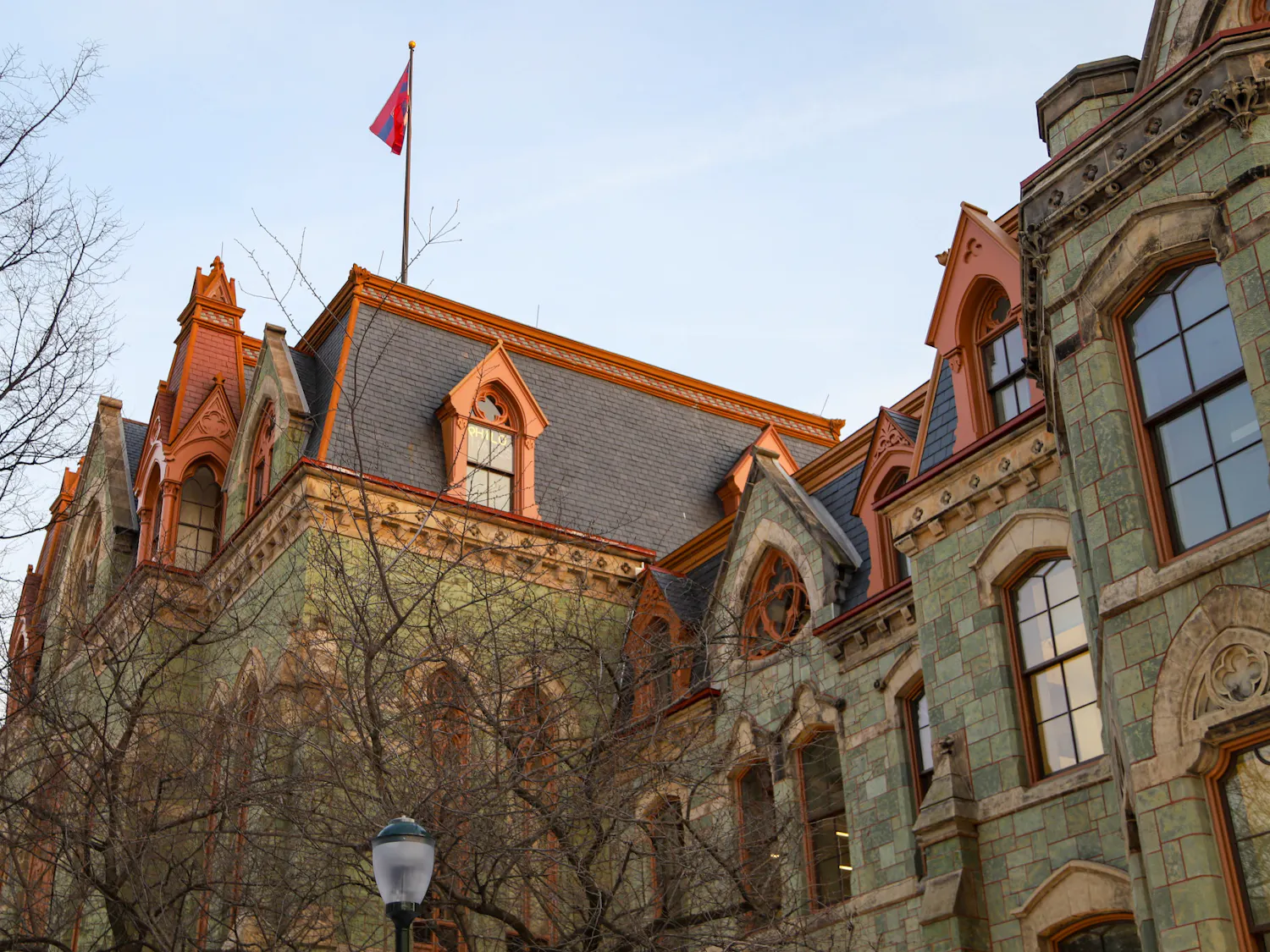
Like most great universities, you'll soon find that Penn fancies the concept of democracy.
A university is, after all, a democracy of ideas, where thought and debate flow freely and unabated.
Penn goes further, priding itself on its ability to instill the traits of good citizenship, producing active contributors to our vibrant democracy.
Sometimes, the fine people in College Hall and the Franklin Building even want you to think that you have a say in what goes on around here. They survey you on your opinions, invite you to serve on committees and hold "fireside chats" to "listen" to you, the students.
But let's make one thing clear: the University of Pennsylvania is no democracy. And every action that the University takes will not be in the best interests of the student body.
You see, Penn is nominally governed by this thing called the Board of Trustees. Theoretically, these are very powerful people. They hire the president and make all of the major decisions.
I say theoretically because for the most part, the Trustees simply act as a rubber stamp for the policies and plans of the president, provost and executive vice president (at times when there is an executive vice president). In those offices lies the real power.
Now, President Rodin and Provost Barchi don't act maliciously and in a concerted effort to make Penn a less pleasant place.
It just seems that way sometimes.
To be fair, by all accounts this university is far better off today than it was 10 years ago. There has been an impressive number of major faculty hires during my time here, improving on an already fantastic lot of professors. The college house system, while arguably falling short of its goals, has markedly improved on-campus living. And the plethora of new retail and redevelopment initiatives have done much to make University City a better place to live and learn.
But sometimes, and more often than we'd like, the higher-ups make pretty bad decisions. Outsourcing facilities management to Trammell Crow was a bad decision. Giving the students a wannabe high-end quasi-diner/bar thing when we asked for a greasy spoon was a bad idea. Banning alcohol at all University events was a bad idea.
In all of these instances, the students' best interests (and, often, common sense) took a back seat to something else (usually money). And usually, the student body rolls over, either because of the decision's lack of immediate consequence to their daily lives or the students' lack of understanding (due in no small part to Penn's nationally renowned spin machine).
But all hope is not lost. You simply have to change your worldview a little bit. Penn's not a democracy, and that isn't a viable way to run a giant institution like this anyway. But the current Penn, Inc., regime has wholeheartedly embraced one important aspect of American democracy -- the free market.
You are not a citizen. You are a customer. And though you may not like to think of yourself in this way, that's certainly the way College Hall thinks of you. So use it to your advantage.
When the University unveiled its new dining program, it lied to you, the student body. It claimed it was raising meal plan size and introducing obnoxiously large freshman plan requirements to "encourage community" and "a stable foundation for [college] house-based programming." Revenue problems? What revenue problems?
Well, you cried foul and raised a stink. And you hit Penn where it hurts the most -- you opted out. You chose not to invest your dollars in a meal plan. You made its unfair and unreasonable scheme blow up in its face.
The administration had no choice. It had to give in. It had to admit that the story about community building wasn't true; the whole thing was a desperate grab for cash to pull the ineptly run dining program out of the red. And it had to change the meal plans, make them more reasonable, make everything right.
Or at least try to. The fact is that the students aren't going to win every battle, but we won't win any if we let administrators run roughshod over our wants and desires in their quest for the almighty dollar.
We are customers, and in our bank accounts sits the only power we need. And it is an awesome power, indeed. Jonathan Shazar is a senior History and Political Science major from Valley Stream, N.Y., and editorial page editor of The Daily Pennsylvanian.