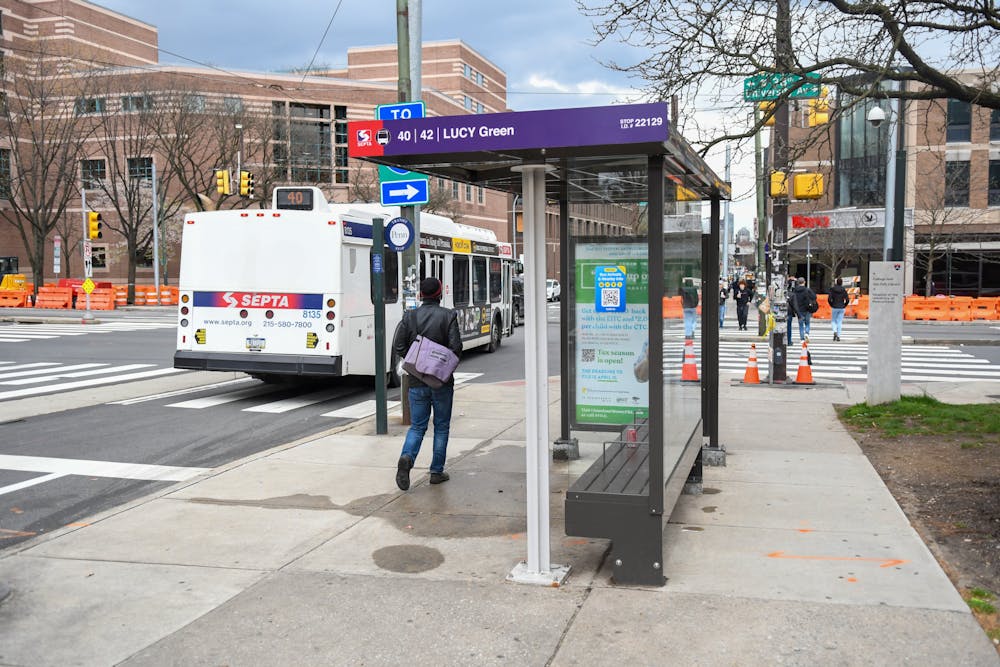
Penn students and faculty are concerned about transportation access this school year as the first phase of SEPTA bus route eliminations and significant rail service cuts was implemented on Aug. 24.
The changes — which were approved in June when the SEPTA Board cited a $213 million budget deficit — include the elimination of 32 bus routes, reductions on 88 others, and a 20% reduction in services across buses and metro. There will also be fewer rail services along with the end to all special services, including the Sports Express.
A 20% service cut to Regional Rail services and a 21.5% increase in fares, which were scheduled to take effect this week, were halted per a ruling from a Pennsylvania Court of Common Pleas judge. SEPTA was ordered to stop any additional service cuts and fare increases that were not already in place as of Aug. 29 until further notice — though the Aug. 24 cuts will remain in effect. Fares are intended to increase from $2.50 to $2.90.
At Penn, the changes affect both employees and students who rely on public transportation. Over 12,000 Penn employees and hundreds of students use SEPTA to commute.
Some students told The Daily Pennsylvanian that the cuts are already making commutes more difficult.
Wharton sophomore Maggie Gao, who is originally from Philadelphia, said she uses SEPTA often to visit home. She expressed frustration over longer bus wait times due to the cuts.
“I remember, previously, without the service cuts, I was taking the bus to the subway stations, and it generally takes around 10 minutes or less. But now, when I have to get out of my house, I have to actually double check it extra early because I have to wait around 30 minutes for each bus,” Gao told the DP.
Unlike Gao, College sophomore Zinnia Zheng said that she “[doesn’t] really care” because she does not use SEPTA very often.
“I feel like it’s just people would have to work their schedule around the SEPTA schedule,” Zheng said. “Or they find some other alternative like Uber or bike or something.”
Fourth-year Graduate School of Education student Emmy Talian noted that as a graduate student, there are more “knock-on effects” to think about besides getting to and from campus — including being a parent and having access to schools for her children. Talian is a member of a local parent group in which there has been a “lot of chatter around the start of the Philadelphia School District about how bus route cuts were impacting children’s commutes to school.”
“While I do not have a school-aged child, that is something that was kind of on my mind ahead of living in this neighborhood and planning to send our kids to public schools, is that access to schools around the city is going to be limited,” Talian said.
She also shared concerns about her ability to use public transportation to conduct research in schools across the city.
“I’m in the Graduate School of Education, so my dissertation project involves going to teachers’ schools to do observations and collect data in Philadelphia School District schools,” Talian said. “While I haven’t yet started that stage of my research, I am sure that there’s going to be an impact on my ability to get to teachers that I work with who are in Northeast Philadelphia.”
Delaware Valley Regional Planning Commission officials also projected heavier traffic that could result in up to 275,000 more vehicles on the road as more riders turn to driving as an alternative to public transportation.
“There’s maybe more push to drive to campus for those of us who don’t live in West Philadelphia and to pay exorbitant parking fees instead of making use of public transit to access,” Talian said. “[This] really changes the calculus on how much money I’m going to be spending and how easily I’ll be able to access campus resources and campus activities as a graduate student.”
2023 University of Pennsylvania Carey Law School graduate Brian, who only provided his first name due to fear of retaliation, said that while his Regional Rail commute has not yet been affected due to the postponed cuts, he noticed that one of the bus lines that he regularly takes was less frequent after the first round of cuts went into place.
Brian also criticized the “real hypocrisy” of Pennsylvania state representatives from rural districts who are “expecting construction of their transit systems [and] their roads to be subsidized, while being unwilling to fund the transportation system of someone who’s living in a different area.”
“I think the cause behind the service cuts is pretty clear, which is that the Republican majority in the [Pennsylvania] state Senate is simply not willing to fund public transit,” Brian told the DP.
Talian shared a similar sentiment and said she hopes that Penn’s administration “put[s] some pressure on Republican lawmakers at the state level who are acting as if completely defunding Philadelphia’s public transit system is an acceptable thing to do.”
“Penn is a very, very well-resourced political force in this state, and I would hope that they are using that leverage to advocate for adequate funding of Philadelphia’s public transit system, being one of the largest employers in the city of Philadelphia, in order to support their workers, in order to support their students,” Talian said.
Penn recently expanded its Commuter Benefits Program for faculty, which provides a 50% discount on Regional Rail passes and a 5% discount on contributions to the Health Equity Commuter Card that has a maximum discount of up to $105 per month. Starting Sept. 1, the maximum monthly benefit will increase to $130 per month.
An announcement from Penn Transportation, Parking, and Commuter Services attributed the decision to “challenges presented by the changes SEPTA is making in response to its unprecedented budgetary crisis.”
At a town hall held last week, local lawmakers and transit advocacy groups condemned the political nature of transit funding.
“There have been solutions that have been proposed to fund SEPTA and all transit agencies across the state, but we have been in this logjam with the Senate because they don’t want to fund mass transit for reasons that still elude me to this day,” Pennsylvania state Rep. Rick Krajewski (D-Philadelphia) said at the Aug. 28 event.
Further reductions, such as the elimination of five Regional Rail lines and the Broad-Ridge Spur, are scheduled for January 2026. A 9 p.m. curfew on all train services is also underway. SEPTA officials said that only new funding from the state legislature will prevent the cuts.
Senior reporter Amy Liao covers student life and can be reached at liao@thedp.com. At Penn, she studies philosophy, politics, and economics and cinema and media studies. Follow her on X @amyliiao.