

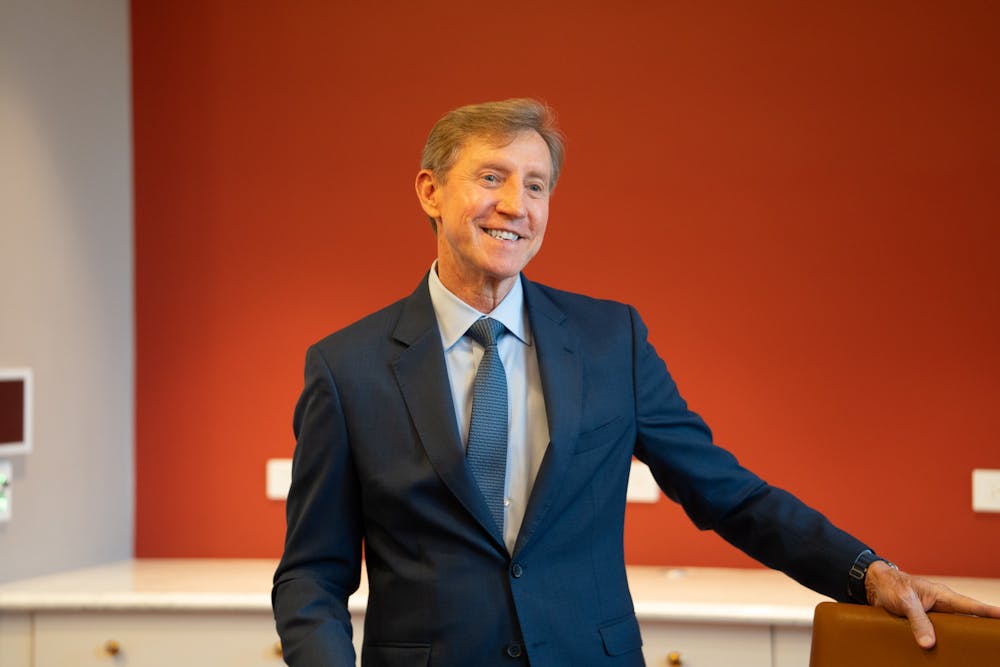
Next Monday will mark Penn President Larry Jameson’s 1,000th day on the job.
In a volatile climate for higher education, Penn has been sued by the federal government and investigated by the Department of Education. Since Jameson was appointed interim leader of the University in 2023, Penn has faced a changing federal funding landscape that has reshaped support for its schools and research, and been forced to navigate evolving immigration policies affecting international students.
Despite the relentless external pressures, Jameson maintains that his job is the “best presidential leadership role in the country.” And, he would rather spend time discussing the people, places, and innovations he thinks define Penn than linger on pressures imposed by the federal government.
It’s an attitude that permeates Jameson’s approach to the role. As he enters his final act as president, he remains guided by what he says is an unrelenting focus on steering the University toward its best possible future.
“I think Penn is well poised to have someone new come in and lead,” he said in a wide-ranging interview with The Daily Pennsylvanian on Monday. “You can go through all the different kinds of metrics that you would like to look at: quality of the faculty, the quality of the students, the engagement of the alumni, the breakthrough advances, the research productivity, and the rankings of the schools.”
***
Jameson stepped into the presidency following a 12-year stint as executive vice president of the University of Pennsylvania Health System and dean of the Perelman School of Medicine.
The endocrinologist, who trained at the University of North Carolina, began his career at Harvard Medical School before spending 18 years at Northwestern University’s Feinberg School of Medicine. For Jameson, becoming Penn’s president represents an extension of his time leading the Health System, not a departure.
“The bulk of my time, I served as the EVP and dean at Penn Medicine, and so I think about the whole arc,” Jameson said. “I consistently focus on innovation and creativity and how to get things done.”
While at Penn Med, Jameson championed a strategic plan — “Serving a Changing World” — to improve patient affordability and boost the Health System’s name recognition as a hub for innovation.
As dean of the Medical School, he served on the consultative committees that selected Provost John Jackson Jr. and Wharton School Dean Erika James, as well as the committee that helped pick former Penn President Liz Magill. Through regular meetings with Magill and former Penn President Amy Gutmann, he forged close relationships with his predecessors-to-be.
Jameson — at the time, the University’s longest-serving dean — was named Penn’s interim president just days after Magill resigned in December 2023.
His work leading the hospital system helped familiarize him with the responsibilities that come with an administrative role at Penn, he said. Following his interim appointment, Jameson’s colleagues at Penn Med lauded his unpretentious approach to leadership and ability to raise provocative questions.
Jameson has sought to apply those same qualities over the last three years — an effort he said has rendered the University “more innovative and agile.” Last fall, he announced Penn Forward, a new strategic framework for the University designed to address both the challenges and opportunities facing higher education.
“When you’re sitting in the seat, you get much more familiar — in the weeds, if you will,” Jameson said. “It was going to be important for the University’s decision-making to become more agile so that we could, in an ecosystem kind of analogy, adapt effectively to what’s going on in the external environment.”
In April, Penn unveiled nine key initiatives born from the framework, centered on extending the University’s global reach, lowering financial barriers to attendance, and embracing new technological advances.
Finer points of the plan included expanding Penn’s San Francisco campus and cementing the University as a leader in artificial intelligence research and development.
Since announcing Penn Forward last September, the University has assembled six working groups and begun to implement key initiatives. The framework’s timeline is a point of pride for Jameson, who said projects like this one can traditionally “drag on for years.”
“The lens I think through is, ‘What’s best for the University of Pennsylvania long term,’ and I think this is a good strategic move,” Jameson said. “It’s not the only one.”
***
In June, Jameson announced that he would step down as president at the end of this academic year.
“When I accepted the honor of leading Penn, my goal was to help restore stability during unanticipated leadership transitions, refocus our community on Penn’s mission, and strengthen Penn for the future,” Jameson wrote in an email at the time. “With your partnership, resilience, and dedication, we have accomplished these objectives and much more.”
His final year as Penn president is a historical one. The University is celebrating 150 years since women first enrolled as students, and is commemorating 275 years of Penn Medicine, 150 years of Penn football, and a century of the historic Palestra.
Whoever Penn’s next leader might be, Jameson plans to avoid offering them unsolicited advice.
“If they want my input, I’ll be happy to work with them, but I also think it’s really important that they’ll be a leader,” Jameson said. “I will do everything I can to be supportive, but not impose anything.”
He did, however, have one recommendation.
“I would advise them to take the time to be consultative and get input from people that have content expertise,” he said.
In July 2025, the University struck a deal with the Education Department to restore $175 million in federal funding. At the time, the decision drew sharp backlash from faculty and community members.
But only a few months later, in October, Penn rejected the White House’s education compact — a proposal that guaranteed the University preferential funding in exchange for its compliance with a set of sweeping reforms.
The decision marked a shift in the University’s approach to negotiating with the Trump administration. Unlike the closed-door discussions that led to the University’s settlement with the Education Department, Jameson was public in his consultation of student and faculty leaders prior to issuing Penn’s formal rejection, in large part due to calls for transparency from the Penn community.
***
Jameson described his medical career as one of constant learning, a habit he’s kept alive as president. Just last weekend, Jameson said he spent time studying and taking continuing education courses.
A highlight of his job, he added, has been the chance to eat lunch with current students, learn about the careers of alumni, and discuss ideas with faculty. Those experiences are what make the role “totally awesome.”
“We’ve been around for almost three centuries — there are very few institutions in our society that last that long,” he said. “I think the judicious way that we’ve navigated over those centuries has served us very well.”
Still, Penn’s best days lie ahead, he believes.
“The caliber of the institution has just progressively improved over time,” Jameson said. “I’m very proud of those things.”
Ethan Young is the Editor-in-Chief of The Daily Pennsylvanian and can be reached at young@thedp.com. At Penn, he studies history and political science. Follow him on X @EthanYoung.
Senior reporter Christine Oh leads coverage of student life and can be reached at oh@thedp.com. At Penn, she studies English and philosophy. Follow her on X @ChristineOh_.


