

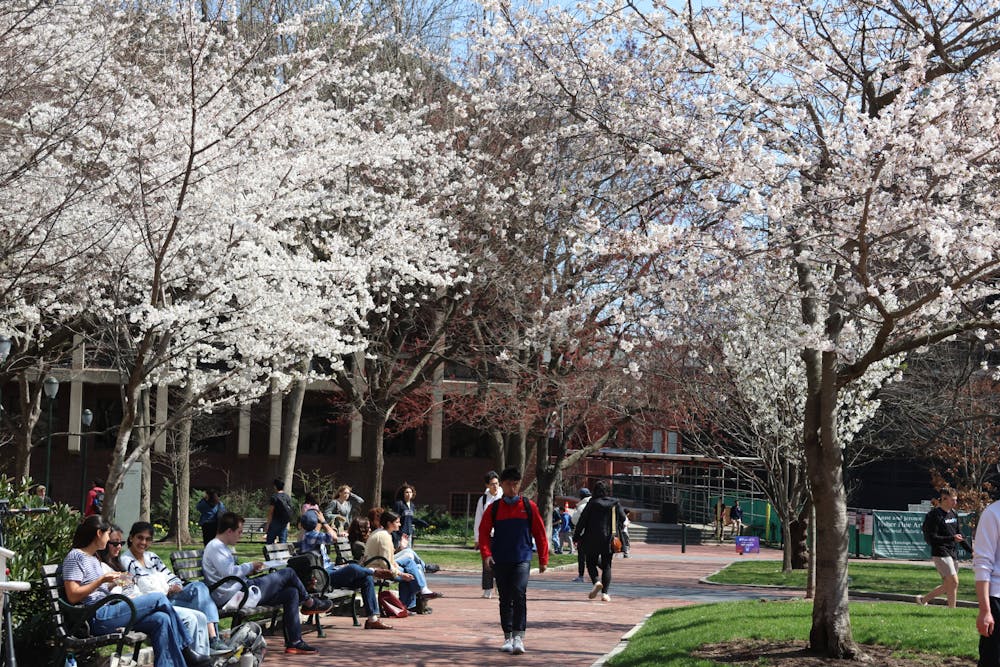
In the summer before my junior year, halfway through my time at Penn, I find myself reflecting on the person I have become. I have four semesters left, which sounds generous until I measure it against how quickly the first four went, and how little of college I still feel I understand.
But the counting has led me to a far more unsettling question: when, exactly, did I determine what my college experience was supposed to be?
Sometime during your first semester, you meet the phantom of Locust Walk. No one can describe their face, and yet everyone knows them; no one has met them, and yet they are all anyone talks about. The phantom has a perfect GPA, a flashy return offer, the “right” Greek bid, and a look smothered in catalog Ralph Lauren. You catch glimpses of them in overly humbled LinkedIn posts and Stommons small talk, until slowly they become a standing reminder of an ideal self you are always an action item behind.
And so, as students who spent our youth learning how to achieve, we let the phantom’s shadow creep into our own. In a bid to optimize the “best four years of our lives,” we maximize and streamline, as though joy were yet another deliverable, guarding against the gnawing suspicion that somewhere, someone is doing this correctly. We recruit two years early to avoid squandering our target school status. We rush because friendship, too, has an application cycle. We spend midnight hours formatting club slide decks nobody will read, all for a single line on a resume.
We keep every door open until we are left standing in a crowded hallway with nowhere to go.
At some point, I became that student. I came to Penn to study cognitive science because I was fascinated by human consciousness and memory. Try defending that utility in a 200-word application essay. In every campus coffee chat, I noticed my descriptions increasingly peppered with references to consumer behavior and analytics systems, enough to pacify an interviewer about my fit. They never asked a follow-up question. Neither did I.
We tend to assume peer pressure will be loud, that it will announce itself clearly enough to choose whether to accept or reject it. Most often, though, the most insidious forms arrive quietly, planting the fear that every other student is in on an insider secret about the “right” path.
You find yourself formulating your own proofs. Maybe the point of a school like Penn is, in fact, its recruiting pipeline, making it foolish not to step onto it. Maybe the club initiations eating into every waking hour are the price of community. Maybe the value of an Ivy League education is hidden inside the sameness of rituals every student seems so eager to survive.
SEE MORE FROM DIYA CHOKSEY:
But if we, students at one of the wealthiest and most prestigious institutions in the world, cannot afford to take risks, then who can? Who will? If elite institutions admit students for their unique interests only to funnel half of them into two industries, we might as well select on test scores alone and drop the pretense of individuality entirely.
The prestige that should license experimentation instead morphs into a compulsive caution against deviation. The pedestal we put ourselves on is narrow enough to become a battleground for yet another status quo. And so we choose the doors that open instantly, and in front of each other, over the ones that must be built quietly and alone.
The phantom, I have come to understand, does not exist to bring pain. In many ways, it offers a twisted comfort, a way to give success a shape after a childhood so full of right schools and right scores that we cannot bear a future without one. It spares us the vertigo of a path without hallways, where every door must be constructed on your own. And in accepting that comfort, we forget the real value of schools like Penn: that the tools to build any door imaginable are almost always lying around.
After two years of trying to predict which doors were the right ones, I am beginning to suspect that finding peace in the not knowing is the real education. That building your own doors, however uncertain, is worth more than standing in a crowded hallway, staring at a shadow, unable to tell where the phantom ends and you begin.
DIYA CHOKSEY is a rising College junior from Mumbai, India, studying cognitive science. Her email is dchoksey@sas.upenn.edu .

Diya Choksey is a College junior studying cognitive science from Mumbai, India. Her column focuses on student culture and identity. She can be reached at dchoksey@sas.upenn.edu.


