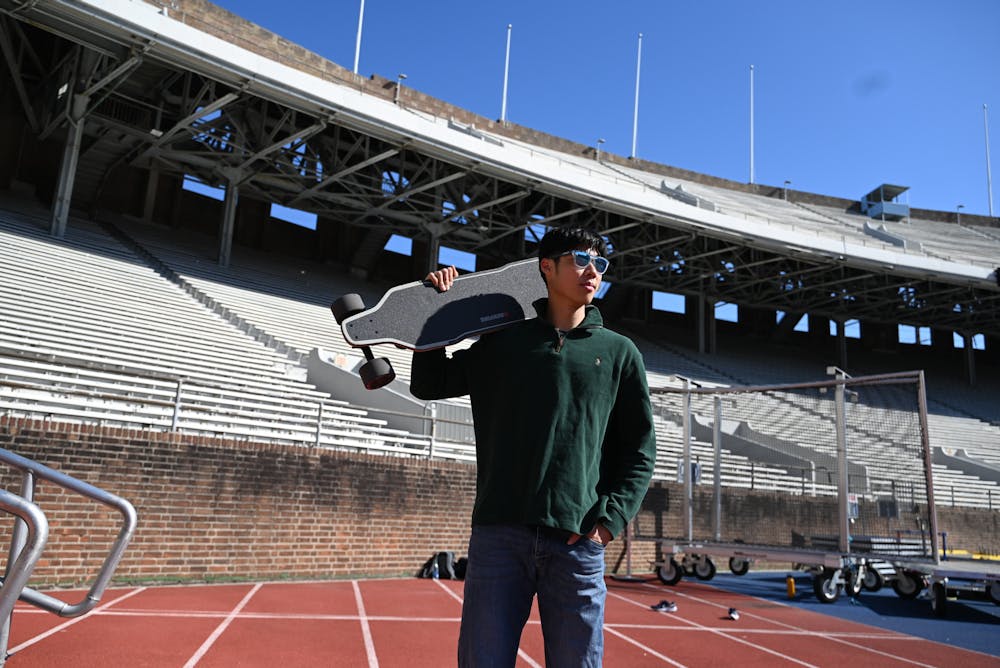
Kampton Kam was just a student looking for a sport from the sidelines at the 2010 Youth Olympic Games in Singapore.
“We were sent as a school to go watch and support Singaporean athletes there,” Kam said nearly 16 years later. “I was like, ‘Oh my gosh, one day I really really want to be at the Youth Olympic Games.’”
At only nine years old, Kam had tried nearly every sport. From swimming to rock climbing to badminton, nothing stuck until a chance rotation at a physical education camp introduced him to high jump.
He would later walk across the commencement stage on Franklin Field proudly donning a student-athlete stole after four years of representing the Red and Blue as the program’s premier high jumper.
High jump is a relatively niche event in the broader track and field landscape. Although jumping contests originated with the original Greek Olympic games, they were mostly focused on horizontal jumps and primitive pole vaulting. The modern concept of vertical jumps emerged in Scotland during the early 19th century, making its debut at the 1896 Olympic Games in Athens.
Singapore wasn’t known for its high jumpers until Wong Yew Tong came onto the scene in the 1990s, breaking a then-two-decade-old national record with a 2.22-meter jump at the 1995 South East Asia Games to qualify for the 1996 Olympics.
After his Olympic campaign concluded, Wong hung up his spikes, becoming the last Singaporean to qualify for the Olympics in the men’s high jump and earn a medal at the SEA Games.
As a nine-year-old primary school student who was only “marginally better” than his peers at physical education camp, Kam didn’t know it yet, but his natural affinity for the high jump would lead him to eventually eclipse Wong’s mark.
***
Kampton Kam likes measured progress. He likes feeling like every practice is a test. But above all, he likes the adrenaline rush of scaling each bar higher than the last.
Two months after PE camp, Kam competed at his first National School Games — the biggest meet of the school year where top performers earned a chance to make the youth national team. Despite competing against athletes in the age group above him, Kam walked away with his first career gold medal.
Kam was a juggernaut in the Singapore youth high jump circuit, claiming the U18 national record with a 2.10-meter jump at the 2018 ASEAN Games. In 2019, he became the first Singaporean student to cross the 7-foot mark with a successful clearance at 2.15 meters for his final National School Games title, breaking the U20 national record in the process.
Unlike most high school athletes who transition immediately to collegiate competition, however, Kam had an obstacle: Singapore’s mandatory military service.
Upon turning 18, all male Singaporean citizens and permanent residents are required to enlist in the National Service. Kam’s momentum was effectively halted, and the outbreak of the COVID-19 pandemic in early 2020 stalled his training even further.
Kam was used to training on his own. After all, he had worked one-on-one with the same coach since he was nine years old. While other junior and senior athletes would come and go, his relationship with his coach remained a constant as he aspired to make the youth and junior national teams.
“I was kind of used to just being on my own, having that mentality of ‘this is just me and my coach, we’re gonna try to work towards the national record, we’re trying to get medals for Singapore on the senior stage eventually,’” Kam said.
Singapore’s Circuit Breaker protocols strictly enforced social distancing while limiting outside activities to necessities. Once Singapore started to relax its policies, Kam was back on the track twice a week, doing workouts and improving his technique to prepare for his future in the NCAA and on the Singapore national team.
“In the military, the goal was not to peak at all,” Kam said. “Like a plane without two engines, you’re just trying to glide down as long as you can, and to send it as little as possible.”
When Kam was finally ready to return to competition in May 2022 for the South East Asia Games, he was faced with a harrowing discovery: He had suffered a lung collapse. He had to choose between jumping and risking future collapse or a surgery that would take him out of the competition.
With a future in the NCAA on the horizon, Kam chose the surgery.
***
It’s March 2024, and eight Quakers just touched down in Boston for the NCAA Indoor Championships. While his teammates are warming up on the track and preparing to pole vault, then-sophomore Kam waits in a conference room in a suit at the New Balance Track for his Goldman Sachs superday interview.
Despite describing himself as an “athlete-student” rather than a traditional “student-athlete,” Kam isn’t impervious to the preprofessionalism that runs rampant at the Wharton School. Off the track, he served as vice president for Phi Chi Theta, a preprofessional business fraternity, while also being involved with the Wharton Investment and Trading Group.
Coming off a freshman indoor campaign that concluded with his first career scratch at Indoor Heps, Kam was finally ready to make his mark and put points on the board.
But as a sophomore interested in recruiting for investment banking and consulting, the balancing act between athletics and academics was also in full swing. Kam tuned into Zoom crash courses, breaking down 400-question guides from winter break training camps in Japan. He did technicals on the bus to away meets and scheduled coffee chats in between competitions.
“I had super days in New York, which I went to, and then coach was like ‘you’re kind of screwing yourself over with the injury between injuries,’” Kam said. “I was locked in, but I had to definitely shift practice around for interviews.”
A new indoor personal best performance at the Darius Dixon Memorial Invitational in February 2024 solidified Kam’s place atop the Ivy League rankings as he navigated interviews. Indoor Heps was just around the corner, and although he hadn’t received an internship offer yet, Kam had secured his first ticket to the NCAA Indoor Championships.
Kam passed through the first three bars at Indoor Heps, cleanly clearing his first four bars. On his final attempt at the 2.18-meter bar, Kam cemented his Ivy legacy — but at a cost.
“That was the moment I’ve been waiting for [since] my freshman year,” Kam said of winning his first Ivy League title. “But on the last jump, when I cleared that, that was when I felt my sesamoid … one of the tendons on the ball of the foot, I injured it, or sprained it really, really hard … I couldn’t even walk the next day because it was so much pain.”
As he finished up his interview in the conference room and returned to the track at the 2024 Indoor National Championships, Kam had one goal: jump in spite of the injury, clear the first bar, and become an All-American.
He took a short approach in taped-up spikes, falling just short on his first attempt at the 2.10-meter bar. Kam fought through the pain for his second attempt, gliding over the bar to secure a sixteenth-place finish and his first career All-American honors.
The grind didn’t stop there. As his fraternity brothers and peers secured offers, Kam was left battling an injury while navigating the bleak recruiting landscape. He tried to come back to competition in early April 2024, but his body wasn’t ready and he scratched for only the second time in his career.
In April, about a week before The Penn Relay Carnival, Kam finally secured his coveted junior summer internship.
***
A hot and humid breeze rolled through the USF Track and Field Stadium on April 11, 2025. While the rest of the Quakers have adjusted to outdoor competition, Kam is beginning his outdoor season on the Bulls’ turf after earning his second All-American honors at the NCAA Indoor Championships one month prior.
Although the team is on the road, Kam isn’t exempt from his academic responsibilities, taking a critical midterm the day before the competition on the road to Tampa. The midterm — combined with a minor knee injury — left Kam unsure about his season debut, a sentiment he shared with then-roommate and 2025 College graduate Conrad Moore.
“I was like, ‘Conrad, I don’t think I’m gonna jump, I’m just gonna tell coach [Clem] I don’t really want to jump,” Kam said. “So I warmed up, and I took a few attempts at a practice bar, and I jumped 2.10 [meters], 2.15 [meters] easily. I was like, ‘maybe we could do this today.’”
Kam took a bold approach, starting off at the 2.05-meter bar where both of his teammates stumbled. It was clean — the Singaporean surmounted the bar in only one attempt. When an opponent from Grand Valley State asked Kam if he was still in the competition after a clean attempt at the 2.10-meter bar, Kam was incentivized to keep performing.
Two more clean attempts took Kam to his greatest obstacle yet — the 2.25-meter bar. The ghost of Wong’s outdoor and all-conditions record glimmered in the distance. After clearing 2.21 meters at 2025 Indoor Heps in March, Kam had lain claim to every other Singaporean record. Would the elusive 30-year-old mark finally be touched?
Near misses on his first two attempts sent Kam to the line with one last chance to etch his name in the history books. He pushed off after a few steps, glid through the air and flopped on his back. The bar stood. Wong’s record was history.
Like Dick Fosbury’s unexpected gold medal at the 1968 Summer Olympics, Kam had done the impossible, changing Singaporean high jump forever.
The momentum of his record-breaking performance carried Kam through the rest of the 2025 outdoor season, where he claimed his first Penn Relays title, earned Second-Team All-Ivy honors, and punched his first ticket to the NCAA Outdoor Championships off a 2.22-meter clearance from a short approach.
After claiming the Singaporean national record, Kam only had two more items to cross off his college bucket list: a national title, and breaking the outdoor program record.
“This might be my year to take it home, especially after my coach is telling me that 2.19 [meters] won second,” Kam recalled. “I said, ‘you’re right, you’re right, like I could actually do it,’ and I was just enjoying that experience because I was gonna work that summer in New York.”
Coming into competition in Eugene, Ore., Kam was ranked third in the NCAA in the high jump behind Georgia’s Riyon Rankin and Ole Miss’ Arvesta Troupe. After clean clearances at the 2.05- and 2.10-meter bars, he would walk away with an eighth-place finish, securing an NCAA trophy and first-team All-American honors.
The Monday after he became an All-American, Kam was in a cubicle in New York City, starting his internship two weeks late.
***
Kampton Kam may have ended his collegiate career with the Red and Blue with a 16th-place finish at the NCAA Outdoor Championships in June, but he hasn’t given up on his dreams yet.
After securing a return offer in mergers and acquisitions at the end of last summer, Kam was left with a choice: embrace the infamous 80-hour investment banking workweeks, or keep his athletic ambitions alive. With his emerging career at Morgan Stanley and a Wharton education, Kam knew he had the qualifications needed to land a job anywhere, even after taking a few years off.
But as an international student, Kam could only stay in the United States for 90 days after graduating if he didn’t have a job lined up or a firm to sponsor him. The clock was ticking, and the time to decide was now.
Negotiations and conversations with human resources dragged on for months as Kam finished his degree requirements and prepared to represent Singapore at his first SEA Games in December 2025.
By the time his final semester of college rolled around, Kam was still at a crossroads. His ability to succeed on the international stage was affirmed by a silver medal finish at the SEA Games — Singapore’s first medal in the event since the 1990s — but the question was still there. Was it worth it to pursue this dream of making it to the 2028 Olympics?
Conversations with alumni like 2016 Wharton graduate Sam Mattis and 2022 Wharton graduate Marc Minichello influenced Kam’s thought process as he waited for something to work out.
“If you ask people who have been in your shoes who’ve gone down the corporate route, they say to do the sport, and then those who did professional sports, they’re like ‘I don’t regret doing this,’” Kam said. “I really wanted to chase my dream. I want to make the Olympics, like Sam [Mattis], he made it, multiple-time Olympic finalists. Marc Minichello, world championship [team], he’s so close to the American record.”
Kam’s passion ultimately won out, but he lives with the best of both worlds, securing a position near Philadelphia that allows him to train at Penn’s facilities while volunteering as a vertical jumps coach.
“I was having conversations with people, and it was not an easy choice, because it’s hard to navigate that as an international student with the timeline that you need to have a job upon graduation with your OPT and everything,” Kam said. “I’m glad something worked out.”
No one from Singapore has even qualified for the Olympics in men’s high jump since 1996 — five years before Kam was even born. Before 2025, no one from Singapore had crossed the 2.25-meter bar.
Kam has already rewritten the Singaporean record books. He stands on the shoulders of giants as one of the greatest athletes in program history. What’s one more obstacle to overcome?