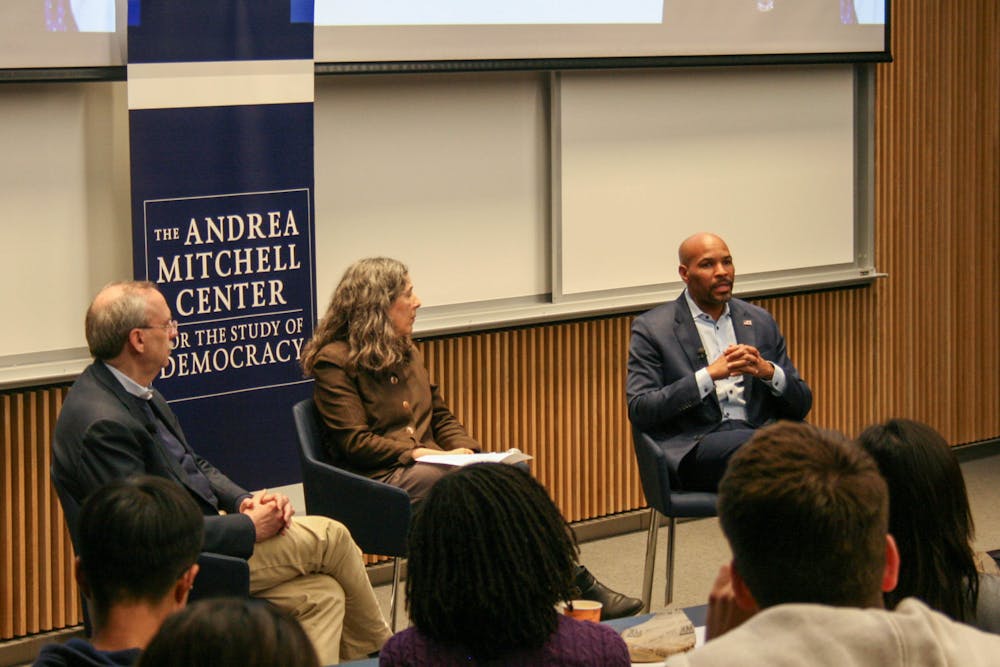
Penn Political Union hosted two federal health policy experts for a Wednesday discussion about the future of United States healthcare.
The April 22 event featured former Chief Medical Officer of the Centers for Medicare & Medicaid Services Lee Fleisher and former U. S. Surgeon General Jerome Adams. The speakers discussed the politicization of public health issues, upcoming Medicaid changes, and artificial intelligence use in healthcare.
In an interview with The Daily Pennsylvanian, Adams expressed that “health has always been political, but it’s become much more partisan.”
“We’ve taken health issues out of the realm of medical and science discussions and put them in the realm of political discussions,” he added. “That makes it challenging to communicate in this space.”
Executive Director of the Penn Center for Public Health Cheryl Bettigole, the event’s moderator, similarly expressed that the U.S. healthcare system has “really gotten stalled” because conversations have become about “the right says this and the left says this” — ensuring that officials “can’t get anything done.”
Ahead of the Trump administration’s upcoming work requirements for Medicaid coverage, which are mandated for implementation by Jan. 1, 2027, the speakers discussed how these healthcare changes will impact the American public.
The Medicaid coverage plan was signed into law in July 2025 as part of the administration’s “One Big Beautiful Bill Act.” The bill specifically imposes mandates for Medicaid members aged 19 to 64, who are covered only under an expansion to the program.
Adams expressed the need for “more community health workers” and educational opportunities to help individuals understand how the system will change.
Such resources should be available to explain that “you’re about to be kicked off of your Medicaid if you don’t complete this form and turn it into this office by this date,” he added.
Fleisher said that the bill will create “a huge access problem in the future,” adding that the law should be “implemented as intended.”
During the event, Adams suggested that “the delivery of healthcare is going to be fundamentally changed by AI.” He added that the technological shift “concerns” him because “everyone’s not going to benefit equally from this AI revolution.”
Fleisher, on the other hand, described how AI can be used to “democratize” healthcare — pointing to its ability to enable a “regular radiologist anywhere to be as good as the expert at Penn who spends every hour of the day looking at specific images.”
College sophomore and PPU president Marcus Michie explained that the “best way” to ensure “these conversations have the greatest reach possible” on campus is through collaboration with other clubs and organizations.
The fireside chat, held at the Perelman Center for Political Science and Economics, was co-hosted by the Wharton Undergraduate Healthcare Club, the Andrea Mitchell Center for the Study of Democracy, and the Penn Center for Public Health.
In a statement to the DP, College junior and WUHC co-president Joseph Richards wrote that as an undergraduate, it is “profoundly meaningful" to have the “opportunity to engage with leaders of this stature in an intimate setting.”
College junior and PPU vice president of external Neil Pereira, who helped coordinate the event, similarly expressed that the organization hopes to “bring important current events to the front of the minds of students.”