

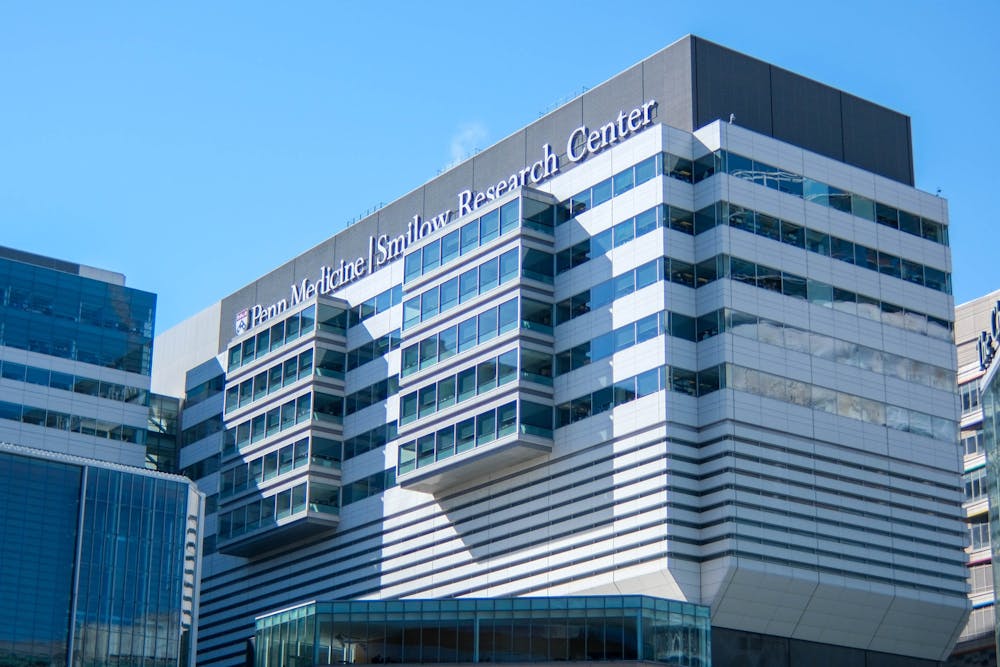
In the past decade, the University of Pennsylvania Health System has grown significantly — now treating nearly half a million emergency patients a year, employing over 50,000 workers, and handling more than eight million outpatient visits annually.
To understand how the system has evolved, The Daily Pennsylvanian analyzed a decade of publicly available data from 2015 and 2024. The figures — which comprise of patient visits, employee numbers, and hospital capacity — offer unique insight into Philadelphia’s largest private employer.
The data spans all seven Health System hospitals — including the Hospital of the University of Pennsylvania, Penn Presbyterian Medical Center, Pennsylvania Hospital, Chester County Hospital, and Lancaster General Hospital. The data also includes the Princeton Medical Center, which was incorporated into the Health System in 2018, and Doylestown Hospital, which was integrated in 2025.
A request for comment was left with a Penn Medicine spokesperson. Penn has yet to publish the Health System’s annual data for 2025.
The Health System experienced a 47.8% rise in emergency department visits from 2015 to 2024, increasing from 296,000 in 2015 to over 400,000 in 2024.
In every year but 2024, Lancaster General Hospital recorded the most visits. It was surpassed by HUP in 2024, which reported over 109,000 visits that year. Doylestown Hospital — whose 2024 data was counted separately — had 53,294 emergency department visits that year.
RELATED:
Doylestown Health integrates into Penn Health System, marking network’s seventh hospital
Penn researchers explain rising skepticism over pediatric vaccination
The Health System similarly reported increases in outpatient visits — visits without an overnight hospital stay — over the 10-year-long period. From 2015 to 2024, outpatient visits grew from 4.73 million to 8.28 million, a 75% increase.
In the same timeframe, adult admissions at the Health System, referring to patients admitted for overnight care, increased from about 118,000 to nearly 140,000, marking an 18% jump.
Emergency department visits, outpatient visits, and adult admissions all reached their highest numbers in fiscal year 2024, according to the data.
The Health System also experienced a steady increase in total employees over the decade-long period. From 2015 to 2024, the number of employees at the Health System grew from 31,235 to 50,924, marking a 68% increase.
The number of physicians working at the Health System has grown at a slower rate. The number steadily increased until 2021, when it dropped sharply from 8,923 to 6,052. In 2023, the number slightly increased to 6,243, a 3% jump. The Health System did not publish data on the number of employed physicians for FY23 and FY24.
Penn saw year-to-year fluctuations in the number of births recorded between 2015 and 2024. In FY24, the Health System reported 18,059 births, a lower number than every year but 2016.
In FY24, HUP led all seven Health System hospitals in visits, admissions, and births. Lancaster General Hospital was a close second in all three categories.
RELATED:
Doylestown Health integrates into Penn Health System, marking network’s seventh hospital
Penn researchers explain rising skepticism over pediatric vaccination
Senior reporter Rachel Kang contributes to data reporting and can be reached at kang@thedp.com. At Penn, she studies neuroscience. Follow her on X @rchllkng.


