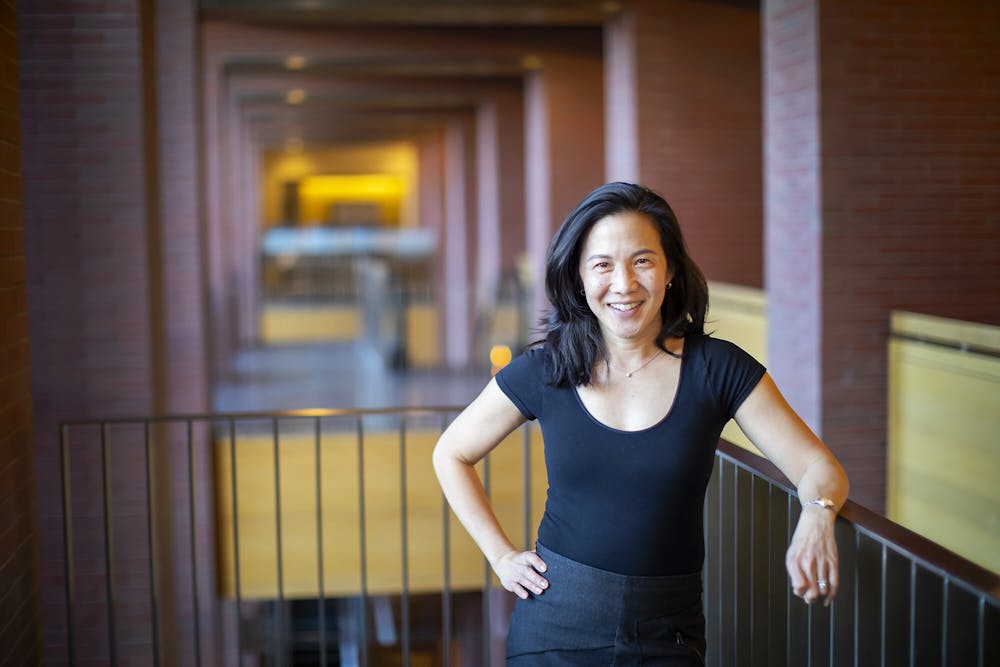
As state governments and school districts across the country consider bell-to-bell cellphone bans, Penn Psychology professor Angela Duckworth has continued her research into the impact of technology in classrooms.
Duckworth’s ongoing Phones in Focus initiative has suggested so far that stricter phone policies correspond with higher teacher satisfaction and lower rates of distraction among young students in K-12 schools. The findings — which rely on surveyed insights from educators — may provide a roadmap for schools seeking to implement phone bans.
In an interview with The Daily Pennsylvanian, Duckworth said her research team has surpassed its goal of receiving 100,000 responses, and has recorded responses from approximately 46% of schools in the nation.
The policies listed in the research include partial-use restrictions, which allow for limited phone use at desks, “no show” policies, which prohibit only visible phone use, and “away for the day” policies, which require phones remain completely out of sight for the entirety of instructional hours.
She said that “away for the day” policies have shown the best outcomes. The team also found that there has been a nationwide shift towards stricter phone use policies.
“I think it was inevitable that we would develop some ambivalence toward these devices that clearly are not entirely for our own good — yes, there are some benefits, but I think increasingly we’re aware of the downsides,” she said.
In January, Pennsylvania Gov. Josh Shapiro called for the state legislature to pass a bell-to-bell cellphone ban. The next month, a bell-to-bell ban passed the Pennsylvania Senate by a near unanimous vote and now sits in the Pennsylvania House of Representatives.
Even in states that haven’t had a “formal policy change,” Duckworth observed that there has been a “seismic shift” in attitudes toward cellphone usage in schools.
RELATED:
Annual TEDxPenn conference features nine speakers for ‘Mosaic’-themed event
Early findings from Penn psychology study suggest benefits from reduced phone use at school
Since reporting their preliminary findings in October 2025, Duckworth’s team has also added a question on laptop misuse during class, citing concerns that the devices could be a source of distraction in schools, even in cases of a phone ban.
“The complex challenges of managing technology in the classroom are not just phones but increasingly other forms of technology,” she said.
According to Duckworth, surveyed teachers estimated that one in three middle and high school students use laptops for nonacademic reasons.
2025 College graduate Lila DiMasi, a member of Duckworth’s research team, warned that overly restrictive cellphone policies could have the opposite of the intended effect.
“There’s this kind of concerning opposite trend, where the stricter the policy, the more kids are on their laptops doing things they’re not supposed to do,” she said.
DiMasi also highlighted that the study’s findings would provide data for how schools could implement cellphone bans, which might optimize future policies and prevent repeals down the line.
She added that when schools implement cellphone bans without thinking through the implications, it can lead to “backsliding” if the policy is repealed. She called the possibility of repeal “a pattern” across education policy.
2021 College graduate Kelly Flynn, another member of Duckworth’s team, echoed DiMasi’s statements about the necessity of adequate information before implementing a cellphone policy.
“A lot of the policies that are going into effect right now are not based on data and research,” Flynn said. “We just don’t really have causal data yet to support or say that they don’t work. Our goal is to provide that data so … lawmakers, principals, school leaders, district leaders are all making decisions that are based in actual causal outcomes, and not just on the national conversation or people’s opinions or anecdotes.”
As the school year comes to an end, the researchers said they plan to analyze additional metrics to provide further insight into the effectiveness of cellphone policies in schools.
“It’s going to be really exciting when we do connect this data to attendance, test scores, disciplinary outcomes,” DiMasi said. “We’re even trying to get some data on library book checkouts, so we’re really exploring what other outcomes we could look at with this data.”