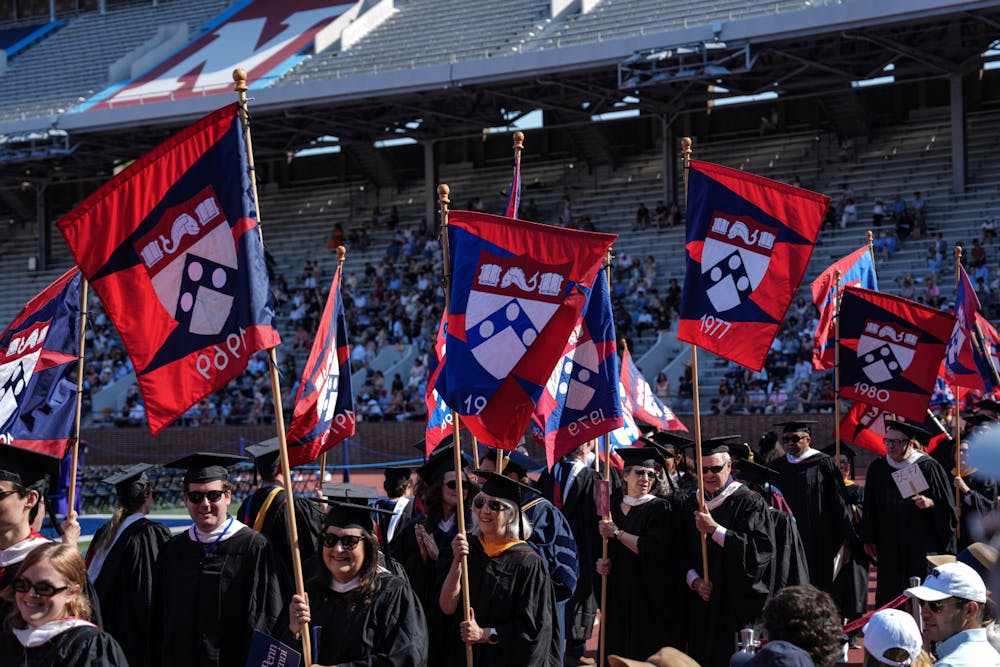
Graduates from the Class of 2026 gathered for Penn’s 270th Commencement ceremony on Monday morning, capping off an academic year shaped by the country’s upcoming 250th anniversary.
Approximately 6,000 students arrived on Franklin Field at 10:15 a.m. after taking part in a procession from Penn Park. The ceremony featured remarks from Penn President Larry Jameson and Commencement speaker Michael Beschloss, a United States presidential scholar and best-selling author.
Graduating students walked alongside alumni flagbearers, ceremonial bagpipers, and the Penn Band. Vice President and University Secretary Medha Narvekar led the march while carrying the University Mace, a staff designed to resemble maces of medieval knights.
After students assembled on Franklin Field, University Board of Trustees Chair Ramanan Raghavendran opened the ceremony. 2026 College graduate Noah Milad performed the national anthem, and University Chaplain Charles Howard led a prayer expressing gratitude for perseverance “during what historians will point to as a uniquely difficult” moment.
As part of his remarks, Jameson referenced the signing of the Declaration of Independence, along with the contributions of University founder Benjamin Franklin.
“Eight Penn affiliates would go on to sign that document and help define the promise of this nation,” he said. “You too are stepping into a transforming world. Forces moving faster than we imagined are reshaping how we live and how we connect.”
He discussed technological and scientific advances, including Penn Medicine’s gene editing breakthrough from last year.
Jameson also encouraged graduates to “cherish the arts,” “embrace nature,” and “choose people.”
“The world will test you, but you are ready,” he said. “Not because you have every answer, but because you have learned to ask better questions.”
Following Jameson’s speech, Provost John Jackson Jr. recognized students and faculty who have received academic honors and distinctions — including those inducted into academic honor societies, the recipients of school and departmental awards, and grant fellows.
Faculty Senate Chair and neurology professor Roy Hamilton discussed his family background and the importance of education, highlighting that he was both the first Black member of his family to receive a college education and the son of a Japanese immigrant.
“The fact that I’m here on this stage alongside the President, the Provost, our distinguished speaker, honorary degree recipients, and others is itself a testament to the transformative power of education,” Hamilton said.
As he described rapid changes across the world, Hamilton drew on his knowledge as a neurologist to explain that “the human brain is always adapting to its demands.”
“The real secret to the brain’s success is its connectivity,” he said. “As you leave Penn and move toward your bright futures, stay connected.”
Penn granted Beschloss and four other individuals honorary degrees. The recipients included Stanford University chemistry professor and Nobel Prize laureate Carolyn Bertozzi, 1986 Penn graduate and Stuart Weitzman School of Design professor emeritus James Corner, Harvard University economics professor and Nobel prize laureate Claudia Goldin, and renowned harpist Ann Hobson Pilot.
Beschloss, who was granted an honorary doctor of letters degree, opened his address by recalling “the days that the Constitution was written here in Philadelphia, 1787 — one of the hottest summers on record.”
Beschloss also described the political experiences of the Class of 2026, including the wars in Iraq and Afghanistan, Hurricane Katrina, and the 2008 financial crisis.
He then went further back in history, discussing the Vietnam War and the “sacrosanct” Voting Rights Act of 1965 — which he characterized as “under challenge, not only this year but in the last couple of weeks because of the decision by the Supreme Court.”
“As an historian, I believe that some elements of the national crisis we are in at this moment do echo those of our civil war struggle over slavery, as well as the late 1930s when our citizens argued into the night about mobilizing for war against Adolf Hitler,” Beschloss added.
He advocated for six traditions: the rule of law, free and fair elections, an honest and competent political system, “robust leadership” within American society, the role of historians in democracy, and national unity.
“Our founders did not believe in kings,” Beschloss said. “We Americans do not ever work for a president. A president is supposed to work for us.”
While refraining from mentioning 1968 Wharton graduate and President Donald Trump by name, Beschloss repeatedly emphasized the shifting political situation under the current administration.
“There are some politicians in Washington, D.C. who would prefer that we American historians and scholars perform for them sort of like obedient circus clowns,” Beschloss said. “This kind of a demand that historians be lapdogs does not fit American democracy.”
After the address, the deans of Penn’s undergraduate and graduate schools conferred degrees to students, followed by closing remarks from Jameson. In total, 7,457 diplomas were awarded to May 2026 graduates.
“You are enough,” Howard said. “May you be free to chase dreams and joy, not from insecurity.”
Senior reporter James Wan leads administration reporting and can be reached at wan@thedp.com. At Penn, he studies communication and computer science. Follow him on X @JamesWan__.