

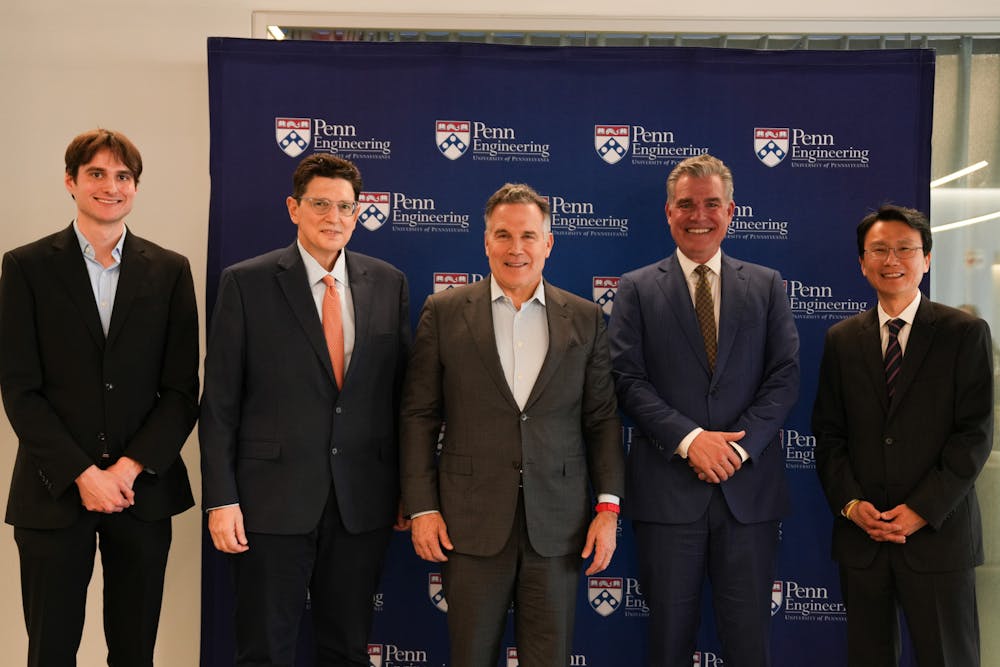
Sen. Dave McCormick (R-Pa.) visited Penn’s Artificial Intelligence-Driven RNA BioFoundry last Friday to highlight the state’s role in biotechnology development.
As part of the May 15 tour, McCormick spoke with researchers and AIRFoundry leadership about new technologies at Penn. The visit comes amid turmoil at the National Science Foundation, the organization that funds the AIRFoundry.
In a statement to The Daily Pennsylvanian, chemical and biomolecular engineering professor and AIRFoundry director Daeyeon Lee wrote that the team was “encouraged” to hear McCormick’s “emphasis on the importance of federal support for research.”
At the event, McCormick said that he wanted the “best people in the world” to be “here in America.” He later added that the United States is in an “existential race” with China over artificial intelligence.
In response to a question from McCormick about differences in the quality of work between the U.S. and China, David Issadore — Penn bioengineering professor and AIRFoundry associate director of research coordination — said that China has “more resources” that allow technologies to be “built at scale.”
Lee spoke to Penn’s work on AI education with George Pappas, an electrical and systems engineering professor and AI program director. He also highlighted the necessity of developing national guidelines.
“Right now, it’s all on us to come up with these things, but some kind of support or guidelines from the federal agencies would be tremendously helpful,” Lee said.
McCormick said the “general consensus” was that AI regulation should happen on the federal level rather than being determined by individual states.
RELATED:
Penn researchers use AI to accelerate RNA drug development
Meet Betty, Penn's newest supercomputer
“If you move too quickly and overregulate, then you lose the innovative lead, but if you underregulate or under give inadequate guardrails, people are left to their own devices,” he added.
At the event, AIRFoundry user facility director Benjamin Davis described the organization’s development of a nanoparticle formulation device that works with lipid nanoparticles and their applications on drug formulation. The technology, he said, would benefit hospitals and scientists, as well as veterinary medicine and agricultural researchers.
“We can screen lots of drugs and drug candidates this way, and speed up research,” Davis said.
Issadore said that combining lipid nanoparticles with robotics allows researchers to “very rapidly” generate “recipes” of particles that could potentially target specific diseases. The data, he said, can then be fed into an AI model to discover new applications of the formulation.
At the event, Lee also noted the AIRFoundry’s work with RNA.
“RNA can save lives — cancer therapy, gene therapy — but it can also help American farmers,” Lee said. “We talked about protecting livestock, crops from heat, disease, pesticides, and reducing reliance on chemicals.”
In his statement to the DP, Lee wrote that the AIRFoundry looks forward to “engaging with various communities to further expand our reach and impact in bringing RNA-based technologies to all fields of biotechnology aided by AI and robotics/automation.”
In March, McCormick visited Penn Medicine alongside National Institutes of Health Director Jay Bhattacharya. The tour was meant to highlight “how NIH-supported research is driving medical progress,” according to a press release.
RELATED:
Penn researchers use AI to accelerate RNA drug development
Meet Betty, Penn's newest supercomputer
Senior reporter Lavanya Mani covers legal affairs and can be reached at mani@thedp.com. At Penn, she studies comparative literature. Follow her on X @LavanyaMani_.


