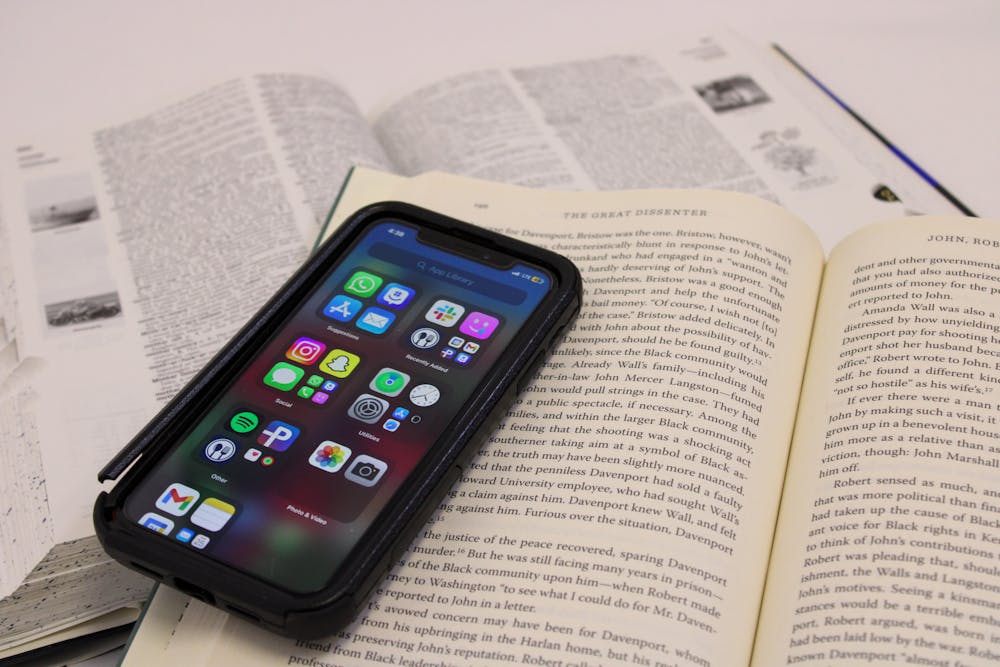
Early findings from Penn research study “Phones in Focus” suggest that stricter policies surrounding cell phone use may contribute positively to student mental health and learning outcomes.
Psychology professor Angela Duckworth, who is known for her research on non-IQ intellectual competencies, heads the research work. Supported by the National Governors Association, the project seeks to help determine policy outcomes surrounding restricting phone use.
In 2025, an increasing number of schools have enacted stricter cell phone policies, according to a report from NPR.
The research team found that “away for the day policies,” in which phones remain completely out of sight during the instructional day, correlate most strongly with improved classroom focus. These results were most commonly seen from elementary and middle schools.
By contrast, classrooms with partial-use policies, which include looser rules like allowing students to have phones on desks for limited use, were more likely to report difficulties with student engagement. This trend was particularly noticeable in high school settings.
According to the research, the “no-show policy,” in which students are allowed to carry phones but must keep them out of sight, performed the worst out of the three. It was also the most common, used by over half of the schools in the sample.
“So far two patterns stand out: The stricter the policy, the happier the teacher and the less likely students are to be using their phones when they aren’t supposed to,” Duckworth said to Penn Today.
Looking ahead, Phones in Focus will continue to collect responses and aim for 100,000 participants before releasing its full set of policy recommendations.
“Our team looks forward to diving deeper and, in longitudinal analyses, establishing how changes in policies over time predict changes in outcomes like attendance and academic performance,” Duckworth added.
Maryland Gov. Wes Moore is the vice chair of NGA.
“We can’t afford to ignore what educators are telling us,” Moore said to Penn Today. “This survey makes it clear that the people closest to our students are sounding the alarm about the impact of phones in the classroom — and they’re pointing us toward solutions that work.”
Staff reporter Saanvi Ram covers science and health and can be reached at ram@thedp.com. At Penn, she studies health and societies. Follow her on X @Saanvi_vivi.