It had to get worse before it got better for the Red and Blue.
On Saturday, Penn women’s basketball fell to Harvard, 53-42, extending its losing streak to three in Ivy League play. Penn (10-6, 0-3 Ivy) started 0-3 in conference play for the first time since 2010, Mike McLaughlin’s first season as head coach.
Here’s where Penn struggled and what Harvard (9-7, 2-1 Ivy) did well on Saturday, resulting in the Quakers’ loss to the Crimson.
An ineffective full-court press
The game opened with fiery adrenaline.
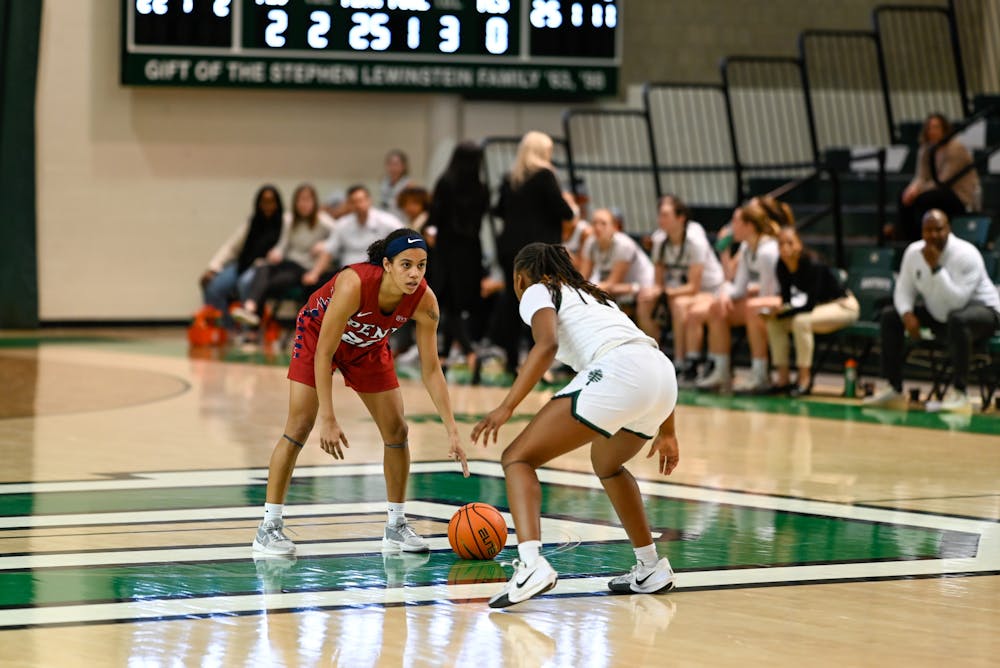
From the get-go, the Quakers applied a full-court press that stifled the Crimson’s early scoring. Penn held Harvard to 3-13 in field goals and 1-3 from the three-point line in the first quarter. Penn led by 10, their largest lead of the game.
However, this defensive presence quickly dissipated, and so did Penn’s lead. In the second quarter, the Crimson countered with a press of their own, and the noticeably exhausted Quakers struggled to respond. Harvard outscored Penn 12-2 in the second quarter and 22-12 in the third quarter.
“We didn’t respond great,” coach McLaughlin said in a press conference. “We had some transition opportunities that we didn’t take advantage of. It’s just a question, maybe too many dry spells, you know, that made the difference in the game.”
Although the Quakers showed flashes of defensive energy in the beginning of each quarter, it ultimately was not enough to spark a scoring run.
Two points scored in the second quarter
Penn’s overall offense in this game can be explained through one quarter — an offense that scored only two points in the second quarter. The Quakers went 15-55 from the field and 5-21 from the three-point line as a collective team. Penn ended with a total score of 42 points, a stark drop from the 74.4-point average in Penn’s last two previous Ivy League games.
“You know, missing not good shots is never a good thing. I didn’t think we had great shots in the basket … we had opportunities. We did miss a couple of tough ones,” McLaughlin said.
Accumulated turnovers and missed layups resulted in several scoreless droughts in the second and third quarters, ultimately decided Penn’s fate.
“We scored like two points in about 11 minutes and that’s a tough one,” he said.
Harvard’s physicality
Although the Quakers seemed intent on protecting the paint throughout the game, their dwindling defense led to the Crimson attacking the basket more frequently. Harvard’s physicality in the paint helped them generate free throws, while Penn struggled to convert field goals and three-pointers in the final two quarters. Harvard went perfect from the free-throw line, making all 13 attempts.
“Credit to them, they applied pressure really well,” junior guard Mataya Gayle said. “But I think we kind of got away from our principles, and that showed in our efficiency.”
“It’s not where anyone wants to be, but this team’s got a lot of basketball to go. Monday is really vital for this program to get where we need to go, and we’ll respond,” McLaughlin said.
The Quakers did, in fact, manage to turn it around.
In their second game of the weekend’s doubleheader, the Quakers were finally able to find their footing in Ivy League play as they beat Dartmouth 67-59. Both teams were seeking their first conference win of the season heading into the matchup, and it was a strong team effort that allowed the Quakers to pull through.
Below is what the Quakers showed against the Big Green (9-8, 0-4 Ivy).
A must-win mentality
McLaughlin said on Saturday that Monday’s game would feel like a must-win, and he certainly managed to instill that mentality in his players. From tip-off to the final buzzer, the Quakers put their heart into every minute of the game.
It was an intense game from the get-go, and several players for the Red and Blue ended up on the floor hustling for the ball at some point during all four quarters. The Quakers went the extra mile for this win, showing aggression in their full-court press and putting up six forceful blocks compared to the Big Green.
“If you’re good at [basketball], you have to play that way,” McLaughlin said. “It would have been a huge uphill battle to not have a win after four games, and we all know that, so I’m glad we played well against a good Dartmouth team.”
Four players, four unique strengths
The Quakers who scored more than 10 points had their roles cut out for them Monday. For Gayle, that meant running the full court to make a layup when she had the chance, driving through the Dartmouth defense, and kicking the ball out to wide-open senior guard Simone Sawyer for a three-pointer a few minutes later.
Sawyer, in turn, was perfect from the three-point line until the last two minutes of the game, four of five shots from beyond the arc, a substantial part of her 15 total points.
“I haven’t shot great the past few games, so it felt good to just keep shooting, and the confidence kind of came back for me,” Sawyer said.
Meanwhile, junior center Tina Njike had her third double-double of the season, scoring a team-high 16 points and grabbing 13 rebounds. Six of those were offensive rebounds, highlighting her key role in the Quakers’ offense.
Sophomore forward Katie Collins rounded out the quartet as one of the most impactful defensive players on the team. It took her a while to start scoring, but at the beginning of the fourth quarter, she scored six points in quick succession — the only field goals for the Quakers over a four-minute stretch.
“I know numbers are what they are, but we wouldn’t have the success right now without Katie on the floor as much as she is,” McLaughlin said.
The full-court press works for the Quakers
Starting midway through the first quarter, Penn employed a full-court press, at times successfully trapping the Big Green in their own half. Even as the minutes dwindled in the fourth quarter, the Quakers rarely let up, squashing a late-game effort that cut the margin to two possessions.
In the second game of the weekend doubleheader, that physical and mental intensity was an impressive feat, which ultimately set the Quakers apart from Dartmouth.
The Quakers will take on Yale on Saturday, Jan. 24, in New Haven, Conn., a battle of two teams with the same conference record.