
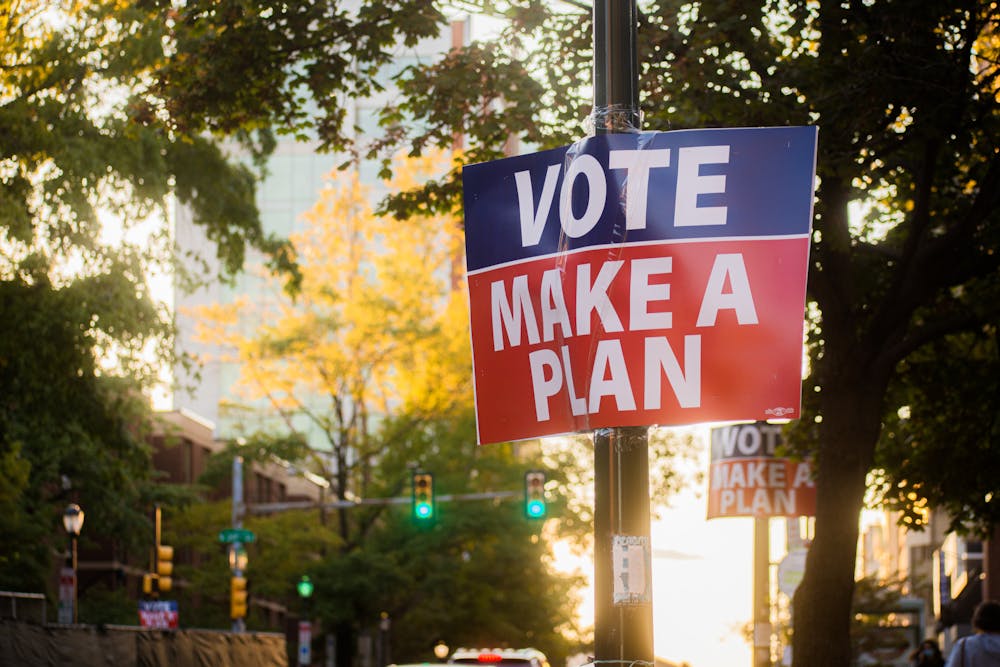
Ahead of Election Day, The Daily Pennsylvanian has compiled a comprehensive ballot guide to all of the candidates on the state and municipal ballots, along with where you can go on campus to vote for them on Tuesday, Nov. 4.
Registering to vote and mail-in ballots
The deadline to register to vote has already passed, but voters can check their registration status here.
The mail-in ballot request deadline has also passed. Registered mail-in voters can track their ballot here. Mail-in ballots must be received — not postmarked — by the voter’s county election office at 8 p.m. on Election Day.
Polling locations
Voters can cast their ballots on Penn’s campus from 7 a.m. to 8 p.m. on Nov. 4.
Students living in Kings Court English, Lauder, and Hill College Houses, as well as Domus and Sansom House East and West, can vote in ARCH Room 108.
Quad and Stouffer Hall in Stouffer College House residents can vote in the Reading Room at Houston Hall.
RELATED:
Who runs Penn? Here are 10 administrators defining the University’s future
Phila. City Commissioner emphasizes importance of voting ahead of upcoming election at Penn event
Residents of Harnwell, Gregory, Harrison, Rodin, Du Bois, and Gutmann College Houses; Mayer Hall in Stouffer College House; and the Axis, The Chestnut, the Radian, Chestnut Hall, Hamilton Court, The Hub on Chestnut, and 3737 Chestnut can vote in Bodek Lounge in Houston Hall.
Students living in The Simon at Founder’s Row can vote at Paul Robeson High School, which is located at 4125 Ludlow St.
Members of the Penn community living in off-campus housing can check the location of their polling place here.
Races on the ballot
Philadelphia District Attorney
The district attorney race has unfolded in a highly unusual rematch. Pat Dugan is running across party lines against incumbent Larry Krasner.
Krasner first beat Dugan in May 2025 in the Democratic primaries. The race — which had seemed to be an uncontested reelection for Krasner — was stymied when Dugan secured the Republican nomination through write-in votes, setting up a rematch on the Nov. 4 ballot.
The District Attorney’s Office prosecutes crime in Philadelphia and works with local, state, and federal law enforcement to ensure that the city’s laws are upheld and citizens are protected.
Krasner is coming off his second four-year term. During his tenure, Krasner ended cash bail for most nonviolent offenses, prioritized treatment over incarceration, and created the Conviction Integrity Unit, which has exonerated over 30 wrongfully convicted people.
His reforms have faced criticisms, which culminated in an impeachment vote in the Pennsylvania House of Representatives in 2022, though the Pennsylvania Supreme Court later dismissed the proceedings.
Krasner has regularly used his platform to condemn 1968 Wharton graduate and President Donald Trump’s administration, and he recently promised to use legal means against the president if the National Guard is deployed to Philadelphia.
Dugan previously served on the Philadelphia Municipal Court before stepping down in 2024 to run for district attorney. He is best known for establishing Philadelphia’s Veterans Court, which offers rehabilitation and alternative sentencing for charged veterans.
His platform proposes a reorganization of the District Attorney’s Office into six regional divisions, with each division staffed by a corresponding prosecutor. Although Dugan is running under the Republican ticket, he considers himself an “independent Democrat.”
Philadelphia City Controller
Incumbent Democrat Christy Brady is running against Republican Ari Patrinos for city controller. The role involves conducting audits independent of the Office of the Mayor and Philadelphia City Council to provide information about the city’s finances.
Brady has served as city controller for three years and worked in the Office of the City Controller for the past 30 years, during which she was known for audits investigating the Philadelphia Department of Licenses and Inspections. She also uncovered a lack of employment documentation at eight construction sites around the city, preventing employees from proper workplace benefits and uncovering possible contractor tax evasion.
For her next term, Brady’s primary areas of focus are on the underground economy, gun violence, and the opioid and drug crisis.
Patrinos built his career in the New York financial sector before returning to his hometown of Philadelphia to teach math and history and write for local publications. He decided to run for city controller to ensure taxpayer money is used more efficiently to provide basic services like safe streets and high-quality education.
Races for the Philadelphia judge of elections and inspector of elections will also be on the Nov. 4 ballot. Candidates running for these positions in every division of Philadelphia can be found here.
Judicial retention
This November, five Pennsylvania judges are up for retention. After 10-year terms, all Pennsylvania Supreme Court, Superior Court, and Commonwealth Court judges seek reelection through retention elections.
For their first terms, candidates run as members of political parties. However, candidates running for retention do so in a nonpartisan capacity — with voters offered the options of “yes” or “no” on their ballot.
If a majority votes yes, the judge is reelected. If a majority votes no, Pennsylvania Gov. Josh Shapiro will appoint a temporary replacement that the Republican-majority Pennsylvania State Senate must vote to approve. If the state Senate decides not to approve Shapiro’s appointment, the seat will remain vacant until 2027.
Supreme Court of Pennsylvania
Seven justices serve on the Supreme Court of Pennsylvania. Currently, the bench has a 5-2 Democratic majority. On Nov. 4, voters will determine retention for three Democratic justices, and with these three spots up for grabs, Pennsylvania Republicans are looking at an opportunity to flip the court.
If the three Democratic justices are not reelected and Shapiro's appointments are blocked by the state Senate, Pennsylvania’s Supreme Court will remain in an ideological stalemate with two Democrats and two Republicans. Voters will not be able to elect judges to the state Supreme Court until November 2027.
The race has garnered concerns about the repercussions of a stalemate court ahead of the 2028 presidential election.
Historically, justices retain their seats. In Pennsylvania history, only one statewide judge has lost a retention election. However, Democrats have expressed worry this November as leading Republicans are speculated to be pouring money into judicial campaigns, urging people to vote “no” on retention.
The first judge up for retention is Christine Donohue, who was elected to the court in 2015. Donohue, who is currently 72 years old, will have to step down in 2027 even if she is reelected due to the court’s retirement age of 75.
Donohue started her career as a civil trial litigator before serving on the Superior Court of Pennsylvania for eight years. During her time on the state Supreme Court, Donohue upheld lockdowns during the COVID-19 pandemic and was part of the court’s unanimous vote to uphold the results of the 2020 presidential election.
Her retention is recommended by the Pennsylvania Bar Association, and she is backed by several local labor unions and Democratic leaders.
Kevin Dougherty was also elected to the Pennsylvania Supreme Court in 2015. Since then, he has worked on a behavioral health initiative that aims to reform how state courts respond to people with mental health disorders and substance abuse problems.
In a more contentious ruling, Dougherty joined the court’s two Republican justices in deciding that mail-in ballots need to be dated, and that this requirement is not in violation of the Civil Rights Act of 1964.
Dougherty comes recommended by the Pennsylvania Bar Association.
The last judge up for retention is David Wecht, who was elected in a 2015 Democratic sweep. Wecht’s campaign leans on his record of preventing gerrymandering and protecting access to abortion.
While on the state Supreme Court, Wecht authored the overturn of Bill Cosby’s sexual assault conviction. In 2024, he joined Republican justices in arguing that provisional ballots should not be counted.
Wecht has received endorsements from Nurses for America and the Fraternal Order of Police, and he is recommended by the Pennsylvania Bar Association.
Superior Court of Pennsylvania
One of Pennsylvania’s intermediate appellate courts is the Superior Court of Pennsylvania, which hears cases before they move to the Supreme Court of Pennsylvania. The court primarily considers appeals on criminal and civil cases.
Democrat Alice Beck Dubow — who graduated from the College of Arts and Sciences in 1981 and the University of Pennsylvania Carey Law School in 1984 — is the one state Superior Court judge up for retention this year. Beck Dubow was elected to the state Superior Court in 2015 after a 20-year career that included serving as general counsel for Drexel University.
In her first term, Beck Dubow ruled that a speeding driver who killed three people should be resentenced to life in prison, and a former school police officer who sexually assaulted four students should also serve life in prison.
The Pennsylvania Bar Association recommends Beck Dubow’s retention.
Commonwealth Court of Pennsylvania
Pennsylvania’s Commonwealth Court is the second intermediate appellate court and is made up of nine judges who preside over civil actions brought against the commonwealth.
The court currently has five elected Republican judges and three elected Democrats, leaving one spot open.
Stella Tsai, a Democrat and 1988 Penn Carey Law graduate, has served on the Philadelphia Court of Common Pleas since 2016. Since then, she’s served in several divisions and presided over cases involving medical malpractice, election candidacy challenges, and disputes over trusts and estates.
Previously, Tsai worked as a private practice attorney and oversaw child welfare and social service cases in the City of Philadelphia’s Law Department.
Tsai is highly recommended by the Pennsylvania Bar Association and is backed by several labor and education unions.
Republican Matt Wolford worked in the state Attorney General’s Office and the state Department of Environmental Protection before opening his own law firm in 1999. Wolford now works for private-sector clients including landowners seeking advice on oil and gas leases and energy companies that need help with environmental compliance.
Wolford comes highly recommended by the Pennsylvania Bar Association and is backed by Gun Owners of America, law enforcement groups, state Republican leaders, and Conservative Latinos PA.
Democrat Michael Wojcik is also up for a retention vote after his first 10-year term. He is best known for a 2023 ruling — which reversed his previous opinion — asserting the court lacked jurisdiction to decide whether the state House’s four impeachment articles against Philadelphia District Attorney Larry Krasner were constitutional.
Wojcik’s retention is recommended by the Pennsylvania Bar Association.
Philadelphia Court of Common Pleas
The Philadelphia Court of Common Pleas is divided into three divisions responsible for criminal cases, domestic and juvenile relations, and the orphans’ court. In Philadelphia, the court is composed of 101 judges. This election, 11 judges are running for their first terms, and 13 are up for retention.
The candidates for election — who are all Democrats — are Will Braveman, Sarah Jones, Deborah Watson-Stokes, Kia Ghee, Irina Ehrlich, Larry Farnese, Leon King II, Brian Kisielewski, Anthony Stefanski, Joseph Russo, and Jennifer Santiago.
All candidates are recommended by the Philadelphia Bar Association except Russo, who declined to participate in the review process.
The candidates for retention are Gwendolyn Bright, Ann Butchart, Scott DiClaudio, Michael Fanning, Daine Grey Jr., Christopher Mallios, Walter Olszewski, Frank Palumbo, Rainy Papademetriou, Tracy Roman, Stephanie Sawyer, Susan Schulman, and Lyris Younge.
The Pennsylvania Bar Association has recommended all candidates for retention except Grey, who was not recommended, and DiClaudio, Palumbo, and Younge, who declined to participate.
Philadelphia Municipal Court
The Philadelphia Municipal Court is composed of 27 judges divided into three divisions. The Criminal Division tries adult criminals carrying a sentence of incarceration of five years or less; the Civil Division deals with small claims cases, landlord and tenant disputes, and real estate and tax cases; and the Traffic Division adjudicates traffic violations.
The candidates for election — all Democrats — are Amanda Davidson, Sherrie Cohen, Cortez Patton, and Michael Parkinson.
Davidson and Parkinson were recommended by the Pennsylvania Bar Association, while Cohen and Patton were not.
The candidates for retention are David Conroy, Jacquelyn Frazier-Lyde, Henry Lewandowski, Wendy Pew, and T. Francis Shields.
All candidates were recommended for retention by the Philadelphia Bar Association except for Frazier-Lyde.
Staff reporter Ishani Modi covers state and local politics and can be reached at modi@thedp.com. At Penn, she studies biochemistry.


