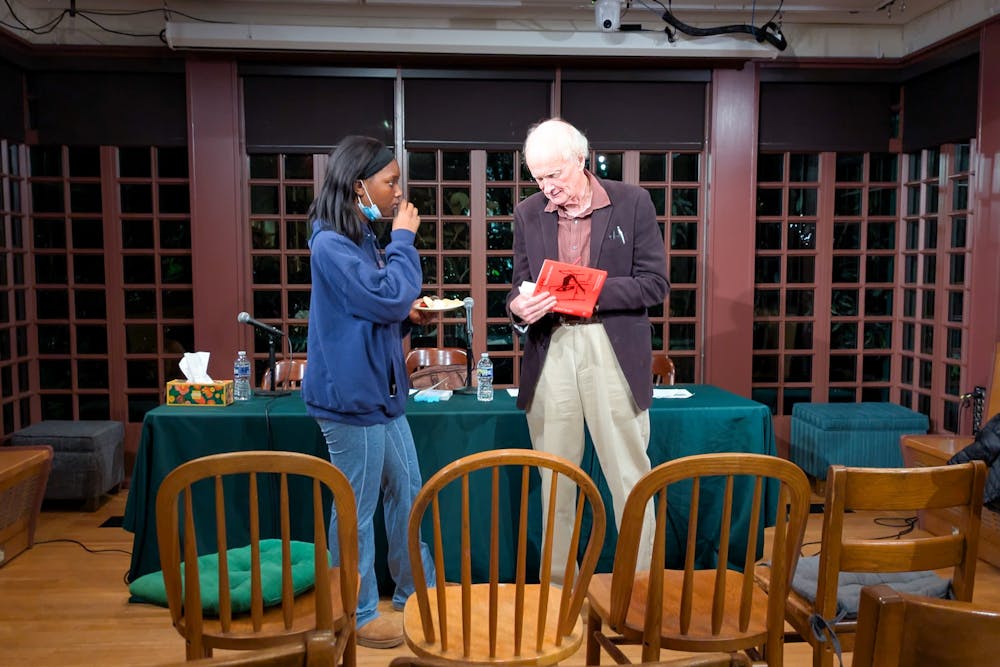
On Nov. 5, the Kelly Writers House hosted a conversation with translator Mark Harman about his new translation of Franz Kafka’s “Selected Stories.”
The event consisted of Harman discussing the process of translation, reading of excerpts from his book, and a conversation with English professor Jean-Michel Rabaté and German and comparative literature professor Liliane Weissberg. Harman then took questions from the audience before the event concluded with a reception and book-signing.
At the event, Harman detailed how he discovered Kafka while he was an undergraduate student reading “The Castle.” While he first read the translation in English, he began translating the stories himself as his German progressed.
“One of my goals in [previously] translating two novels of Kafka and [“Selected Stories”] has been to craft readable English, while retaining at least some of the subterranean strangeness of his German,” Harman said at the event, adding that he aims to “bring out the visceral quality in Kafka's writing.”
Beyond the text itself, Harman highlighted the value of reading Kafka aloud, recalling how Kafka would read his own stories to his sisters and friends. Standing up in front of the audience, Harman read from “Wish To Become an Indian,” “The Transformation,” “A Country Doctor,” “An Imperial Message,” “A Report for an Academy,” and “Little Fable.”
“[There is] variety in Kafka and the variety of moods and tones,” Harman said. “I tried to give a sense of the variety because people tend to stereotype—you know, the ‘Kafkaesque.’ He’s so varied, how can you bring him to just one term?”
Rabaté, who teaches the course “Modernisms and Modernities: Kafka, Joyce, Beckett” at Penn and has written a book about Kafka, praised Harmon’s work.
“It begins with a relatively substantial biography, with original images, photographs and so on, annotations that are relatively detailed and new,” Rabaté said of the book during the event, which he also called the “best [translation] in a long time” in an interview with The Daily Pennsylvanian.
While Rabaté had previously allowed students to select any translation they wish, he stated that Harman’s new translation will become his go-to.
“What is special is that Mark knows Kafka extremely well … and he understands this mixture of horror and humor that is so particular in Kafka,” Rabaté added.
Wharton first-year Ph.D. students Aimee La France and Susan Wang attended the talk as part of an assignment on "qualitative research methods” where they were tasked to “find a public space on campus and sit and observe.”
La France commented on how Harman's readings prompted her to make connections to her previous background in reciting poetry.
“[You] take something that already has a specific meaning and then you’re being this vessel so that it’s understood by others,” La France said. “You have to be really careful in your craft in terms of what you emphasize, what you take away, [and] what you add.”