

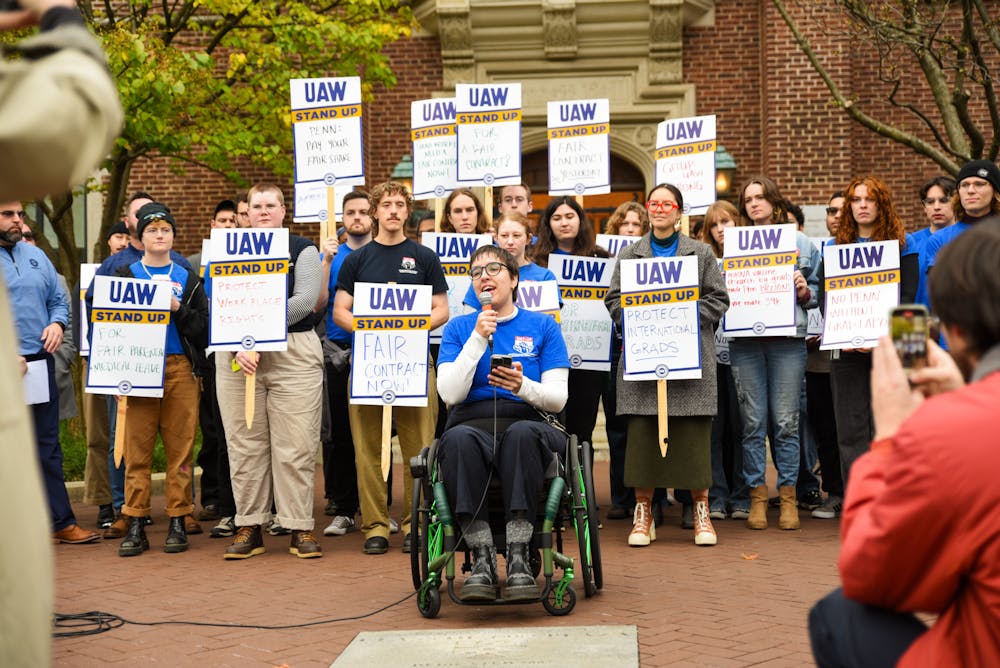
Graduate Employees Together — University of Pennsylvania hosted a press conference on Monday with local elected officials to formally announce its strike authorization vote.
The Nov. 3 event was the latest effort by GET-UP to rally graduate workers across the University in favor of contract negotiations. If the strike authorization vote — which will be conducted from Nov. 18-20 — passes with a two-thirds majority, GET-UP’s bargaining committee will have the authority to call a strike at any time.
During the press conference, Katelyn Friedline — a second-year Ph.D. student and GET-UP bargaining committee member — cited “needless delays and insulting offers” from Penn’s administration as the rationale for holding the authorization vote.
GET-UP’s economic proposals have included pay increases to match a living wage, comprehensive vision and dental coverage, health insurance for dependents, childcare benefits, retirement contributions, and access to employee benefit programs.
During the union’s bargaining sessions on Oct. 28, Penn provided counterproposals on various economic articles, including compensation and healthcare. In its response, according to Friedline, Penn proposed raising the minimum stipend for graduate workers from $39,425 to $43,000.
Friedline emphasized the union’s disappointed reaction to this counterproposal.
“Just last week, Penn admin finally responded for the first time to the economic articles that we proposed in the beginning of June,” Friedline said. “Their initial offer was an insult to the workers that perform the bulk of the teaching and research labor that Penn relies on to fulfill its academic missions.”
In an Oct. 30 post on Instagram, GET-UP wrote that “most graduate workers already make more” than Penn’s proposed stipend, adding “is not an improvement on the status quo.”
A University spokesperson wrote to The Daily Pennsylvanian that Penn administrators have been “bargaining in good faith” and “believe that a fair contract can still be achieved … without a work stoppage.” The spokesperson added that “first contracts typically take over a year to negotiate.”
RELATED:
RAPUP launches bargaining campaign, discusses initial demands for Penn at community meeting
Allied Universal security officers rally across Philadelphia ahead of potential strike
“We appreciate the progress so far and hope the union will continue constructive negotiations,” they wrote.
Beyond economic proposals, negotiations have also continued over protections for international students, which Friedline emphasized as “especially important amidst a national anti-immigrant political climate.”
“Penn must do better by the workers that ensure its continued success,” Friedline added. “Penn only works because we do.”
Representatives from United Auto Workers, which represents GET-UP, attended the press conference in support of the union.
Wence Valentin — the political director of UAW’s Region 9, which includes most counties in Pennsylvania, New York, and New Jersey — emphasized UAW’s “solidarity” with graduate workers at Penn.
“No one dedicating their life to education and research should have to struggle just to pay rent,” Valentin stated.
At the conference, graduate workers were also joined by city councilmember Jamie Gauthier, state Sen. Nikil Saval (D-Philadephia), and Pennsylvania state Rep. Rick Krajewski (D-Philadelphia).
“Penn loves to call itself world class,” Gauthier said. “But you cannot declare yourself a world-class institution if you don’t treat the workers that power your success in a world-class way.”
Saval also expressed his support for the union and its effort, referencing his own experience as a graduate student worker.
“Once a graduate worker and a teacher and researcher myself, I know personally both the sacrifice and the beauty that such labor entails,” Saval said. “I also know the bullshit that we get from the administration … time and time again.”
Krajewski criticized Penn’s unwillingness to use its endowment to meet GET-UP’s proposals. He characterized the University’s current situation as an “emergency” due to the action of 1968 Wharton graduate and President Donald Trump’s administration and the lack of a “livable wage” for graduate student workers.
“You’re sick and tired of being nickeled and dimed by a university that has $22 billion in an endowment — and yet, again and again, excuses,” Krajewski said. “After a while, you start to ask yourself: Is this a university, or is this a corporation?”
The union first announced its intention to hold a strike authorization vote at an informational picket on Oct. 12. During the event, GET-UP representatives encouraged graduate workers to start pledging to authorize a strike. By pledging, graduate workers declared that they would vote to strike if an official vote were to be held.
In response to the initial strike pledging, the Office of the Vice Provost for Education issued a memo which gave guidance to department chairs in the event of a strike. These recommendations were designed to “maintain teaching continuity” should teaching and research assistants withhold their labor.
Penn’s chapter of the American Association of University Professors described these guidelines at the time as “strikebreaking” and independently issued a list of recommendations to help faculty members support the graduate workers if they participate in a work stoppage.
“It is a frustrating memo for Penn to have put out, considering that they still have plenty of time to meet us at the table and give us a contract that we deserve before going on a strike,” Friedline said in an interview with the DP. “They have every option to avoid this.”
RELATED:
RAPUP launches bargaining campaign, discusses initial demands for Penn at community meeting
Allied Universal security officers rally across Philadelphia ahead of potential strike
Senior reporter James Wan leads administration reporting and can be reached at wan@thedp.com. At Penn, he studies communication and computer science. Follow him on X @JamesWan__.


