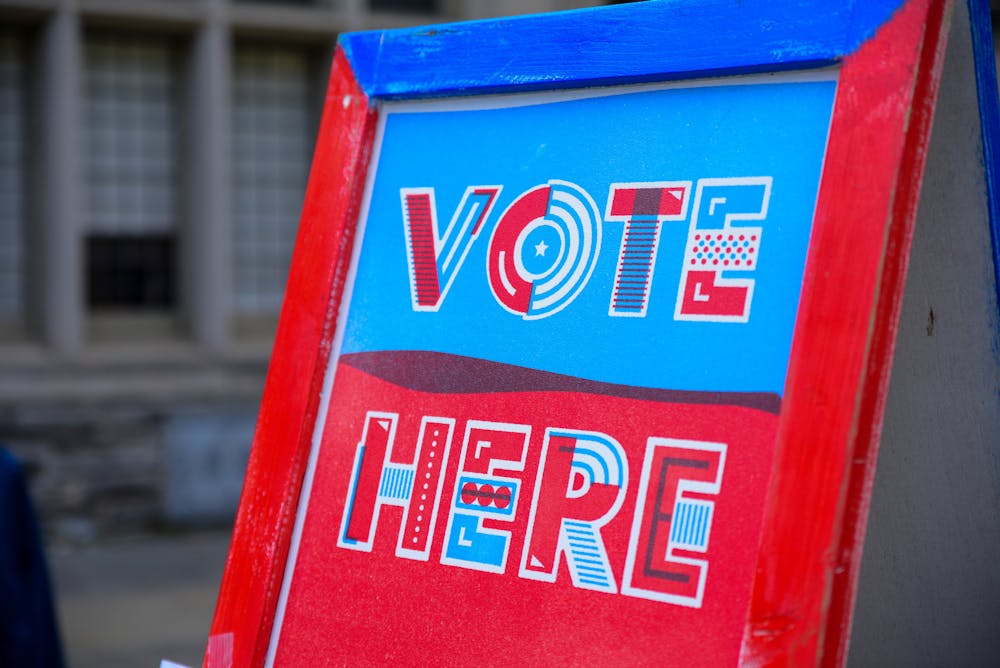
This isn’t a presidential election year, and it’s not even a midterm congressional election year, so voting isn’t front of mind for many people. But this November, there’s a critically important election happening right here in Pennsylvania, and it’s vital that you not sit this one out. Three justices on the state Supreme Court are vying to retain their seats, and the outcome of the election could affect the balance on the state’s highest court. The federalist design of our Constitution means that some of the most important legal decisions are reserved for the states, and unless an issue of federal law is involved, the Supreme Court of Pennsylvania has the final word when interpreting both state legislation and Pennsylvania’s own state constitution. So, who sits on the state’s highest court matters a great deal.
Our political culture tends to overemphasize national politics. We pay much more attention to elections for president than elections for governor or mayor. More Americans can name their Senators and representatives in Congress than their representatives in the state legislature. And in states like Pennsylvania, where judges appear on the ballot, judicial elections are often bewildering — even for legal and political junkies.
For newer voters, the very fact of voting for judges can feel like an anomaly. Of course, federal judges are appointed by the president and confirmed by the Senate; they don’t run for office. And practice in the states varies widely when it comes to judicial selection. Just across the river in New Jersey, for example, almost all state judges are appointed by the governor and confirmed by the state Senate, a process similar to the appointment of U.S. Supreme Court justices. Here in Pennsylvania, though, state judges, including justices on the Supreme Court of Pennsylvania, run for elected office (or are sometimes appointed by the governor to fill existing vacancies). Once elected or appointed, the justices appear on the ballot for “retention” every ten years. This means they stand unopposed for a yes/no retention vote.
Typically, these are uncontroversial affairs. But there’s more interest than usual in this round of judicial elections in Pennsylvania, likely because the partisan balance of the Court is at stake. In some states, judicial elections are nonpartisan (that is, judges do not affiliate themselves with a party). But here in Pennsylvania, state judicial elections are partisan, so judicial candidates appear on the ballot as members of a political party. And in this November’s election, the three justices standing for retention are all Democrats. If they lose, the state high court would shift from 5-2 Democratic composition to a 2-2 tie. Although Governor Josh Shapiro could in theory appoint justices to fill those vacancies, the appointments would require a supermajority vote in the state Senate, which there’s no guarantee they’d get confirmed. For months, the governor and legislature have been at an impasse in negotiations over a budget bill.
The possibility of both shorthandedness and deadlocks on the state high court could be disastrous. In recent years, the Court has handed down a number of consequential decisions. The Court has ruled against both partisan gerrymandering (which involves the redrawing of political boundaries to increase the power of one political party) and efforts to restrict voting rights, including around recent federal elections. We know that when the composition of state Supreme Courts change, those results can sometimes change – something that was on stark display when a change in the membership of the Supreme Court of North Carolina led to that court’s decision to revisit rulings striking down partisan gerrymandering and voter ID requirements, among other things. North Carolina then created one of the most heavily gerrymandered maps in the country.
The majority of the Supreme Court of Pennsylvania has also voted to protect reproductive rights under the state Constitution — coming to a different conclusion than the U.S. Supreme Court did in Dobbs v. Jackson Women’s Health Organization, which in 2022 overruled Roe v. Wade and held that they federal constitution does not protect the right to terminate a pregnancy. A differently composed state Supreme Court could revisit that question.
In this election, the nonpartisan Pennsylvania Bar Association recommends “Yes” votes for all three Supreme Court justices. Ballotpedia is also one objective source to get more information about each of them, and of course, we urge everyone to make up their own minds! What is most important is to engage in the political process if you are a citizen and exercise your right and responsibility to vote.
Other judges are on the ballot too, including a judge on the Commonwealth Court up for retention, and an open seat on that same court. So are important Philadelphia government positions such as City Comptroller. Probably the other most consequential choice involves a challenge to Larry Krasner, Philadelphia’s incumbent Democratic District Attorney. The outcome of that election could make an important difference in law enforcement in our city. Who serves as District Attorney would likely affect, for example, how the Philadelphia police and justice system respond if President Trump decides to send the National Guard or the military into Philadelphia, perhaps in ironic conjunction with the semiquincentennial (250-year) celebration of the Declaration of Independence this summer.
The news out of Washington, D.C. can be overwhelming: the federal government is in a shutdown, increasingly aggressive immigration enforcement is affecting families as well as students across the country, and the National Guard and even the military have been deployed in United States cities. But there’s something close to home you can do right now to play a part in the shape of our democracy. Don’t miss your chance.
Head to Penn Leads the Vote for more information on how to register (once again, the deadline to register to vote in this election is Oct. 20) and vote.
ERIC ORTS is a Wharton professor of legal studies and business ethics. His e-mail is ortse@wharton.upenn.edu.
KATE SHAW is a Penn Carey Law professor of law and a contributing opinion writer at The New York Times. Her e-mail is kateshaw@law.upenn.edu.