Free speech has always been at the heart of universities, from the medieval disputations of the University of Oxford to the modern lecture halls of the United States. A university is strongest when it allows ideas to clash freely without fear of political reprisal. College students, given their general disposition toward an inflated sense of self-importance more than the average individual’s, have often led the charge for changes deemed incompatible with the emerging values of the next generation.
Penn’s campus has seen its fair share of protests, including the 1969 College Hall sit-in protesting the University’s plans to expand the University City Science Center, the mass protests during the Vietnam War, and the series of protests over race relations that have been present since the ’60s. Previous uprisings, as well as recent, have been pivotal in establishing Penn’s free speech reputation: a distinction in decline.
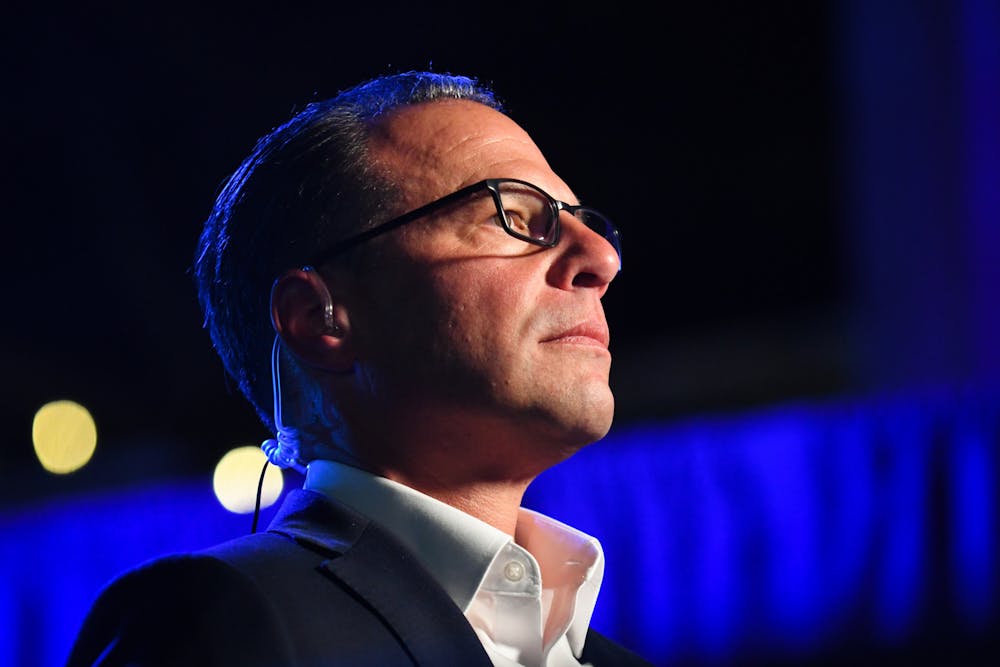
A recent report authored by University of Pennsylvania Carey Law School graduate and the Foundation for Individual Rights and Expression’s Government Affairs counsel Michael Hurley raises concerns about Pennsylvania Gov. Josh Shapiro’s decision to dispatch a surrogate — who occupies the nonvoting observer seat allocated to the governor under an archaic Penn statute — to the University’s Board of Trustees. Hurley warns that, if handled badly, this move could “risk turning private universities into de facto extensions of the state — undermining both academic freedom and the First Amendment itself,” thereby mortally wounding one of the core qualities of the college experience — free expression.
The governor’s actions were not wrong, per se, given the polarization of the current political climate. Some restraint might be advised, but rather, the problem is with the dangerous precedent this could set for Penn’s free speech policy. Even if Shapiro does not make any moves during his term to suppress free speech here on campus, this doesn’t mean his successor, either conservative or liberal, will share this self-restraint. By intervening, the governor is essentially cracking open Pandora’s box and sending a message to future governors that putting their finger on the scale is acceptable.
The state of Pennsylvania, in recent years, is as purple as they come. In 2024, the U.S. Senate race was decided by under 30,000 votes, 1968 Wharton graduate and President Donald Trump only carried the state by 1.71%, and control of the state House of Representatives came down to 496 votes in a northeast Philadelphia district. This means it could be entirely possible that orders out of Harrisburg, Pa. could change every four years as voters swing back and forth on the political pendulum.
The inconsistencies in the governor mansion’s ideological leanings would prove detrimental to free speech here at Penn. If students and faculty were subject to a completely new standard of free speech regulation every four years, the campus would be thrown into chaos. One year, individuals could lose their jobs for using gendered language. The very next, they might be barred from discussing questions of race or identity altogether. Under such a regime, every member of the Penn community would be ensnared in a catch-22, unsure of which views are even acceptable to espouse.
A college education was always meant to challenge your preexisting notions of right or wrong, to make you enlightened. If you go four years without ever having a moment where you question your logic, you’re doing something wrong.
Shapiro’s current efforts may have stopped at securing the premise and maintaining a safe environment for all students to study here at Penn, but the same may not be true for his successor — or their successor, for that matter. If Penn’s free speech future rests on the state making the right call and electing a responsible philosopher king every four years, it’s a pretty big gamble for such a pivotal issue. To safeguard speech is to safeguard democracy itself; if the University falters here, the nation will follow.
EDEN LIU is a College sophomore from Taipei, Taiwan studying philosophy, politics, and economics. His email is edenliu@sas.upenn.edu.

Eden Liu is a College sophomore studying philosophy, politics, and economics from Taipei, Taiwan. His column focuses on civil engagement and University policy. He can be reached at edenliu@sas.upenn.edu.