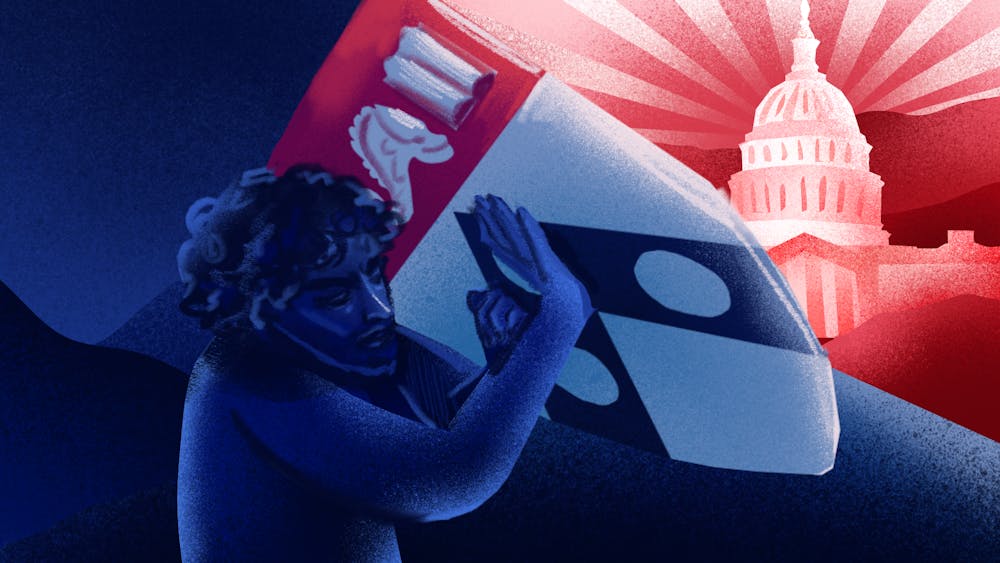
On Sept. 8, the Supreme Court of the United States overruled a lower court’s order that prevented federal agents from stopping and questioning individuals “about their immigration status based solely on factors like their ethnicity.” These factors included flagging down individuals speaking English with an accent and individuals who are heard speaking Spanish. Throughout my time at The Daily Pennsylvanian, I have expressed the importance I associate with speaking my first language. Since then, the weight of said importance has only grown.
Once, I was talking to my father on the phone when I was stopped by a woman who asked if I was speaking Spanish. After I said yes, she told me she was Puerto Rican and expressed how she rarely hears the language on campus. She was happy to learn that there was a thriving Latine community at the University. For that brief moment, our shared language brought us together, which brightened my entire day.
Moments like these are crucial when a plethora of recent policies (including the aforementioned Supreme Court decision) have created an environment that breeds fear for ethnic minorities — particularly impressionable students. These worries are not ill-founded. U.S. residents have been wrongfully deported, and such grave decisions have been reduced to “administrative errors,” showcasing that there is, unfortunately, good reason to be concerned.
For example, a friend of mine was nearly denied entry to her domestic flight due to her Puerto Rican ID (and, to save you the Google search, this was prior to the federal law change earlier this year). Moreover, parents have advised us to actively carry our passports to class due to the risk of being questioned. These are just a few key examples, but be aware that there are numerous instances such as these that demonstrate the biases targeting Latines.
More importantly, notice I present these examples as a U.S. citizen myself. The fear is exponentially worse for Latine students on visas. I have friends who are worried to go out, worried about future job offers because of the decrease in visa sponsorship by employers (with new petitions for H-1B visas requiring a $100,000 fee), et cetera.
For students already adjusting to a completely different culture, the additional concern of being questioned worsens Latine students’ abilities to feel a sense of belonging on campus. While earlier in April the University updated students on student visa terminations, new orders and policy initiatives exacerbate anxieties. Considering this, the University should, at the very least, further prioritize fostering a safe environment for concerned students. The University’s failure to act would not only continue to breed fear among Penn’s community but would also actively disincentivize potential students from applying. If Penn benefits from students’ accomplishments (whether that be by maintaining its graduation rate, retention rate, or post-graduate success) and wishes to continue doing so, it must establish measures that make its students feel safe, beyond an FAQ page.
Penn, along with various universities and colleges across the nation, is overflowing with intelligence and creativity from Latine students — genius that is actively being stifled by the danger presented by deportations and the increasing requirements that may be imposed to acquire U.S. citizenship.
You may justifiably question why I, as a U.S. citizen, am the one writing this piece. The answer is tied to the fear I am actively discussing. With policy decisions actively placing obstacle after obstacle in the process of naturalization, students who aim to eventually seek permanent citizenship may rightfully not want to risk their waning chances by speaking out against our political leaders.
SEE MORE FROM BEATRIZ BÁEZ:
In its aforementioned update regarding student visa revocation, the University stated that it “deeply values its international community and remains dedicated to fostering an environment where students and scholars from around the world can thrive.” However, more needs to be done to evidence this commitment, as current mechanisms fail to counteract the fear generated by numerous discriminatory policy decisions.
BEATRIZ BÁEZ is a College junior from San Juan, Puerto Rico studying mathematics and political science. Her email is beabaez@sas.upenn.edu.