
Following the assassination of conservative activist Charlie Kirk, Penn experts spoke to The Daily Pennsylvanian about the role of political violence in American life — both past and present — warning that misinformation and polarization are exacerbating the problem.
Penn faculty members universally agreed that political violence has long been part of United States history, from clashes on the congressional floor in the mid-1800s to the racialized politics of the Jim Crow era. But professors told the DP that what distinguishes the current period is how the rapid spread of information intensifies public reactions and exacerbates partisan divides.
In today’s political environment, faculty members argued, isolated acts of violence can reverberate far beyond those directly involved — and foster distrust in public institutions while deepening polarization.
Political Science professor and Director of the Andrea Mitchell Center for the Study of Democracy Jeffrey Green emphasized that the current moment cannot be understood without remembering how frequently violence has marked U.S. politics in the past.
“We’ve lived through many periods of political violence, and it’s not obvious to me that ours is, from a quantity standpoint, significantly worse,” Green said.
He noted that what stands out today is that attacks appear “less obviously connected” to policy or constitutional issues and more so based on “grievance or rage — or in some cases, conspiratorial thinking.”
Over the past few years, the country has experienced several bouts of political violence. Two assassination attempts were made on 1968 Wharton graduate and President Donald Trump last year — one in July 2024 and another in September 2024.
In June of this year, former Minnesota state House Speaker Melissa Hortman (D-Hennepin, Anoka) was killed alongside her husband in a politically motivated assassination. Two months later, a man fired hundreds of rounds of ammunition at the Centers for Disease Control and Prevention headquarters, killing one police officer.
RELATED:
Penn College Republicans hosts vigil for assassinated conservative activist Charlie Kirk
‘Despicable’: Sen. McCormick condemns senior Penn administrator's posts about Charlie Kirk shooting
Other professors also pointed to the way political anger spreads in the digital era. Annenberg School for Communication lecturer Murali Balaji said that while Americans today are not facing the same level of violence as during the 1960s, high-profile attacks receive far more coverage than in previous decades.
“Political violence is more heavily scrutinized and broadcasted across multiple mediums, unlike previous decades when social media did not amplify these sorts of acts,” Balaji said. “I think this speaks to an era in which there are a lot of people who are angry. This anger is not necessarily politically motivated, but the anger manifests itself in our political sphere.”
While these media dynamics may make the problem feel more widespread, research suggests that only a small minority of Americans actually endorse violence. According to the Polarization Research Lab — directed in part by Political Science associate professor Yphtach Lelkes — at most 1-2% of Americans support the use of deadly violence, a figure that has remained consistent across party lines.
Yet the rarity of violent attitudes does not mean the threat is negligible. Balaji and Lelkes both warned that algorithm-driven media consumption is fueling radicalization and social isolation among young people.
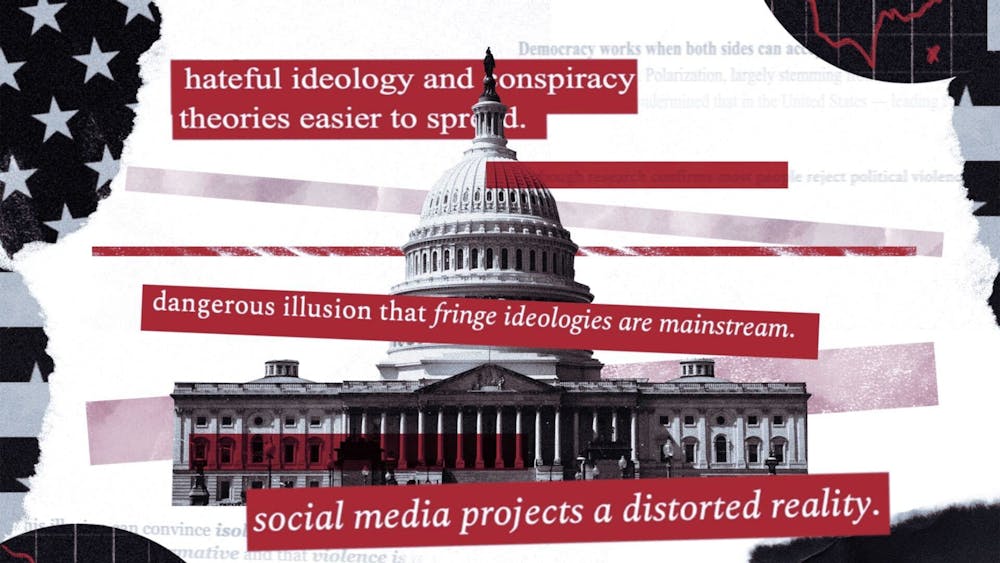
“Algorithms amplify extremist voices and turn opponents into caricatures, creating a dangerous illusion that fringe ideologies are mainstream,” Lelkes wrote in a statement to the DP. “This illusion can convince isolated individuals that their radical views are normative and that violence is a celebrated, necessary tool against a perceived enemy.”
A recent study published in the Proceedings of the National Academy of Sciences further found that much of the danger comes not from mass endorsement of violence, but from exaggerated perceptions. Partisan actors often believe that members of the opposing party are more supportive of violence than they actually are, and correcting those misperceptions can significantly reduce willingness to engage in violence.
Political Science professor Matthew Levendusky highlighted this distinction in a statement to the DP.
“The danger is not so much mass support for violence, it is radicalization of a few individuals. The onus of stopping this does not lie with ordinary Americans, nearly all of whom find violence abhorrent,” Levendusky wrote. “Instead, it lies with political elites, who fan the flames of hatred and intolerance in pursuit of their own selfish aims.”
Still, the perception of widespread approval for violence can create its own risks. Political Science professor Marc Meredith pointed to online discourse following Kirk’s death as an example.
“Anyone looking at social media in the wake of the Charlie Kirk assassination was likely to observe a small number, but also non-trivial number, of people posting justifications of political violence,” Meredith told the DP. “While only a tiny slice of Americans hold these horrific views, effectively polarized people who see these postings may attribute them to the entire group of partisan opponents.”
Political Science professor Jane Esberg connected the present moment to broader questions of democratic stability. She pointed to the assassination of Hortman and her husband in June as an example of how partisan hostility can erupt into violence.
“Democracy works when both sides can accept the rule of the other as tolerable,” Esberg said, adding that elite rhetoric and the spread of conspiracy theories online have eroded that acceptance.
Esberg’s sentiment was echoed by Political Science professor Roxanne Euben, who emphasized that “dissent and disagreement at its best has always been a feature of American politics.”
“The word politics really ought to describe the capacity to argue and disagree about how we want to live collectively together,” she said in an interview with the DP. “Once someone pulls out a gun and says, agree with me, it no longer deserves the word and the name politics. It has become something else.”
The Kirk assassination has also renewed attention on the controversial opinions and decisions Kirk made throughout his career.
Included among them is the “Professor Watchlist,” a database created by Turning Point USA — a conservative nonprofit founded by Kirk — that accuses academics of advancing “leftist propaganda.” A recent Chronicle of Higher Education investigation found that the list, championed by Kirk, “made some professors’ lives a living hell.”
The site currently names 12 Penn professors, along with two from the University of Pennsylvania Carey Law School, citing statements and research initiatives that are viewed as progressive. Critics argue that such lists fuel harassment and threats, blurring the line between ideological disagreement and personal targeting — an occurrence Penn faculty said is especially troubling amid recent political violence.
Euben alluded to the list and other actions taken by Kirk in her interview with the DP. “[Free speech] is not what Charlie Kirk stood for,” she said, criticizing those who have characterized him as a “martyr for freedom of speech.”
“He did not want freedom of speech for many, [he believed] that freedom of speech was only a freedom for some people to speak and to speak in a monologue,” Euben added.
“My worry is that this could end up leading us into a feedback cycle in which people believe that they need to respond,” Meredith added. “While I don’t think such a feedback cycle has been what has driven the uptick in political violence in recent years, I do think we are starting to edge dangerously close to it.”
Senior reporter Riana Mahtani covers national politics and can be reached at mahtani@thedp.com. At Penn, she studies political science. Follow her on X @Riana_Mahtani.


