

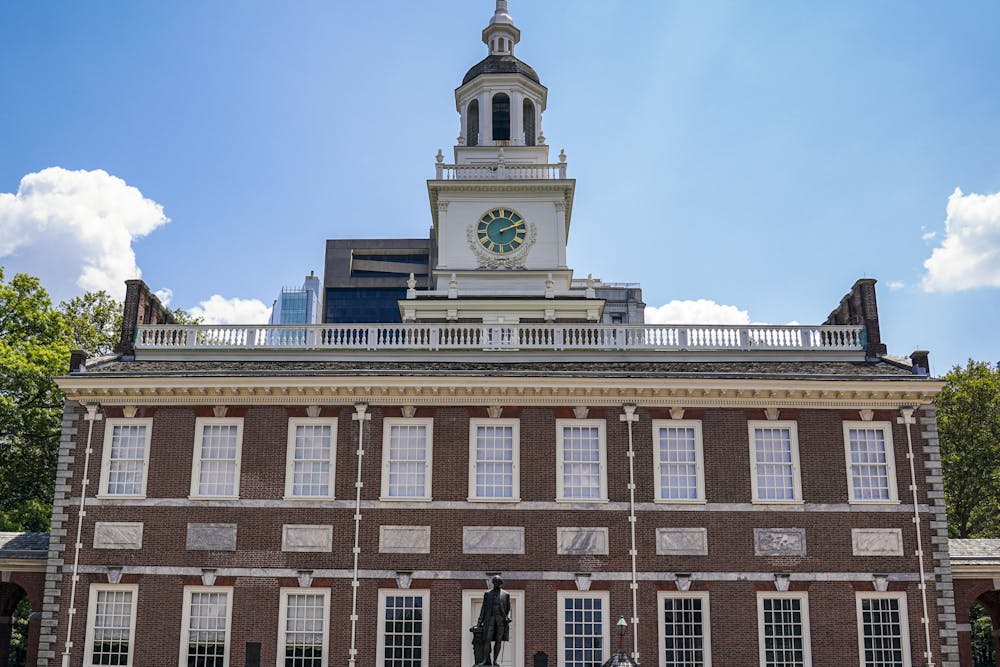
The Trump administration plans to alter exhibits that depict slavery at the President’s House Site in Independence National Historic Park.
Thirteen items at the President’s House that tell the story of the slaves George Washington kept while residing in Philadelphia came under review in July, along with other exhibits at Independence Park. The planned changes follow a March executive order signed by 1968 Wharton graduate and President Donald Trump directing the National Park Service to remove exhibits that “inappropriately disparage Americans past or living” ahead of the nation’s semiquincentennial in July 2026.
The President’s House opened in 2010 after archeological work uncovered the remains of the slaves’ quarters in the house Washington lived in during his presidency. Today, the exhibit displays the remains of the slaves’ quarters and houses a series of signs that tell the story of the nine slaves Washington kept while living in the house.
1991 School of Arts and Sciences Ph.D. graduate Sharon Holt, who helped facilitate the creation of the President’s House Site, told The Daily Pennsylvanian that diminishing the story of slavery in the monument creates a “false narrative” and prevents Americans from being correctly informed about slavery.
“If the monument doesn’t acknowledge slavery, you just open the door to massively defrauding the citizenry, and you have a self-governing society that doesn’t know what it is, doesn’t know its history,” she said.
An influx of tourists are expected to visit the park next summer, when the nation will celebrate the 250th anniversary of the signing of the Declaration of Independence. Trump’s executive order directed Secretary of the Interior Doug Burgum to ensure “all public monuments” within the Department of the Interior’s jurisdiction “focus on the greatness of the achievements and progress of the American people.” The order singled out the advancement of “corrosive ideology” in Independence Park and ordered the park’s infrastructure to be improved ahead of July 4, 2026.
A request for comment has been left with the Interior Department.
“I’m proud of our country, particularly the noble ideals upon which it was founded. We have to be honest about our history, both the positive and the negative,” United States Rep. Brendan Boyle (D-Pa.), whose district contains Independence Park, wrote in a statement to the DP.
RELATED:
AI platforms display considerable variance in judging hate speech, Annenberg School study finds
“Millions visit Independence National Historical Park each year to learn the full story of our nation’s founding. Rather than censoring our history, the administration should be giving Independence National Historical Park the resources it needs, especially during our upcoming 250th anniversary," Boyle continued.
Graduate School of Education professor Jonathan Zimmerman, who specializes in the history of education, called the removal of the exhibits without explanation “cowardly.”
“If the Trump administration thinks its display down in Independence Park is somehow skewed or biased or incomplete, well then it should say how. But you know what? It’s too cowardly to do that. The courageous thing would be to explain which parts of it they thought were somehow biased or misleading,” he said.
He added, “They don’t believe that Americans can understand or accept or discuss difficult parts of the past. If you believe in America, you would believe in our ability to do that, and they don’t.”
History professor Kathleen Brown, who is the lead historian of the Penn & Slavery Project, similarly recognized the exhibit’s role in facilitating “our nation’s honest reckoning with its past.”
“Any nation has points in its history that are not easy to reconcile with a fairy-tale story of that nation’s greatness,” she said. “Every nation that has a mature view of itself has to reckon with hard histories.”
Pennsylvania Gov. Josh Shapiro also criticized the move in a social media post on Wednesday. “There is an organized effort by the federal government to erase our shared history and whitewash our museums and monuments,” the post read.
He added, “But they don’t have the power to dictate our values in Pennsylvania.”
Several groups have protested the possible removal of the exhibits since they came under review in July.
A rally took place outside the President’s House on Aug. 2, where protesters called for the site to remain unchanged. Advocates for the exhibit’s preservation sent a letter to the National Park Service on Sept. 11, aiming to prevent the exhibit from being edited.
“This story’s not going away, and the people who care about it aren’t going away, so whatever [the administration] does today, tomorrow, or the next year, we’ll be back,” Holt said. “If we have to fight it again, we’ll fight it again, because it’s too important not to.”
RELATED:
AI platforms display considerable variance in judging hate speech, Annenberg School study finds
Senior reporter Alex Dash covers administration and can be reached at dash@thedp.com. At Penn, he studies history and political science. Follow him on X @AlexBDash.


