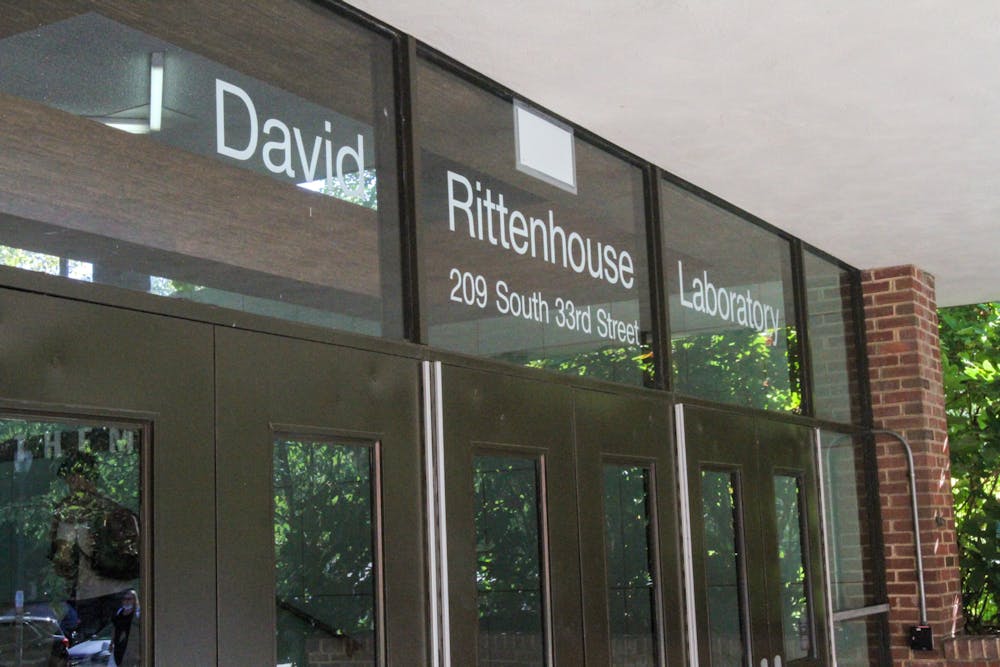
My first week at Penn in August of last year was marked most notably not by new social opportunities or campus events, but by exams in which I tried to show that, yes, I do know what atomic orbitals are and how to take the partial derivative of a function.
Coming in, I thought my four chemistry classes, two physics classes, two biology classes, and six math classes across four years of high school had prepared me to make waves at Penn and immediately jump into the more advanced classes of my chemical engineering degree.
Penn does a decent job of providing students opportunities to get credit for math, chemistry, language, and biology through placement exams during New Student Orientation. In addition, a score of five on various Advanced Placement exams can get you credit or waivers for related courses, although the calculus credit has been removed for the 2025-26 school year and onwards.
With that knowledge, I worked through a painful number of placement exams during my very first weekend at Penn, running between lecture halls for testing and the Palestra for NSO programming. By the end of it, I had taken tests for six subjects over the span of three days, a rate not even comparable to finals or AP exam seasons. I even managed to miss the mandatory Consent Circles my peers were in because of a scheduling fiasco.
At the University of North Carolina at Chapel Hill, my state school and an incredible university in its own right, I was aware that I could start with over half a dozen credits because of my high school coursework. As I talk to other students here at Penn, I find that many could have also had an easier time getting credit for their workload at their local institutions thanks to more benevolent credit policies.
There are a number of reasons Penn might appear strict about placement credits, and no, it’s not just to make our lives more difficult. For one, every student’s dual enrollment experiences from across the country might vary significantly in breadth of topics discussed, depth of lessons, and how grades are handed out. While Penn’s departments offer to review transcripts to award credit, the policies still heavily lean towards having students retake foundational courses — even if their transcript shows they’ve taken AP, International Baccalaureate, or a local university equivalent course.
Part of it could be intended to promote exploration of foundational courses at Penn before diving into more specialized courses, as students often end up changing their majors. I also think it has to do with Penn’s status in the Ivy League, where it is seen as important that students take Penn’s courses to bring us to the highest level of proficiency that only a school such as this could offer. Yet, for those still stubborn and daring enough to jump ahead, Penn concedes and gives us exams.
The results of my placement tests took what felt like forever to come out. I had less than two weeks to drop or add classes based on the timing, and finally, I got one result from a professor:
“Dear Student, I’m sorry to inform you that you did not receive a passing score on the Fall 2024 Chem 1012 Equivalency Exam.
Please note, you are not eligible to take the Chem 1012 equivalency exam again at any time in the future.”
Similar emails would follow for my other tests. I was crushed.
Honestly, I did not take my first major failure at Penn very well. I had the opportunity to prove what I’d learned in my high school courses, but instead I was already struggling with what was supposed to be high school content. Was I not a good student after all?
A year has passed now, and despite it all, I do believe Penn does a fair job with credit transfer opportunities through a combination of AP and IB recognition and testing programs. Although more transparency on exams could always help stressed first years, Penn does its job of choosing students who are best equipped to skip ahead. The vast majority of us do end up retaking several courses from our high school years, whether it’s ECON 0100 or BIOL 1101, but that’s part of the deal when you choose to earn a Penn degree. It comes down to the school’s goals for exploration, mastery, and building a cohesive underclassman experience instead of simply course-maxing.
I don’t want to discourage you from taking advanced credit exams if the opportunity arises, because who knows? You might be better equipped to pass than I was because of your curricular or extracurricular experiences. But I want to remind you not to place your worth on these tests nor let suboptimal results define your next four years. If you, like me, chose Penn, then you probably did it not for the enticing credit transfer opportunities, but for something else. Lean into whatever that is.
NAMRATA PRADEEP is a College and Engineering sophomore from Raleigh, N.C. Her email address is namratap@seas.upenn.edu.