

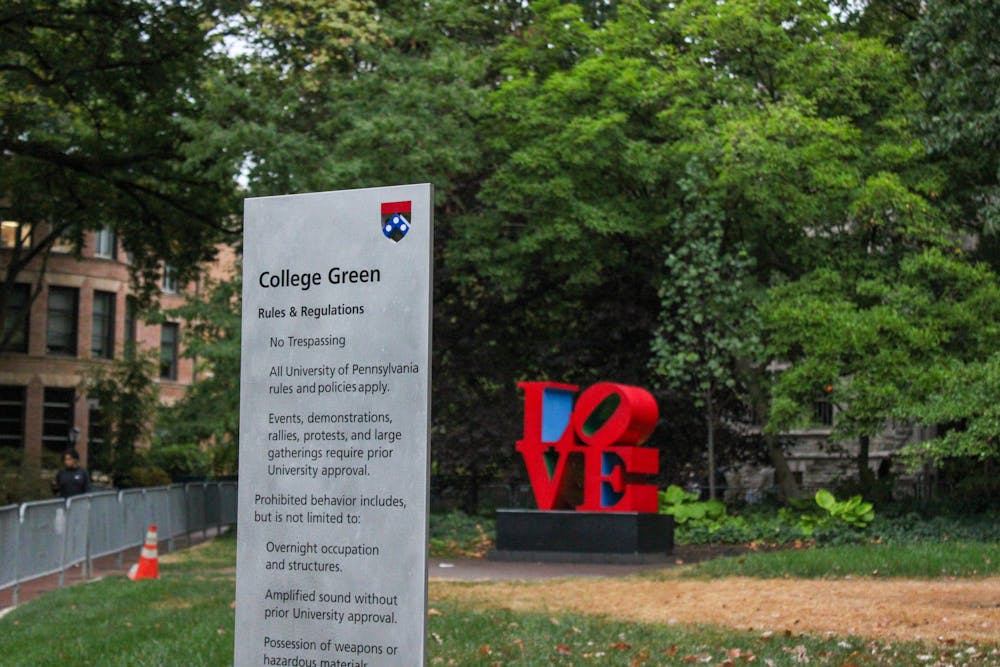
Penn ranked among the worst universities in the nation for free speech, according to a new report on college campuses released by the Foundation for Individual Rights and Expression.
FIRE’s 2026 College Free Speech Rankings gave Penn an overall score of 51.5 out of 100, earning it an F grade and placing it at No. 231 out of 257 schools in free speech. Penn’s score went up 6.5 points and 17 places from last year’s ranking.
University scores are determined by assessing “student surveys, campus policies, and recent speech-related controversies,” according to the report. Any institution scoring below 60 points receives an F mark — Penn was one of 167 schools to receive an F — producing an average score across all institutional assessments of a failing 58.63.
In last year’s FIRE report, Penn ranked fourth from the bottom, while in 2022 and 2023, Penn was ranked second to last — followed only by Harvard University.
A University spokesperson declined to comment.
FIRE’s Chief Research Advisor Sean Stevens explained in an interview with The Daily Pennsylvanian that the rankings are meant to “provide students, parents, alumni, [and] the media a pulse of what’s going on in terms of the climate for students’ abilities to express themselves in the classroom and on campus in general.”
Stevens explained that certain colleges and universities can be lightning rods for speech controversies.
“What happens a lot of times at schools like Penn is, because of their prestige, there’s more opportunity for controversy to occur,” Stevens said. He added that “high-profile” schools “tend to get more attention” from potential free-speech controversies, such as outspoken professors or guest speakers.
Penn projected to hit record lobbying spending amid Trump-era funding threats, DP analysis finds
Wharton fraternity reinstated after suspension for hanging posters alleged to mock Oct. 7 hostages
Stevens pointed out that prominent institutions like Penn are more likely to attract controversial guest speakers “because the speaker is probably not turning down an invitation to go to one of these schools.” However, he noted that they also have “much more opportunity to do well and model the right behavior for other colleges and universities.”
“What comes up a lot of the time with the Ivies is that most of them have a lot of controversies — and they have more than a lot of schools — but they often don’t really handle them very well,” he continued.
A survey of 341 Penn students was used as data to determine the rankings. Concerns included self-censorship and hesitation to express disagreement with professors or in class discussions, while students also indicated support for restricting speakers with certain views from appearing on campus.
Penn’s score was brought down by four “speech controversies” — though none were from 2025.
FIRE cited Penn’s deregistration of pro-Palestinian group Penn Students Against the Occupation of Palestine as a “Students Under Fire” incident. The organization mentioned three other “deplatformings,” including the 2024 cancellation of the West Craft Festival following Penn’s demand for an exclusion of “politically sensitive” artwork and Penn’s refusal in November 2023 to allow progressive Jewish group Penn Chavurah to screen the documentary “Israelism.”
“[Deplatforming events] matter because they send a signal to other people on campus of what is and is not acceptable discourse and acceptable behavior,” Stevens said.
According to history of education professor and free speech expert Jonathan Zimmerman, the rankings show how political disagreements have affected free speech on campus.
“As the new FIRE report shows, right-wing students are as eager as their left-leaning peers to censor allegedly ‘problematic’ speech,” Zimmerman told The Washington Times. “And students across the political spectrum are biting their tongues, lest they incur the wrath of their opponents.”
Zimmerman explained how the results display a shift in attitudes among conservatives regarding freedom of speech at universities in a statement to the DP.
“For years, conservatives have been indicting higher education for suppressing their views. But in the age of [Donald] Trump, turnabout has become fair play,” Zimmerman wrote. “Our entire educational model is based on the free exchange of ideas. If we are censoring others — or ourselves — we won’t learn. Period.”
Penn projected to hit record lobbying spending amid Trump-era funding threats, DP analysis finds
Wharton fraternity reinstated after suspension for hanging posters alleged to mock Oct. 7 hostages
Jack Guerin leads data reporting and can be reached at guerin@thedp.com. At Penn, he studies philosophy, politics, and economics. Follow him on X @JackGuerin_.


