There is a place on campus with only one door and no windows. The grease of last week's pizza hovers in the air. The other scents are a heady mix of cardboard, newsprint, and ink. This is the Pink Palace, the lair of our college newspaper, The Daily Pennsylvanian.
This space became my home away from home, replete with a worn red couch, sterile fluorescent lights, and cups of Charged Lemonade. Much more important than the creature comforts, however, were the people. We challenged, supported, debated, and uplifted one another. The room became a veritable mosh pit of ideas and viewpoints whenever we were together.
This was the room where I found my voice by conceiving articles that pushed our school dialogue forward. This was the room where, as an editor, I discovered a passion for giving others a platform, shepherding but not altering their voices. This was the room where I learned to plan and organize as if it were an Olympic sport.
This was the room where I accepted small defeats with grace — commas might turn into apostrophes, a participle or two might dangle. This was the room where I celebrated the knowledge that, after hitting export to publish an article, the content that we publish will engage but may also disrupt. This was the room where I succeeded and failed in equal measure every day and yet was never judged for it.
At a university so dominated by pre-professional ambition, the DP offered something else: a place where the work mattered for its own sake. I joined as a first year with no real intention of going into journalism. It genuinely just felt like a natural extension of my high school newspaper experience.
What I didn't expect was to pour hours of my soul every day for three full years into something with no direct career benefit. While peers calculated the ROI of every extracurricular, I found myself staying up late to perfect stories that would be forgotten by morning.
As the DP's assignments editor, I welcomed nervous first years into our windowless sanctuary, recognizing my former self in their anxious glances at our newspaper-lined walls. But I knew what they didn’t. They were about to find a community that valued curiosity over credentials and passion over perfection. The pre-professional sheen that coats so much of Penn life dissolved within the Pink Palace. All that remained was the work, the people, and the almost stubborn belief that what we were doing mattered.
In the most Penn way possible — and I have to be cynical about this — my “non-pre-professional” experience ironically gave me better interview material than peers with meticulously crafted resumes. I walked away with messy narratives about chasing truth, resolving conflicts, making decisions under pressure, and building something that genuinely mattered.
I ended my time at the DP in a whirlwind, leaving just days after former Penn President Liz Magill resigned. I hastily handed off assignments, rushed through goodbye coffee chats, and was beyond eager for the adventure of studying abroad during my junior spring. In my eagerness to move forward, I didn’t realize what I was leaving behind.
It wasn’t until I landed in Barcelona that the sense of absence hit me. I missed the 7 p.m. newsletter rankings, the passionate Slack debates over headline wording, and the chaotic energy of fighting over Hummus Grill on production nights. I never felt as close to Penn as I did during those days. After leaving the DP and returning to Penn without it, I spent senior year wondering how you recreate a place you once belonged to.
If I could do anything differently in my Penn journey, I would have sought out more spaces like the DP earlier, communities that are untouched by the shadow of professional calculation. Maybe I would have joined the Social Planning and Events Committee or gone deeper into the South Asian Society.
But ultimately, I did what I could with the time I had, and the DP still finds its way into the fabric of my life at Penn in unexpected ways. I just wrote a TV pilot inspired by life at the DP for my screenwriting class. It’s a tragic, chaotic, and loving look at college students pretending to be The New York Times reporters. Writing it was a form of therapy.
To the 137, 138, 139, 140, and 141: you have made me a better person. If I could tell my first-year self about the amazing, brilliant, dedicated people who would become my closest confidants and lifelong friends, she wouldn’t believe me.
As I prepare to leave Penn, I realize that the Pink Palace’s greatest gift was teaching me that in a world obsessed with professional trajectories, there is profound value in spaces that exist for their own sake, where the work matters simply because it matters, and not because of where it might lead.
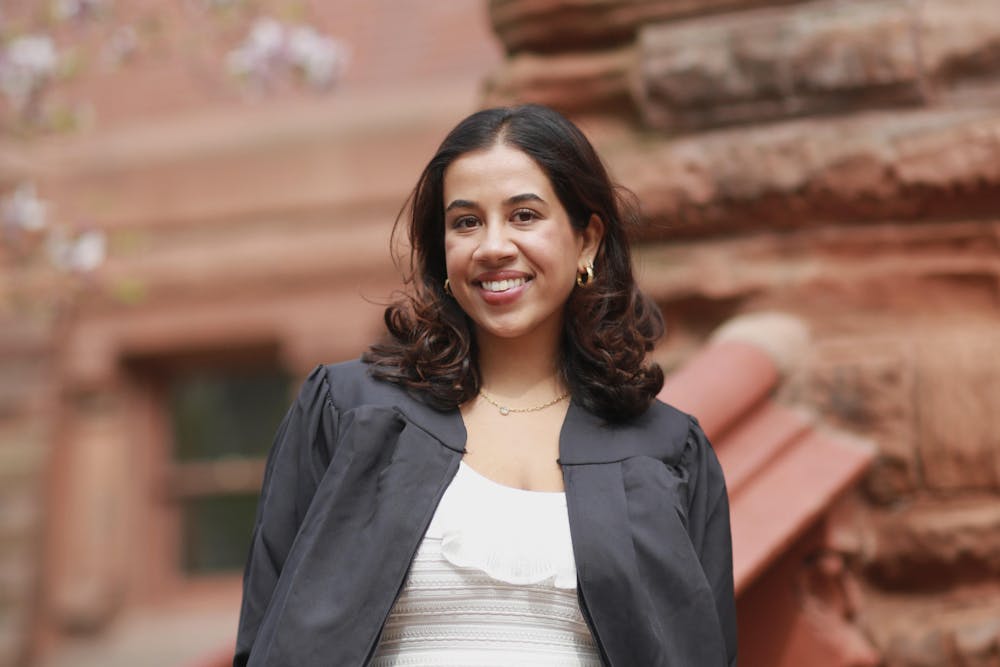
SAYA DESAI is a College senior studying political science, consumer psychology, and Hispanic studies from Pasadena, Calif. She served as DP Assignments Editor on the 139 board of The Daily Pennsylvanian. Her email is sayades@sas.upenn.edu.