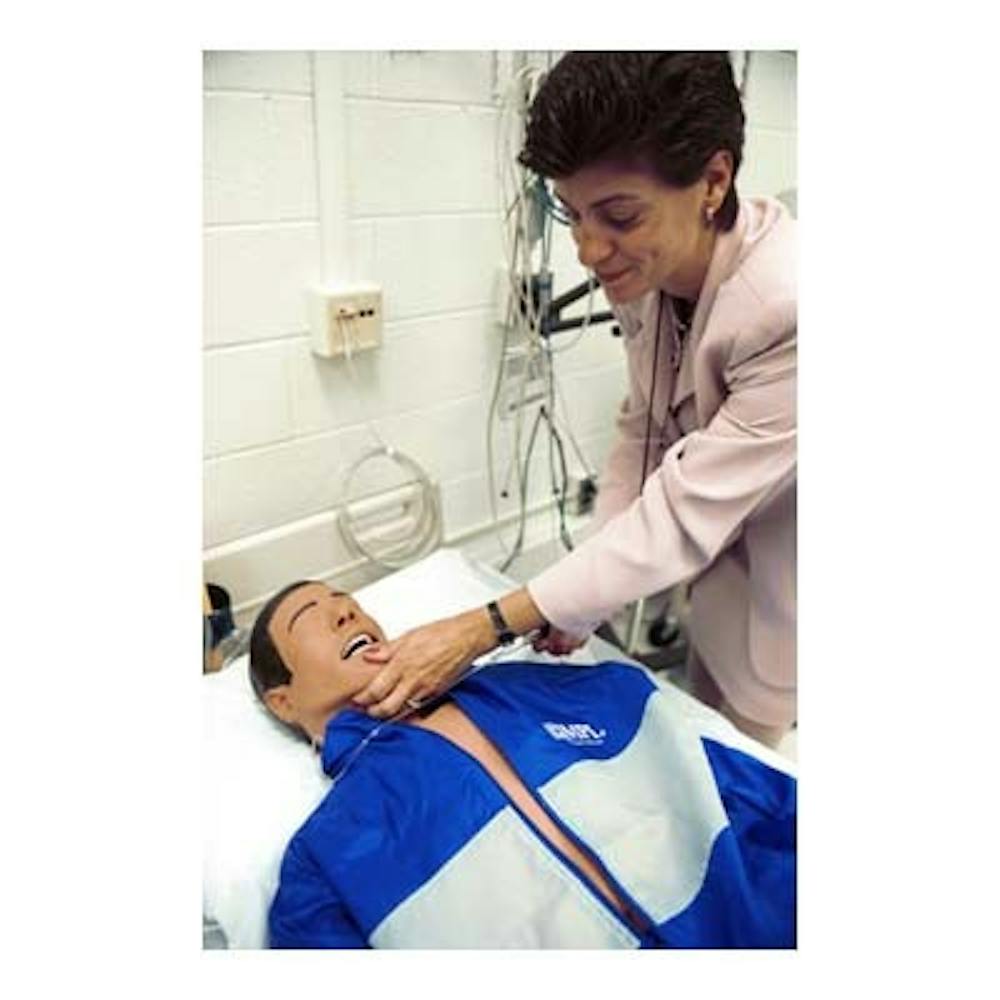
It is not very often that technology helps improve interpersonal contact. But renovations in the School of Nursing will help future nurses work better with their patients. A patient simulation center is now located in the the Mathias J. Brunner Instructional Technology Center, which was constructed over the summer on the first floor of the Nursing Education Building. Here, Nursing students can practice their skills on high-tech mannequins. "Students are now able to mimic reality much better," said Jackie Roberts, the project manager. "It helps decrease the anxiety level of students in the clinical setting by allowing the opportunity for them to practice over and over." With models able to simulate all patients, from neonatal infants to the elderly, these fake patients can mimic heart, breath, bowel and vocal sounds, along with pulses. The simulators can also be used to simulate different sorts of conditions and maladies. The Brunner Center is meant to serve as a bridge between classroom and hospital. "Prior to the lab, we relied heavily on the clinical setting to teach students about patient interaction," said Angela Iorianni-Cimbak, nurse manager of the Nursing Health Care Laboratory. The center is named after Mathias Brunner, an engineer whose widow made a contribution to the Nursing School. Lillian Brunner, an internationally acclaimed nurse, donated money to foster a collaboration between engineering and nursing. The new high-tech center cost $750,000 to build and renovate, which was made possible entirely by the donation. "I believe that the lab we have now is the most sophisticated of any in the Delaware Valley," Interim Nursing Dean Neville Strumpf said. The center includes high-end sophisticated technology to improve patient care through practice, simulation and evaluation. Other new equipment, some purchased and some donated by companies, includes cardiac monitors, ventilators, virtual reality intravenous simulators and bedside computing terminals. Microscopes and the ability to do interactive case studies off the Internet will also be available. "These are very versatile machines, able to be used in all situations, from the simplest to the most advanced," Roberts said. The new lab will be used by Nursing students from the sophomore level to the nurse practitioner level. All clinical Nursing courses with learning lab pieces will use the facility. Penn is the first nursing school in the country to have these advanced simulators integrated into the student curriculum. The center was designed by architect John Aikman, and construction occurred over the summer.
Human touch goes hi-tech for Nursing students