

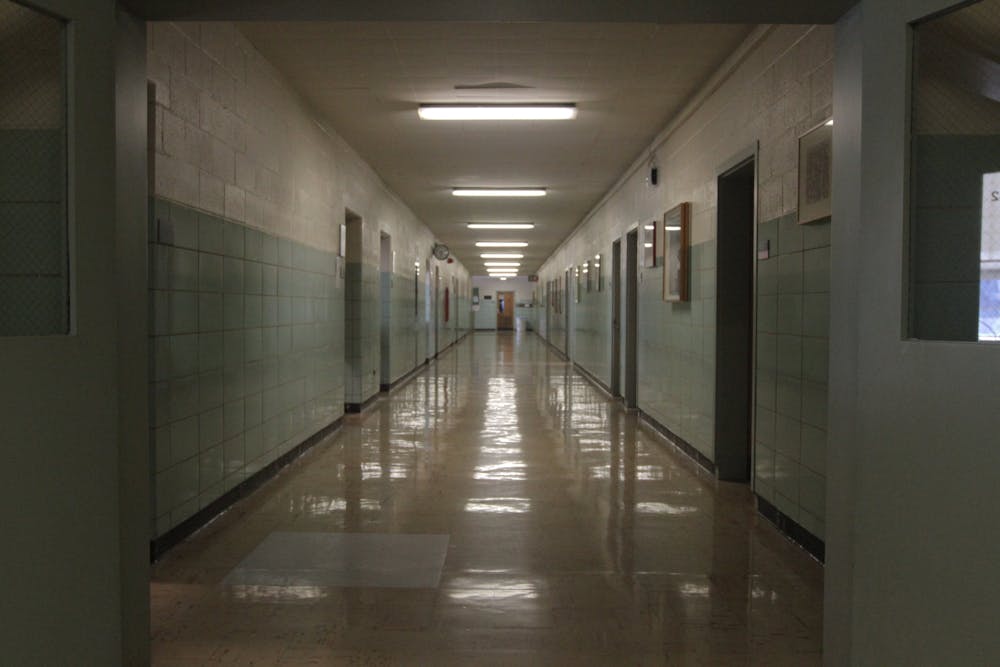
As Penn moves forward with plans to partially demolish David Rittenhouse Laboratory, the faculty members who will be impacted by the renovation have voiced mixed reactions to the project.
The University plans to tear down much of the six-story building and erect a new Physical Sciences Building in its place. The $520 million renovation is scheduled to begin in 2028 and be completed by 2031.
School of Arts and Sciences Dean Mark Trodden wrote in a statement that the planned Physical Sciences Complex will feature “state-of-the-art research, teaching, and collaborative spaces” open to students and faculty and that there is “tremendous excitement” about the project’s future.
Trodden clarified that the University is working to accommodate individual needs “to the greatest extent possible” ahead of a March 2028 move-out date.
“We recognize that a project of this scale inevitably creates disruption, and we understand how difficult it is for our students, postdocs, and faculty when their important work is affected—even in service of a project as important as this,” he wrote. “That’s why we have been working closely with departments and individual faculty to understand their needs and identify ways to minimize the impact on their work.”
Natural sciences professor Randall Kamien expressed concerns about the impact of construction on research.
According to him, moving “sensitive, large, and expensive” equipment twice in four years will cost students and postdoctoral affiliates “valuable time.”
“As far as we know, there will be no resources from the school to support the salaries of the research groups during the downtime,” Kamien wrote. “Even if the University compensates for graduate students doing the move and setting up labs twice, THEY will experience a delay in their research.”
“Given the current funding situation in the US, this could not come at a worse time,” he continued. “Seems like a good way to decimate research.”
Presidential Professor of Mathematics Daniel Krashen similarly expressed doubt about the project’s execution.
“In the short term we have received almost no information about where we will be housed,” he wrote. “In the long term, there is concern about office space, blackboards, and suitable places for meeting with students and research colleagues.”
“I know many of my colleagues in the mathematics department feel the same way,” he added.
Krashen said that the renovation might jeopardize the spaces that mathematics professors, students, and researchers use. He explained that groups typically use blackboards and bookshelves during discussions and expressed worry that adequate spaces would no longer be available during and after the renovation.
“Over time, this could negatively affect research and the intellectual community within the department,” he wrote.
Math professor Robin Pemantle described the planning as a “long and complicated process.”
“It’s apparent that some aspects are going as well as can be expected, while others are alarming, for example we’ve never heard a convincing plan to solve the classroom space issues (university-wide) during the construction,” he wrote. “I’m not saying such a plan doesn’t exist, but I haven’t heard it.”
A SAS spokesperson clarified that planning is underway for temporary workspaces for the impacted departments.
“Because of the large number of classrooms, offices, and experimental labs located in DRL, there is no single temporary space that can house all of its programs and activities,” the spokesperson wrote. “Planning for swing space is still in progress.”
Other faculty expressed optimism about the project’s planning and future.
“Overall, of course, it is in the human nature to be worried about anything new, and I do not look forward to the disruption during the building of new space,” Physics professor Eleni Katifori wrote in a statement. “However, I believe that modernizing DRL will be a good investment and also help with recruitment.”
Robert Ghrist — who serves as the School of Engineering associate dean for undergraduate education — was certain that the renovation would benefit future students.
“It’s the duty of every generation to plant trees whose shade they will not enjoy,” he wrote. “Current students may find the DRL renovation period difficult, but future students will greatly benefit.”
Staff reporter Ryan Rucker contributed reporting.
Jack Guerin leads data reporting and can be reached at guerin@thedp.com. At Penn, he studies philosophy, politics, and economics. Follow him on X @JackGuerin_.


