

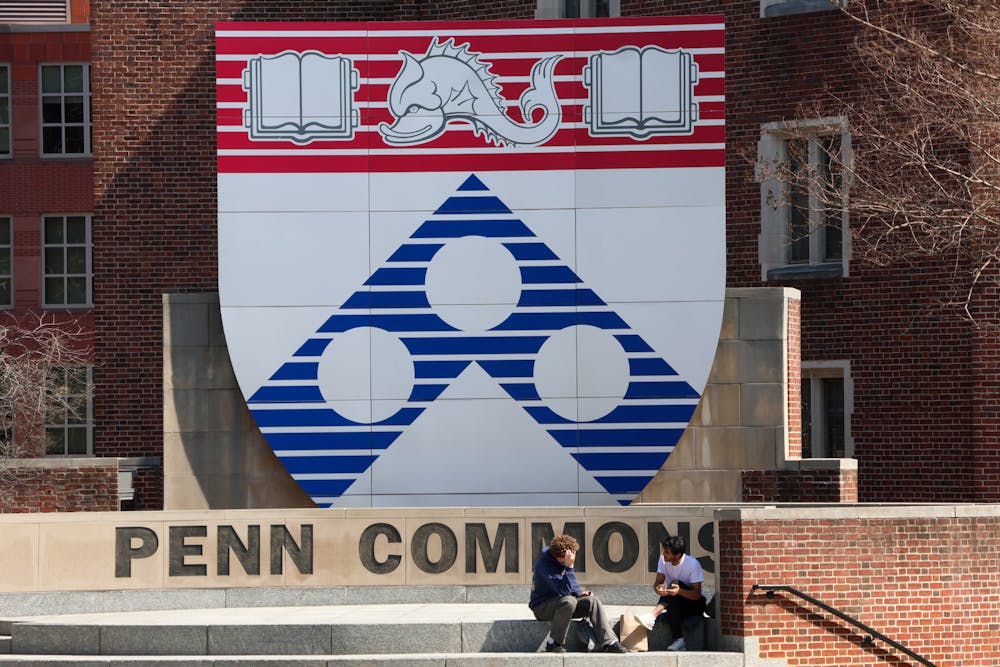
On Tuesday, Penn released its first draft of revised Guidelines on Open Expression following nearly two years of review.
Since their establishment in 1968, open expression guidelines have been a focal point of campus debate. Before switching to a temporary set of regulations in 2024 — implemented in response to a year of heightened campus activism — Penn operated under a version of the policies last updated in 1993.
Intended to “preserve” Penn’s “principles of open expression,” the draft policies could significantly shape how speech, demonstrations, and protests unfold on campus.
Here’s what you need to know.
Community feedback
According to a community-wide message from Provost John Jackson Jr. last week, Penn will continue to seek feedback on the draft over the course of this semester.
The provost’s message outlined two channels by which faculty, staff, and students are able to provide their input on the proposals.
Community members are able to submit feedback via an online form before May 18 and are invited to attend an in-person or virtual community listening session in April. Both sessions will be convened by University of Pennsylvania Carey Law School professor and former Chair of the Faculty Senate Eric Feldman.
Penn unveils draft open expression guidelines following extensive review process
Penn to release draft of open expression guidelines, seek community feedback
“Your anonymous feedback will be shared with Penn leadership working toward finalizing the proposed revisions to the Guidelines on Open Expression,” the online form reads.
According to Jackson, the drafting process has already counseled several University divisions across campus, including Penn’s Office of General Counsel, Division of Public Safety, and Division of University Life.
“President Jameson and I have been working with campus leaders on how best to plan for implementation of the recommendations, in a way that reflects our enduring commitment to open expression while also capturing institutional expectations around clarity and campus safety,” Jackson’s March 25 message read.
Regulating speech
The draft guidelines outline several forms of speech, conduct, and behavior that would be considered violations of the University’s new open expression policies.
Violations named in both the current and proposed guidelines include conduct that interferes “unreasonably” with the regular activities of others, endangers the health or physical safety of others, or demonstrations that are held in private locations.
A new provision in the drafted guidelines also lists “speech or conduct that is threatening, harassing, severe, or pervasive such that it limits or denies a Penn community member’s ability to participate in or benefit from their education or work” as a violation of the proposed open expression principles.
“Such speech or conduct will be considered more severe if it targets individuals or groups on the basis of a characteristic or class protected by the University’s Equal Opportunity Policy and Nondiscrimination Statement, or federal, state, or local law, or other related Penn policies,” the draft document reads.
No similar provision exists under previous policy. In the past, Penn’s Committee on Open Expression continuously declined to regulate the content of speech hosted at the University.
In one specific instance — amid protests in 2017 over neo-Nazi recruitment flyers posted across campus — the Committee defended the right to distribute the materials, adding that the “content of student speech or expression is not by itself a basis for disciplinary action.”
Changes to shared governance
The proposed guidelines, if approved, would mark a shift in the Committee on Open Expression’s function and purview on campus.
Under the newly proposed guidelines, the Committee on Open Expression jointly reports to both the provost and the tri-chairs of the Faculty Senate.
The committee was previously considered relatively autonomous, serving as a standing Committee of the University Council in an advisory role to the Vice Provost of University Life and members of the University community “regarding interpretations of the guidelines.”
Earlier this month, Penn’s chapter of the American Association of University Professors published a letter alleging that under the current guidelines “the Vice Provost for University Life (VPUL) holds exclusive power to interpret and enforce the Guidelines, while the Committee on Open Expression (COE) has been relegated to a purely advisory role.”
In the revised guidelines, the Committee is tasked with general oversight of matters involving open expression on campus. Its responsibilities will include reviewing Penn’s open expression policies “every 10 years, or as needed” and working to support open expression across the University’s schools and centers.
The Committee will now comprise of 13 members, rather than the 17-member body outlined under the existing policy.
Seven of the 13 members are University faculty nominated by the Faculty Senate Executive Committee.
Unlike previous iterations of the guidelines, members selected by the Senate Executive Committee are subject to “consideration by the Provost.”
Currently, Committee members are tasked with “mediating in situations that involve possible violations of the Guidelines” and able to act on behalf of the Committee to “advise the responsible administrative officials and any other person with respect to the implementation of the Guidelines.”
In the proposed policy, the Committee would no longer be responsible for addressing possible open expression policy violations. Instead, all reports of “potential violations” should be referred to the executive director of open expression — a new role established by the revised guidelines.
Executive director of open expression
The director, like the Committee, will report to the provost. According to the draft, they will also “have a dotted line report to the Faculty Senate Tri-Chairs.”
Alongside mediating potential violations, the director is tasked with leading a new Open Expression Observer Program established under the revised guidelines.
The program is intended to “ensure that speech and expression align with the University’s commitment to support the free exchange of views by enabling community members to interact freely, to share their ideas, and to listen to each other.”
It will also allow faculty, staff, and administrators to serve as “neutral parties who engage with meetings, events, or demonstrations when deemed necessary to support and maintain open expression.”
Observers are assigned to events, demonstrations, and meetings “based on the likelihood of disruption as determined by the EDOE without regard to viewpoint.”
Under the current guidelines, “observation of meetings, events or demonstrations, when deemed necessary,” is the responsibility of the Vice Provost of University Life, or a delegate with “full authority to act in the name of the Vice Provost.”
The current policy also includes a provision that allows members of the Committee “to accompany and advise” observers.
Under the drafted guidelines, members of the Committee on Open Expression “may not participate in the Open Expression Observer Program.”
Campus events policies
Both Penn’s temporary guidelines and Penn’s new draft policies give priority to University-related events when allocating campus space. The documents diverge, however, in how they handle events unrelated to official “education, research, and patient care.”
Penn currently requires at least two weeks’ notice for non-academic events taking place on Locust Walk and in other “VPUL spaces.” The draft guidelines cut that timeline in half, requiring most applications to be submitted “seven business days in advance.”
The draft also leaves room for exceptions, stating that select events may receive “more immediate attention” on a “case-by-case basis.” An expedited timeline is not generally granted to events requiring a security assessment from Penn’s Division of Public Safety, according to the proposed guidelines.
While the 2024 policies explicitly banned encampments on campus, the draft specifies that erecting structures — such as tents or encampments — requires “a permit or other permission from the Vice Provost for University Life or authorized University personnel.”
Section four of the draft guidelines formally outlines the University’s policy on inviting speakers to campus, an extension of procedures first introduced as part of interpretative guidelines adopted by the members of the 2014-2015 Committee on Open Expression.
“By allowing a specific speaker to speak or a group to organize and invite a speaker or hold an event, the University does not necessarily endorse that speaker’s or event organizer’s content or viewpoint,” the draft guidelines read. “Rather, it affirms the value of creating a robust marketplace of ideas and fostering reasoned debate, disagreement, and discourse.”
They also note the “denial of a timely request for venue or related services” must not “be based on the substance or nature of the views expressed.”
The new document formalizes temporary regulations on posters, signs, banners, and chalk — including a restriction on non-compliant signage. Some specificity from the temporary procedures no longer exists, namely the mandated removal of banners and signs after two weeks of being posted and the prohibition of “non-water soluble, semi-permanent, and permanent substances.”
The temporary procedures’ restrictions on amplified sound on College Green and during scheduled University events, official exams, and reading days are carried over into the new guidelines.
Penn unveils draft open expression guidelines following extensive review process
Penn to release draft of open expression guidelines, seek community feedback
Isha Chitirala is a News Editor at The Daily Pennsylvanian and can be reached at chitirala@thedp.com. At Penn, she studies economics and political science. Follow her on X @IshaChitirala.
Finn Ryan is a News Editor at The Daily Pennsylvanian and can be reached at ryan@thedp.com. At Penn, he studies political science and Russian. Follow him on X @FinnRyan_.


