

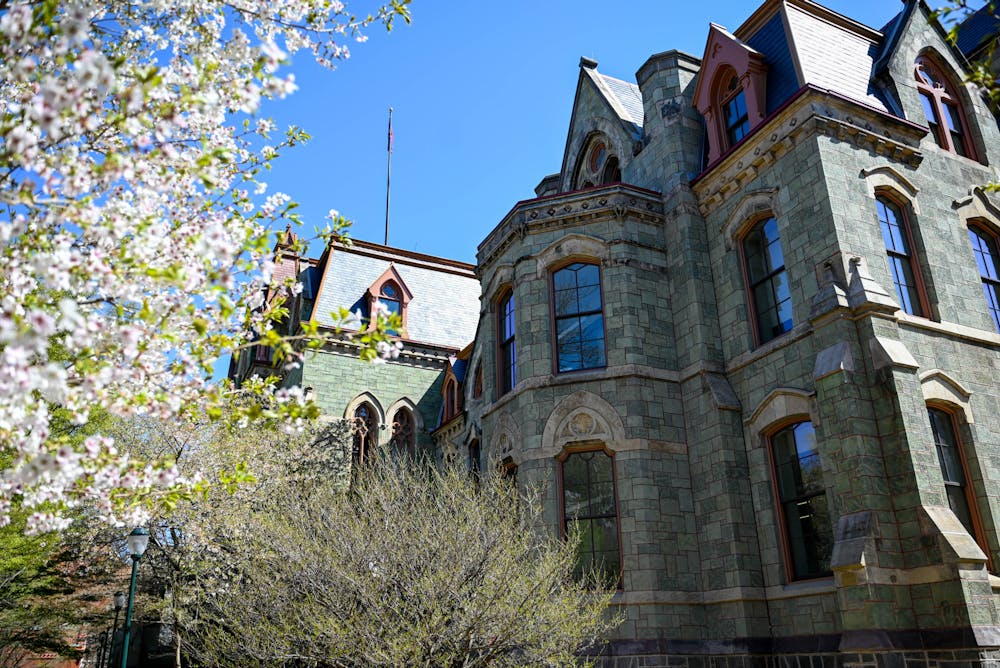
Penn’s School of Arts and Sciences welcomed seven new members to its standing faculty this academic year.
The new faculty — all either assistant or associate professors — are entering the school’s psychology, biology, mathematics, chemistry, and political science department. SAS Dean Mark Trodden shared the appointments in a message to the school's community on Thursday.
SAS standing faculty comprises members who hold the positions of professor, associate professor, and assistant professor at the school.
Two faculty — Ahmed Bou-Rabee and Sarah Brauner — are joining the Mathematics Department. Bou-Rabee’s primary focus is on probability theory — the bulk of his research surrounds homogenization, the Abelian sandpile, and Liouville quantum gravity. He obtained his Ph.D. from the University of Chicago.
Sarah Brauner, who studied mathematics at the University of Minnesota, researches algebraic combinatorics and how they intersect with representation theory and topology, geometry, and probability.
The Biology Department will welcome Mattheau Comerford, whose research surrounds plant/animal interactions, diet breadth, and spatial sorting. Yuting Zhou is set to join the Chemistry Department, and focuses on improving the precision of chemical transformations directed into macromolecules.
Tyler Bonnen will enter the Psychology Department, studying perception and memory. Bonnen — who obtained his Ph.D. in computational cognitive neuroscience from Stanford University — specifically investigates the intersections between neuroscience, psychology, and computer science.
Two members are joining the Political Science Department: Ahmed Ezzeldin Mohamed and Gareth Nellis. Mohamed specializes in comparative politics, political economy, and religion — specifically in the Middle East and the broader Muslim world.
RELATED:
New ‘horizons’ for Penn School of Arts and Sciences as dean unveils strategic plan
Penn SAS unveils academic initiative promoting democracy, liberal arts education
Nellis — who obtained his Ph.D. from Yale University — focuses on comparative politics, and is also recognized as the Madan Lal Sobti Associate Professor for the Study of Contemporary India and the director of the Center for the Advanced Study of India.
According to Trodden’s Aug. 27 message, Penn SAS welcomed 263 incoming students in the Graduate Division, 1,434 students in the College of Arts and Sciences, and 864 students completing programs such as professional master’s degrees, online bachelor’s degrees, and certificates this academic year.
This fall, Trodden announced, SAS is also launching two new programs as part of the school’s “SAS Horizons” strategic vision.
A new Community Forum series will begin on Sept. 14 with a seminar about “The War in Iran at Six Months,” which is aimed at promoting “informal discussion” on “challenging issues.” SAS Commons — a new initiative to create courses, workshops, and symposia around a central theme — will have its inaugural event on Sept. 17.
“Programs like these are a small part of the vast opportunities we have to enjoy the richness of Penn Arts & Sciences,” Trodden wrote. “I hope all of you find time to explore some of them. Welcome back—and welcome to all who join us for the first time.”
RELATED:
New ‘horizons’ for Penn School of Arts and Sciences as dean unveils strategic plan
Penn SAS unveils academic initiative promoting democracy, liberal arts education
Senior reporter Kathryn Ye covers central administration and can be reached at ye@thedp.com. At Penn, she studies biochemistry and philosophy. Follow her on X @Kathryn__Ye.


