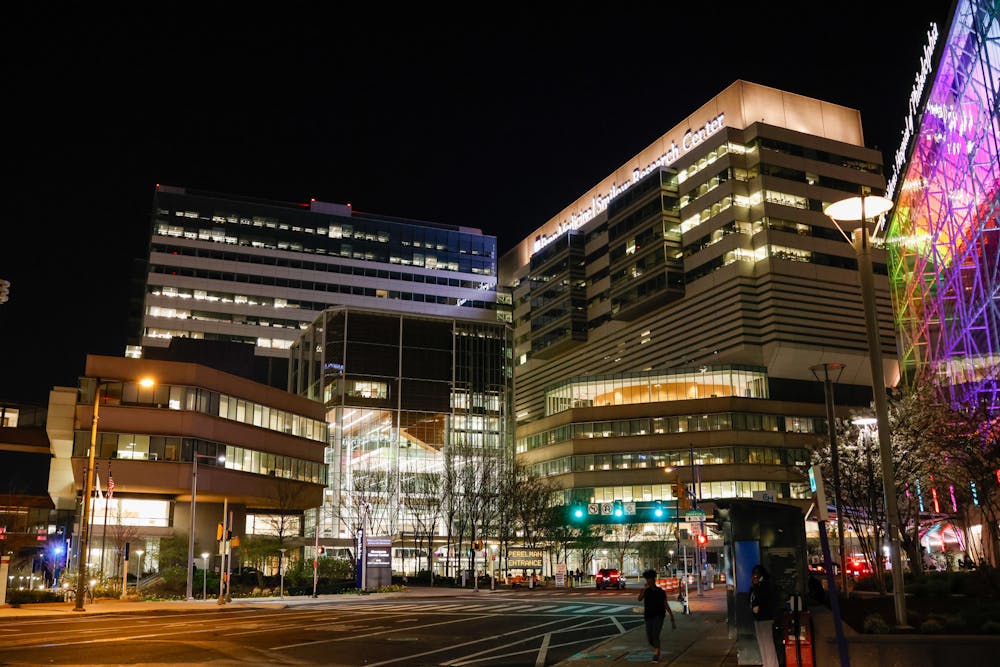
Penn Medicine’s expansion strategy is guided by a common goal — building spaces that can adapt with medical innovation and evolving patient needs.
From research laboratories and hospital wards to community-based clinics, leaders at the University of Pennsylvania Health System say facilities are designed to breed innovation and bridge the gap between scientific discovery and patient care.
The Smilow Center For Translational Research
Located at Perelman School of Medicine’s main campus, the Smilow Center houses research initiatives across a range of biomedical disciplines.
The building, which opened in 2011, has become a “physical manifestation of our integrated mission,” University of Pennsylvania Health System CEO Kevin Mahoney said in an interview.
According to Mahoney, the integration and physical proximity to Penn Med’s patient-care facilities have fostered informal exchanges between researchers and clinicians that can foster innovation. He referenced immunotherapy professor Carl June’s pioneering work with Penn Med physician David Porter on CAR T-cell therapies as a prime example of this phenomenon.
June’s wet labs and mouse hospital are both housed in The Smilow Center.
“Spontaneous conversations” that stem from “bumping into each other in the elevator” or “grabbing a cup of coffee” are what “really move ideas along,” Mahoney explained.
RELATED:
Penn Med study links SNAP accessibility to lower cardiovascular death rates
How Penn Med’s Cedar Avenue crisis center streamlines psychiatric services
In June and Porter’s case, the two met at a cafe below Smilow. They decided that as their funding for an early CAR T-cell therapy trial dwindled, they would publish what they had and see what would happen, Mahoney explained.
Their research went on to gain global attention, marking a turning point for CAR T-cell research.
In “one elevator ride” June could travel “to the outpatient clinic where Dr. Porter was doing a trial with his patients,” Mahoney said.
The Clifton Center for Medical Breakthroughs
The Clifton Center for Medical Breakthroughs, which opened in October 2021, is a more recent example of Penn Med’s approach to expansion. At Clifton, building flexibility into the center and research facilities was a deliberate choice.
“We tried to build it to be a hospital of the future,” Mahoney explained.
For instance, Mahoney said the hospital was designed so all 504 beds could eventually be used as ICU beds, even though that additional flexibility added an estimated 5% to 7% to construction costs.
“Medicine is always changing,” Mahoney added. “Otherwise, we’d be sitting there trying to guess how many ICU beds you're going to need today, 10 years from now.”
Penn tested the construction by creating a 30,000-square-foot mock-up of half a hospital floor — a project that led the University to change parts of its design. GoPro Cameras were installed throughout the mock-up to see how staff actually moved through the spaces, Mahoney explained. Observations from that program led to several construction changes, such as door placement and hallway lengths.
HUP-Cedar Avenue
After Mercy Philadelphia announced its closure, Penn Med took over operations at HUP-Cedar Avenue in West Philadelphia — where nearly a quarter of the population lived below the poverty line in 2024.
HUP-Cedar Avenue Executive Director Sindhu Srinivas said in an interview that Penn has collaborated with community groups to help identify the neighborhood’s needs. That outreach has produced an on-site food pantry, as well as partnerships addressing legal services and other health concerns.
“We’ve been trying to be very creative about what kinds of services we can help to support,” Srinivas explained. “Instead of always just waiting for that to be addressed when they’re in the hospital as that one-on-one patient, is there something we can be doing with community partners that addresses that sort of more broadly?”
Penn Med has also renovated an unused outpatient space at Cedar into a ground-floor ambulatory practice. Ambulatory care refers to medical services performed on an outpatient basis, without admission to a hospital or another facility.
“We took a space that had not been used in the five years we had been there, and that’s the space that we renovated to be our new ambulatory practice space,” Srinivas said. “It’s accessible.”
While the location does not house research facilities, the work at HUP Cedar can still inform research, Srinivas added.
“While it might not be a trial, there’s definitely other ways to demonstrate innovative ways to address needs that subsequently impact health outcomes,” she explained. “How do we continue to evaluate these approaches so that maybe they’re not just at HUP Cedar?”
Telehealth services
Penn’s expansion strategy also extends beyond physical facilities. Senior vice president and chief financial officer of the University of Pennsylvania Health System Julia Puchtler said that access to telehealth services has given patients a more cost-friendly alternative to traditional in-person care.
“Patients don’t necessarily feel like they have to come downtown for everything,” Puchtler explained in an interview. “They’re much more open to staying close to home for care.”
Penn is increasingly thinking of care as “location-flexible” — which includes hospitals, outpatient clinics, patients’ homes and virtual visits — according to Mahoney.
“Healthcare is going to be more virtual, more telemedicine, and we’re going to keep leaning in,” he said.
Finances
Balancing the Health System’s financial responsibilities with its push for innovation is also key to fostering breakthroughs, according to Puchtler.
“There’s so many good ideas that come forward and proposals, and the challenge is that you can't do all of them every year,” she said. “You have to look for those that meet the most of our mission and our financial criteria together.”
Last year, the University’s health system was responsible for over two-thirds of Penn’s total revenue.
“You can’t do only things that don’t have a return on investment,” Puchtler added. “It’s a portfolio. So you’re going to need things that do generate a return so that you can generate returns to fund the things that don’t.”
That does not mean projects that do not guarantee an immediate financial return are automatically rejected, Puchtler explained. She added that Penn often tries to structure projects in phases so that it can change course if an idea does not pan out.
“Not every great idea can materialize,” Puchtler said. “That’s how innovation works.”
RELATED:
Penn Med study links SNAP accessibility to lower cardiovascular death rates
How Penn Med’s Cedar Avenue crisis center streamlines psychiatric services
Staff reporter Saanvi Ram covers science and health and can be reached at ram@thedp.com. At Penn, she studies health and societies. Follow her on X @Saanvi_vivi.
Staff reporter Mariacristina Calcagno covers science and health and can be reached at calcagno@thedp.com. At Penn, she studies biochemistry and economics.