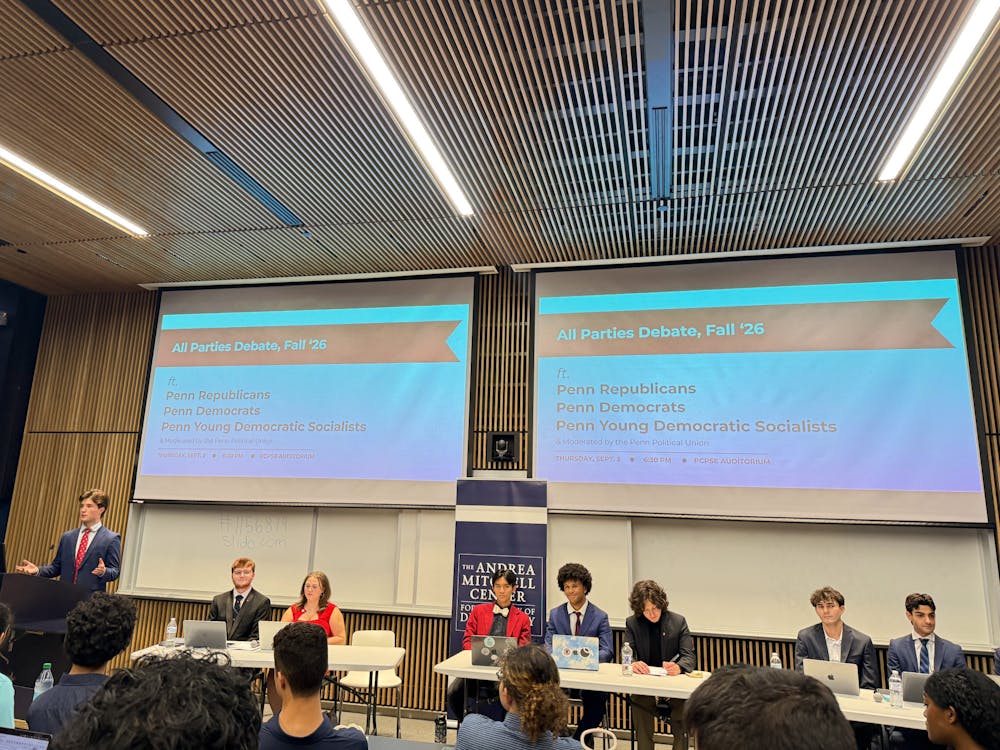
Three of Penn’s student political organizations — Penn Democrats, Penn College Republicans, and Penn's chapter of Young Democratic Socialists of America — participated in an annual all-parties debate last Thursday.
The groups discussed the cost of living, immigration, abortion, foreign policy, and governmental spending at the Sept. 3 event. The debate, moderated by the Penn Political Union, drew roughly 100 students to the Perelman Center for Political Science and Economics.
At the start of the event, College junior and PPU president Marcus Michie collected a survey. Initially, about half the room leaned toward Penn Dems, 35% backed YDSA, and 15% sided with College Republicans. By the conclusion of the debate, both YDSA and the College Republicans had increased their share of support, garnering 38% and 21%, respectively.
To kick off the debate, the three groups outlined their broad goals and key issues they hope to advance.
College Republicans called for “fiscal responsibility, practical regulatory reform, and a government that stops overreaching.” YDSA's spokesperson, however, pushed for a “fair, cleaner society” — naming healthcare for all, free education, and getting “corporate money out of politics” as central causes. Meanwhile, the Penn Dems representative focused on expanding housing, raising taxes on corporations and billionaires, and abolishing the United States Immigration and Customs Enforcement.
Last Thursday was YDSA's first debate appearance since its reinstatement as a club this academic year. The group had historically participated in all-parties debates before it temporarily disbanded during the 2025-26 academic year.
Penn for Liberty, a group that has also historically participated in the All Parties debates, was notably absent from last week's event.
Immigration enforcement
RELATED:
Philadelphia Mayor Cherelle Parker visits Penn for talk on community safety, education
Penn Political Union hosts state Sen. Nikil Saval for housing policy discussion
During the debate, the Penn Dems described the current immigration system as “broken,” citing mass deportation and overwhelming backlogs as key failures. The spokesperson argued that undocumented immigrants contribute positively to American society and characterized ICE as a “rogue agency that tears families apart and detains citizens.”
YDSA took a similar position, calling for immediate amnesty and pointing out that undocumented immigrants have lower per capita conviction rates compared to those born in the United States.
College Republicans — who emphasized that they are “not the Donald Trump party” — said that there must be a balance between secure borders and access to legal immigration pathways.
“We need to fix ICE,” the College Republicans spokesperson said. “We cannot have ICE — who's supposed to be protecting our people from dangerous immigrants — hurting our citizens. We believe that most migrants that want to come here want to do great things for this country.”
The spokesperson added, however, that the group did not want “billions and billions of funding keeping migrants in mandatory idleness.”
”They can do what they're supposed to do and do what the rest of us are doing: working and getting a solid career for themselves, which they're more than capable of doing,” they continued.
Abortion access
College Republicans voiced support for a national abortion ban from conception — a policy that both YDSA and Penn Dems strongly opposed.
“These policies are not meant to protect life,” the YDSA spokesperson said. “If they were, the same people calling for bans and restrictions would be fighting to build the best healthcare system in the world — but they aren't, because this isn't about life. Until then, the position has to unequivocally be: get the government out of our bedrooms, bathrooms, and in this case, bodies.”
U.S. foreign policy
At the debate, Penn Dems said that the primary goal of U.S. foreign policy should be to make Americans “safer and more prosperous,” but argued that the country's current involvement in overseas conflicts prevents it from achieving that goal.
The group rejected “wars of choice” insisting that military force should be reserved for situations where American security is directly under threat.
YDSA supported a similar “people first” policy, calling for the end of unconditional foreign military aid, including stopping U.S. funding of “Israel's genocide.”
In the last few years, numerous human rights organizations and experts — including Amnesty International, Human Rights Watch, and the United Nations — have labeled the Israel-Hamas conflict as a “genocide” by Israel of the Palestinian people.
The YDSA representative added that unlike the Democratic Socialists of America, the Democratic Party has “stood very much by Israel.”
College Republicans advocated for a more restrained, isolationist position — calling back to the country's first president, George Washington.
“That's why I want to keep saying, especially for the Penn College Republicans, we are not the Donald Trump party,” the spokesperson said. “We do not want to be the Donald Trump party.”
Government spending
On the debate's final issue, College Republicans emphasized fiscal restraint and the need to be frugal with federal spending. They raised alarms over the projected depletion of the Medicare trust fund and opposed large tax increases imposed on corporations.
YDSA said that the group supports large-scale spending on Medicare for All, accessible higher education, solving climate change, and universal basic income.
Penn Dems, on the other hand, argued the U.S. must focus on domestic needs and advocated for expanding social programs, raising taxes on large corporations, and rebuilding Internal Revenue Service enforcement to go after tax evasion.
Anjali Ghanta, a member of PPU's external committee, thought that the debate was generally productive.
“Last year, this debate was a lot more extreme,” she said. “Today was a very good example of how much things have changed on this common ground that we found.”
RELATED:
Philadelphia Mayor Cherelle Parker visits Penn for talk on community safety, education
Penn Political Union hosts state Sen. Nikil Saval for housing policy discussion
Staff reporter Cathy Sui covers politics and can be reached at sui@thedp.com. At Penn, she studies finance and statistics.