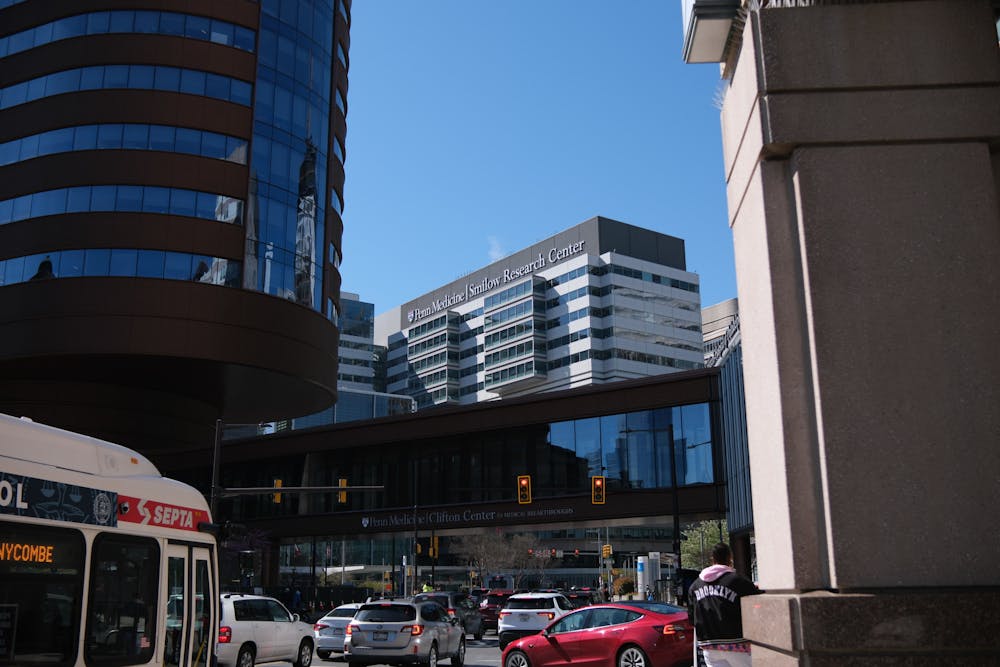
For five hours, I sat in the waiting area of a Penn Medicine emergency room, watching two versions of America collide. There I was with a friend who had injured her arm, which we suspected was a broken elbow. And around us were patients who hadn’t come for emergencies at all, but because the ER was the only place they could reliably see a doctor. Surrounded by one of the most elite medical systems in the country, people seeking basic care had nowhere else to go.
Most Penn buildings are gated or require a PennCard, designed to keep the “real world” of West Philadelphia at a distance. The ER is the only place on campus where the “Penn Bubble” is physically impossible to maintain. It is a porous border — you can’t “prestige” your way out of a triage line. In the waiting room of the ER, I got a reality check about the privileges we receive at Penn every day. The emergency room should not be functioning as a primary care clinic for people without money for health care. At that point, the entire health care system is at fault.
The Penn Med system is not unique in failing to provide people of lower economic means with quality service; many institutions fail to do so. But the ER is one of the few places where the West Philadelphia community and the Penn community are forced into the same struggle. I was there due to an accident, while the people next to me were there because of manageable conditions, but lacked access to a primary care physician. My bad night was their only option. I have the privilege of being frustrated by this experience, while they live knowing this is their only way to be seen by a medical professional.
Penn Med is one of the best medical systems in the country, and Penn makes it known. It’s a leader in innovation, research, and patient care — outstanding nationally for cutting-edge treatment. Yet there is a shocking irony in the data: While Penn ranks at the top for specialized care, its emergency rooms report some of the longest wait times in the state, frequently doubling the national average. It’s a paradox of prestige: Penn actually attributes two-thirds of its $17.3 billion in total revenue to Penn Med, most of that fraction coming from patient revenue, yet it still fails to provide a dignified entry point for its most vulnerable patients. If an institution with billions of dollars and a top-20 ranking still results in this poor of an experience for the marginalized, it proves that the system is fundamentally flawed.
Citizens of Philadelphia already struggle to access health care daily. In 2018, nearly one in five adults in Philadelphia didn’t have a health care provider, even before the pandemic exacerbated the crisis. Despite having one of the highest per capita rates of health care workers in the country, Philadelphia County has significantly higher rates of ER usage than nearby counties, with many adults relying on the ER as their primary care. In a city that trains one of every six doctors in America, it shouldn’t be this hard to find a primary care appointment.
We prioritize the exotic over the essential — specialized surgery over basic primary care access. While specialized care and research are indispensable, a system that doesn’t put enough emphasis on basic care is a system that fails the multitude of America: those who cannot afford basic health care. The excellence that exists is locked behind closed doors, only accessible to a select few.
Penn prides itself on being in and of Philadelphia, “grounded in and whose greatness depends on and rises hand in hand with its diversity and inclusivity.” But if the health care experience for the average resident is this difficult, the University is failing its neighbors. We spend four years learning how to lead the world from inside limestone buildings and gated quads, but I found myself learning more about the state of the country while sitting on a hard plastic chair in the frigid emergency room. The Penn Bubble isn’t just a social phenomenon, but a barrier that prevents us from seeing that for many, “world class” is merely an empty slogan.
SIENNA BEVAN is a College first year from Santa Monica, Calif. Her email is smbevan@sas.upenn.edu.